
Many candidates struggle to understand which English test fits Canada immigration requirements and what scores they actually need. The CELPIP test addresses this by providing a computer-based exam that evaluates listening, reading, writing, and speaking skills in Canadian contexts and maps results to CLB levels used by IRCC.
The CELPIP exam includes two types: CELPIP General for permanent residency and CELPIP General LS for citizenship, each aligned with specific immigration pathways. It follows a single-sitting format of about 2 hours and 50 minutes, with results available within 3 to 5 business days.
CELPIP scores are accepted by IRCC, employers, and institutions, and candidates can improve performance through structured preparation, official materials, and timed practice. Understanding the test format, scoring system, and requirements helps candidates meet target CLB levels and plan their immigration or career pathway effectively..
What is the CELPIP Test? Why Does It Matter for Canadian Immigration?
The CELPIP test is a computer-delivered English language assessment that measures listening, reading, writing, and speaking skills in real-life Canadian contexts. The test is available in two formats, CELPIP General and CELPIP General LS, each of which aligns with specific immigration and citizenship requirements.
IRCC accepts CELPIP scores as valid proof of English proficiency for permanent residency and citizenship applications in Canada. Programs such as Express Entry use these scores to map candidate performance to Canadian Language Benchmark (CLB) levels, which define the minimum language requirements for immigration pathways.
Since the computer-based format ensures consistent evaluation, candidates complete all sections in a single sitting and receive their results within 4 to 5 business days. CELPIP scores align with CLB standards and are widely accepted by institutions such as universities, employers, and licensing bodies, which makes the test relevant for both immigration and long-term settlement
CELPIP Test Types and Immigration Use Case Mapping
- Permanent Residency Programs: CELPIP supports Express Entry applications, such as the Federal Skilled Worker Program, where candidates must demonstrate CLB-based proficiency.
- Canadian Citizenship Applications: IRCC requires proof of language proficiency, and CELPIP General LS meets the listening and speaking requirements under CLB criteria.
- Employment Validation: Canadian employers use CELPIP scores to assess workplace communication ability in roles such as customer service or healthcare.
- Academic Admissions: Institutions such as colleges, vocational institutes, and professional bodies, such as nursing associations, use CELPIP scores mapped to CLB levels to verify English proficiency.
What are the Different Types of CELPIP Tests and Who Should Take Them?
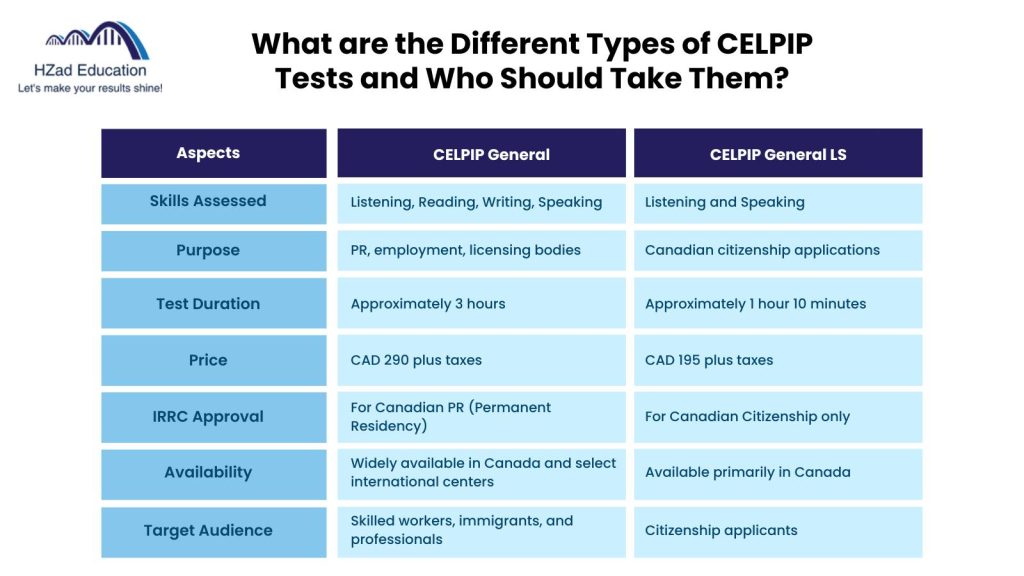
The CELPIP test includes CELPIP General and CELPIP General LS, each designed for specific immigration and citizenship requirements in Canada. Each test type evaluates different language skills and aligns with Canadian Language Benchmark (CLB) levels used by IRCC for decision-making.
The CELPIP General test measures four skills: listening, reading, writing, and speaking, while the CELPIP General LS test evaluates only listening and speaking skills. Both CELPIP Fomat use CLB mapping to determine whether candidates meet the required language thresholds for programs such as Express Entry or citizenship applications.
| Aspects | CELPIP General | CELPIP General LS |
| Skills Assessed | Listening, Reading, Writing, Speaking | Listening and Speaking |
| Purpose | PR, employment, licensing bodies | Canadian citizenship applications |
| Test Duration | Approximately 3 hours | Approximately 1 hour 10 minutes |
| Price | CAD 290 plus taxes | CAD 195 plus taxes |
| IRRC Approval | For Canadian PR (Permanent Residency) | For Canadian Citizenship only |
| Availability | Widely available in Canada and select international centers | Available primarily in Canada |
| Target Audience | Skilled workers, immigrants, and professionals | Citizenship applicants |
CELPIP General
The CELPIP General test evaluates complete English proficiency across listening, reading, writing, and speaking in a single computer-based sitting. IRCC requires this test for permanent residency programs, such as Express Entry and the Federal Skilled Worker Program, in which candidates must achieve a minimum CLB of 7.
The test format reflects real-life communication scenarios, such as workplace emails, discussions, and problem-solving tasks, helping candidates demonstrate practical language ability. CELPIP General scores map directly to CLB levels, and institutions such as employers and colleges use these scores to assess whether candidates meet professional and academic communication standards.
CELPIP General LS
The CELPIP General LS test assesses listening and speaking skills only and is designed for Canadian citizenship applications. IRCC requires candidates to achieve at least CLB 4 in listening and speaking to meet the minimum language requirement for citizenship eligibility.
The test focuses on listening tasks and spoken responses such as giving advice or expressing opinions, which reflect everyday Canadian communication contexts. CELPIP General LS scores align with CLB benchmarks, and candidates use these results to fulfill citizenship requirements without completing the reading and writing sections..
How is the CELPIP Test Structured?
The CELPIP test follows a structured, computer-based format with four sections: Listening, Reading, Writing, and Speaking. The test evaluates real-life English communication skills in a single sitting of about 2 hours and 50 minutes, and candidates receive results within 3 to 4 business days.
Each section measures a specific language ability using task-based scenarios that reflect Canadian workplace, academic, and social contexts. This CELPIP test structure ensures that candidates demonstrate comprehension, expression, and interaction skills that align with Canadian Language Benchmark (CLB) levels.
Listening Section (46-50 minutes)
The Listening section evaluates how well a candidate understands spoken English in everyday Canadian contexts such as conversations and discussions. The section includes 6 parts with 38 questions, where tasks require identifying opinions, understanding key information, recognizing details, and interpreting conversations.
Candidates complete this section using headphones, creating a controlled environment and ensuring consistent audio delivery across test centers. The section takes about 46 to 50 minutes, and it measures how effectively candidates follow spoken English in both casual and professional situations..
Reading Section (43-56 minutes)
The Reading section assesses how accurately a candidate understands and interprets written English texts such as emails, notices, and informational passages. The section includes multiple parts with 38 questions, in which tasks involve selecting correct responses, identifying key details, and understanding tone or intent.
The content reflects real-life reading scenarios that candidates encounter in workplaces or academic settings. The section lasts 43 to 56 minutes and evaluates both comprehension accuracy and time management.
Writing Section (53 minutes)
The Writing section evaluates how clearly a candidate expresses ideas in written English through two tasks: writing an email and responding to an opinion-based prompt. The tasks measure communication ability in practical situations such as formal correspondence and structured argumentation.
Responses are scored based on clarity, coherence, vocabulary, and grammar accuracy, and candidates write 150 to 200 words per task. The section is completed on a computer in 53 minutes and measures how effectively candidates organize and present ideas in writing..
Speaking Section (15-20 minutes)
The Speaking section evaluates how effectively a candidate communicates verbally in English through recorded responses. The section includes 8 tasks such as giving advice, describing situations, making predictions, and expressing opinions.
Candidates record their responses using a headset, without a live interviewer, to ensure consistent evaluation conditions. The section takes about 15 to 20 minutes, and it measures fluency, clarity, and the ability to communicate ideas in real-life Canadian contexts.
How Does CELPIP Scoring Work? CLB Levels Explained
CELPIP scoring uses a scale from 1 to 12, where each score aligns directly with the Canadian Language Benchmark (CLB) system used by IRCC to assess language proficiency. In this process, the CELPIP score is calculated for each skill individually, and these CLB-mapped results ultimately determine eligibility for programs such as Express Entry.
CELPIP Score Chart
The CELPIP score chart defines performance levels from 1 to 12, where each level represents a specific degree of English proficiency. Higher scores indicate a stronger ability to understand, respond, and communicate in workplace, academic, and social contexts.Using the CELPIP score chart helps candidates identify their current level and set clear preparation targets based on CLB requirements. For example, a candidate aiming for Express Entry can use the chart to track progress toward achieving CLB 7 or higher across all four skills.
| CELPIP Score | Language Proficiency Description |
| 12 | Expert proficiency in workplace and community contexts |
| 11 | Advanced professional fluency and comprehension |
| 10 | High proficiency in demanding professional tasks |
| 9 | Effective proficiency in workplace communication |
| 8 | Good proficiency for most daily life activities |
| 7 | Adequate proficiency for basic work and community interactions |
| 6 | Developing proficiency for familiar situations |
| 5 | Acquiring basic language skills for everyday use |
| 4 | Adequate proficiency in daily life activities |
| 3 | Some proficiency in communication |
| 2 | Limited ability to convey immediate needs |
| 1 | Insufficient information to access |
| 0 | Insufficient information to access |
CLB Equivalency
CELPIP scores map directly to Canadian Language Benchmark levels, which act as the national standard for language proficiency assessment in Canada. This CELPIP-to-CLB equivalency ensures that candidates can clearly understand how their scores meet IRCC requirements for programs such as permanent residency or citizenship.
For example, a CELPIP score of 7 corresponds to CLB 7, which is commonly required for the Federal Skilled Worker Program under Express Entry. Lower CLB levels, such as CLB 4, apply to citizenship applications that require only basic communication ability.
| CELPIP Score | CLB Level |
| 12 | CLB 12 |
| 11 | CLB 11 |
| 10 | CLB 10 |
| 9 | CLB 9 |
| 8 | CLB 8 |
| 7 | CLB 7 |
| 6 | CLB 6 |
| 5 | CLB 5 |
| 4 | CLB 4 |
| 3 | CLB 3 |
| 2 | CLB 1, 2 |
| 1 | – |
| 0 | – |
Score Descriptors
The CELPIP score descriptors give qualitative meaning to the numeric scale, showing what a score actually represents in real-CELPIP score descriptors explain what each score level represents in terms of real-world communication ability. These descriptors define how well a candidate can express ideas, understand information, and interact in English across different contexts.
Key examples of score descriptors include:
- Level 12: Advanced command of English in workplace and community contexts with high accuracy and fluency.
- Level 9: Strong fluency and accuracy suitable for professional communication and complex interactions.
- Level 7: Adequate proficiency for most daily, workplace, and immigration-related communication needs.
- Level 5: Basic ability limited to familiar situations with moderate understanding and expression.
- Level 3 or below: Minimal communication ability with frequent difficulty understanding and responding effectively.
Each section uses a structured scoring rubric, ensuring that listening, reading, writing, and speaking abilities are evaluated consistently against CLB-aligned criteria.
Which Test is Better for Canada Immigration — CELPIP vs IELTS?
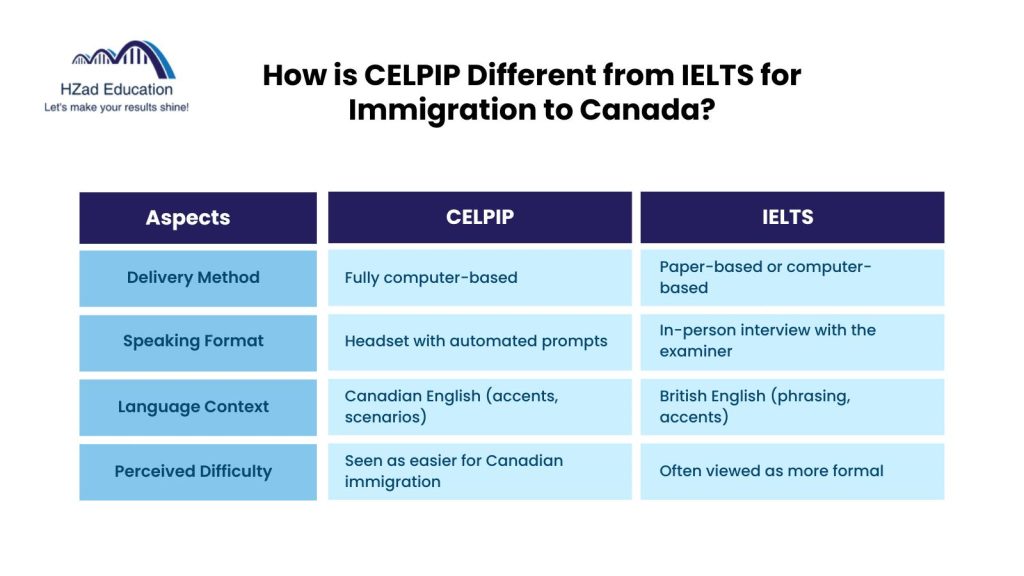
CELPIP is suitable for candidates who prefer a computer-based test with a Canadian context and no face-to-face interaction, while IELTS is suitable for candidates who are comfortable with handwritten responses and in-person speaking interviews. Both tests are accepted by IRCC and map scores to Canadian Language Benchmark (CLB) levels required for immigration programs such as Express Entry.
The following CELPIP vs IELTS comparison highlights these core differences.
| Criteria | CELPIP | IELTS |
| Test Format | Fully computer-based | Paper-based or Computer-based (Speaking is in person) |
| Speaking Test | Recorded on computer (no examiner) | Face-to-face interview with the examiner |
| Content Context | Canadian English (accents, scenarios) | International English (mixed accents) |
| Sections | Listening, Reading, Writing, Speaking (single sitting) | Listening, Reading, Writing, Speaking (may vary by format) |
| Scoring System | Scores from 1–12 mapped to CLB | Band scores from 1–9 mapped to CLB |
| Result Time | 3–5 business days | 5-7 days (computer) / 13 days (paper) |
| Best For | Candidates comfortable with typing and the Canadian context | Candidates comfortable with written exams and interviews |
Difficulty Level
Both CELPIP and IELTS are valid English language tests, but many test-takers perceive their difficulty differently. CELPIP is often considered easier because it is fully computer-based, features Canadian English accents, and uses familiar everyday scenarios. IELTS, on the other hand, can feel more challenging due to its use of British English phrasing, wider vocabulary range, and the face-to-face speaking interview.
While some candidates prefer CELPIP for its consistent format and Canadian focus, others may perform better with IELTS depending on their language background and comfort level. Ultimately, the perceived difficulty of each test is subjective and depends on individual strengths and familiarity with the test format.
Speaking Format Differences
The main difference in the speaking format is that CELPIP is computer-recorded while IELTS involves a live interview. In CELPIP, candidates respond to pre-recorded prompts using a headset, ensuring consistency and reducing pressure for those who are uncomfortable with face-to-face interviews. IELTS, by contrast, requires speaking directly with an examiner, offering real-time interaction that some test takers may find more natural but others may find intimidating.
CELPIP’s approach appeals to candidates who prefer a standardized, technology-driven process, while IELTS speaking allows for conversational flow and immediate clarification. These contrasting formats mean that the better choice often depends on whether a candidate feels more confident speaking to a computer or to a person.
Computer-based vs Paper
A key difference between the two exams is that CELPIP is delivered only on a computer, while IELTS can be taken on either paper or a computer. CELPIP’s format allows candidates to type responses, which makes editing and time management easier for those comfortable with keyboards. IELTS, by contrast, offers handwriting for paper-based tests, which may be preferred by candidates used to traditional exams but can slow down response time.
The IELTS computer version provides typing, but the interface varies slightly by location, while CELPIP maintains a uniform and consistent system across all centers. For many test takers, the choice comes down to whether they are more confident typing answers or writing them by hand.
How Can You Effectively Prepare for the CELPIP Test?
Effective CELPIP preparation involves understanding the test format, studying official materials, taking timed practice tests, building daily vocabulary through immersion, practicing with credible materials, and avoiding memorization to improve accuracy and time management. Consistent practice matching CELPIP test scenarios, along with regular performance tracking and targeted revision, helps identify weak areas, build confidence, and steadily improve overall scores.
Understand the Test Format
Start by reviewing the CELPIP test structure, including section types, timing, and question formats, because this understanding directly improves response accuracy and reduces hesitation during the exam. Candidates should analyze sample questions, such as email writing or opinion-based speaking tasks, and practice identifying what each task requires.
Focus on how each section aligns with CLB scoring criteria so you can match your responses to evaluation standards. This approach helps you avoid guesswork and improves clarity, which leads to better performance across all sections.
Study Official Materials
Use official CELPIP materials, such as practice tests, study guides, and sample responses, to ensure your preparation aligns with exam standards, thereby improving scoring reliability. Candidates should follow structured resources that demonstrate correct answer formats and scoring expectations.
Review model answers and compare them with your own responses to identify gaps in vocabulary, structure, or grammar. This method builds consistency and ensures that your preparation aligns with official evaluation criteria.
Take Timed Practice Tests
Practice under timed conditions to improve speed and accuracy, as time management directly impacts your ability to complete all tasks effectively. Candidates should take full-length mock tests that replicate the CELPIP exam environment.
Simulate test conditions by using a headset, avoiding interruptions, and strictly following time limits. This practice builds stamina, improves pacing, and helps you adjust strategies based on performance trends.
Daily Vocabulary and Immersion
Build vocabulary daily by engaging with English content such as podcasts, news, and conversations, because a stronger vocabulary improves both comprehension and expression. Candidates should focus on commonly used Canadian contexts, such as workplace or community scenarios.
Apply new words in writing and speaking practice to reinforce retention and improve fluency. Consistent exposure helps you develop natural language usage, which supports higher CLB scores.
Practice with Credible Materials
Choose credible materials, such as official CELPIP resources and recognized preparation platforms, to ensure accurate, relevant practice and prevent learning incorrect patterns. Candidates should prioritize resources that include exam-style questions and scoring rubrics.
Combine different formats such as mock tests, guided exercises, structured courses, and CELPIP classes to cover all skill areas. This approach broadens exposure and strengthens overall test readiness.
Avoid Memorization
Avoid memorizing fixed answers because CELPIP evaluates your ability to communicate naturally, and memorization reduces flexibility during the test. Candidates should focus on understanding how to structure responses instead of repeating prepared content.
Practice generating ideas, organizing thoughts, and adapting responses to different questions. This method improves clarity, adaptability, and overall performance across all sections while aligning with CLB-based scoring.
What are the CELPIP Retake Rules and Re-evaluation Options?
CELPIP retake rules require candidates to retake the entire test if they want to improve their score, as section-wise retakes are not allowed. Candidates must wait at least 4 days between attempts and may request a re-evaluation of Writing and Speaking if they believe their scores do not reflect their performance.
These rules help candidates plan their strategy to meet CLB requirements for immigration programs such as Express Entry. Candidates who fall short of a target score, such as moving from CLB 6 to CLB 7, must either retake the full test or apply for re-evaluation based on performance gaps.
How Many Times Can You Retake the CELPIP Test?
Candidates can retake the CELPIP test as many times as needed, but they must observe the mandatory 4-day waiting period between attempts. This waiting period ensures that results are processed and allows candidates time to adjust their preparation strategy.
Plan your retake by identifying weak sections, such as writing or speaking, and focusing on targeted practice before booking another test. Candidates can also reschedule the CELPIP test date, time, or location at least 7 days in advance, where the first change is free, and additional changes cost CAD 50 plus taxes.
What is the CELPIP Score Re-evaluation Process?
The CELPIP score re-evaluation process is a formal procedure that allows candidates to request a review of their Writing or Speaking scores to ensure they accurately reflect performance. Candidates must submit the request within 6 months of the test date and pay a CAD 55 fee.
Opt for the CELPIP score re-evaluation when a single section score appears inconsistent with overall performance, as the results may remain unchanged after review. This option can help avoid retaking the full test, especially when only a small score increase is needed to meet CLB requirements.
Which Institutions and Programs Accept CELPIP?
CELPIP scores are accepted by immigration authorities, educational institutions, employers, and licensing bodies as proof of English proficiency. Each institution sets specific CLB-based score requirements depending on the purpose, such as immigration eligibility, academic admission, or professional certification.
IRCC
IRCC accepts CELPIP scores for immigration and citizenship applications, which makes it a primary requirement for candidates applying through programs such as Express Entry. Candidates must achieve specific CLB levels, such as CLB 7 for NOC TEER 0 or 1 and CLB 4 for citizenship using CELPIP General LS.
Use the CELPIP General test for permanent residency applications and the CELPIP General LS for citizenship requirements. Always verify current score thresholds on the IRCC website, as requirements may vary by program.
Post-Graduation Work Permit (PGWP)
PGWP eligibility may require proof of English proficiency in certain cases, and institutions can accept CELPIP scores to validate language ability for work permit pathways. Candidates who complete programs in Canada may use CELPIP results to demonstrate communication skills when required by immigration or institutional criteria.
Check program-specific and institutional requirements, as PGWP eligibility depends on the study program’s conditions and immigration policies. Using CLB-aligned CELPIP scores helps meet language expectations where applicable.
Canadian employers
Canadian employers use CELPIP scores to assess workplace communication skills, especially for roles that require interaction with clients, teams, or public services. Employers evaluate whether candidates meet practical language requirements for tasks such as customer support or healthcare communication.
Present CELPIP scores during job applications to demonstrate your ability to function in Canadian work environments. Higher CLB levels indicate stronger communication skills, which can improve employment opportunities.
Professional associations and licensing bodies
Professional associations use CELPIP scores to verify communication ability for licensing and certification in regulated professions such as nursing, accounting, or engineering. These bodies require candidates to meet specific CLB levels to ensure safe and effective professional practice.
Review the required CLB thresholds set by each regulatory body before applying for certification. Meeting these benchmarks ensures compliance with professional standards and improves the chances of approval.
Universities, colleges, and vocational institutions
Universities, colleges, and vocational institutions accept CELPIP scores as proof of English proficiency for selected academic programs. Institutions set minimum CLB or equivalent CELPIP score requirements based on course level and complexity.
Check the admission criteria for each institution, as score requirements vary across programs, including diploma courses and degree programs. Submitting valid CELPIP scores helps demonstrate readiness for academic communication in Canadian education systems.
CELPIP scores are accepted by Immigration, Refugees and Citizenship Canada (IRCC), Canadian universities, and professional licensing bodies as proof of English proficiency. Immigration authorities use CELPIP for Permanent Residency and Citizenship, universities may require them for admission, and licensing boards in fields such as healthcare or accounting use them to validate professional communication. Score requirements vary depending on the pathway, so applicants should confirm the specific minimum score set by the institution or authority.
How to Prepare for the CELPIP Test Online?
Prepare for the CELPIP test online by following a structured routine that includes diagnostic testing, official resources, and timed practice, as this approach improves accuracy and CLB-based performance. Candidates should use online tools to identify weak areas, practice with real test interfaces, and track progress across listening, reading, writing, and speaking.
Build consistency by combining daily study sessions with full-length mock tests and skill-specific exercises that mirror exam-day tasks. A focused online strategy helps candidates improve fluency, manage time effectively, and align responses with CELPIP scoring criteria.
Follow these 7 effective strategies to perform better in the CELPIP tests:
- Take a CELPIP quiz to identify strengths and weaknesses across listening, reading, writing, and speaking.
- Practice with exam-like mock tests with the CELPIP interface to build familiarity and confidence.
- Use official CELPIP preparation materials, including workbooks, online modules, sample questions, and free tests available at Celpip.ca.
- Join CELPIP preparation classes for guided instruction and personalized feedback. Contact us at [email protected] to enroll.
- Study for 30 to 45 minutes daily to maintain consistency.
- Take full-length timed tests under real-time conditions to improve speed and pacing.
- Focus on skill-specific practice:
- Writing: Improve grammar, tone, and structure
- Speaking: Record responses and review fluency and coherence
- Listening: Identify key details, tone, and intent
- Reading: Develop scanning and information analysis skills
What is the Minimum CELPIP Score Required for Express Entry?
The minimum CELPIP score required for Express Entry is CLB 7 for most programs, such as the Federal Skilled Worker Program, which corresponds to a CELPIP score of 7 in each section. Higher CLB levels, such as CLB 9, increase CRS points and improve the chances of receiving an invitation to apply. If you are taking CELPIP for Express Entry, set a target level for each ability before you start preparing. A free Express Entry checklist for CELPIP covers how to choose that target and when to book.
What is the Total Duration of the CELPIP Test?
The total duration of the CELPIP test is about 2 hours and 50 minutes, including the Listening, Reading, Writing, and Speaking sections, all completed in a single sitting. The test runs continuously without separate day scheduling, which requires candidates to maintain focus throughout all sections.
How Long Does It Take to Get CELPIP Results?
It takes 3-5 business days to get CELPIP results after your test date. Candidates will receive an email notification once their scores are available. From the CELPIP account, they can download the PDF file of the CELPIP Official Score Report. You can access and view the test score for up to 2 years from the test date.
CELPIP results are available within 3 to 5 business days after the test, and candidates receive an email notification once scores are released. Candidates can download the official score report as a PDF from their CELPIP account and access it for up to 2 years from the test date.
Can I Retake Only One Section of the CELPIP Test?
You cannot retake only one section of the CELPIP test, as candidates must retake the entire test to improve their scores. This rule means you need to prepare all four skills again, even if only one section score is low.
Is CELPIP Easier Than IELTS?
CELPIP is easier for candidates who prefer a computer-based test with Canadian accents, while IELTS is easier for those who are comfortable with handwritten exams and face-to-face speaking interviews. The difficulty depends on individual strengths, test-format preferences, and familiarity with question types rather than on the test itself.
Is CELPIP Accepted for Quebec Immigration?
CELPIP is not accepted for Quebec immigration, as the Ministry of Immigration, Francisation and Integration (MIFI) requires French-language proficiency rather than English test scores. Quebec immigration typically requires French language tests such as TEFAQ, TEF Canada, or TCF Canada.
Candidates applying to Quebec programs must meet MIFI’s French-language criteria rather than submit CELPIP scores. This makes CELPIP relevant for federal immigration pathways but not for Quebec-specific programs.
Is CELPIP Accepted in Australia?
Yes, the CELPIP General test is officially accepted by the Australian Department of Home Affairs (DHA) since August 7, 2025, for visa and immigration purposes. Candidates can use CELPIP scores for visa categories such as Subclass 482 Temporary Skills Shortage, Subclass 485 Temporary Graduate, and permanent residency visa subtypes that require English proficiency.
Applicants must meet the minimum English-language thresholds set by DHA, and CELPIP scores are evaluated alongside other approved tests, such as IELTS and PTE. Candidates should verify the required score levels for each visa category, as requirements vary based on visa type and application criteria.
Where can I take CELPIP outside Canada?
CELPIP is available at international test centers in countries such as India, the UAE, the Philippines, and the United States. All centers follow the same testing protocols as those in Canada. Visit the official CELPIP website to check the latest availability and book your location.