
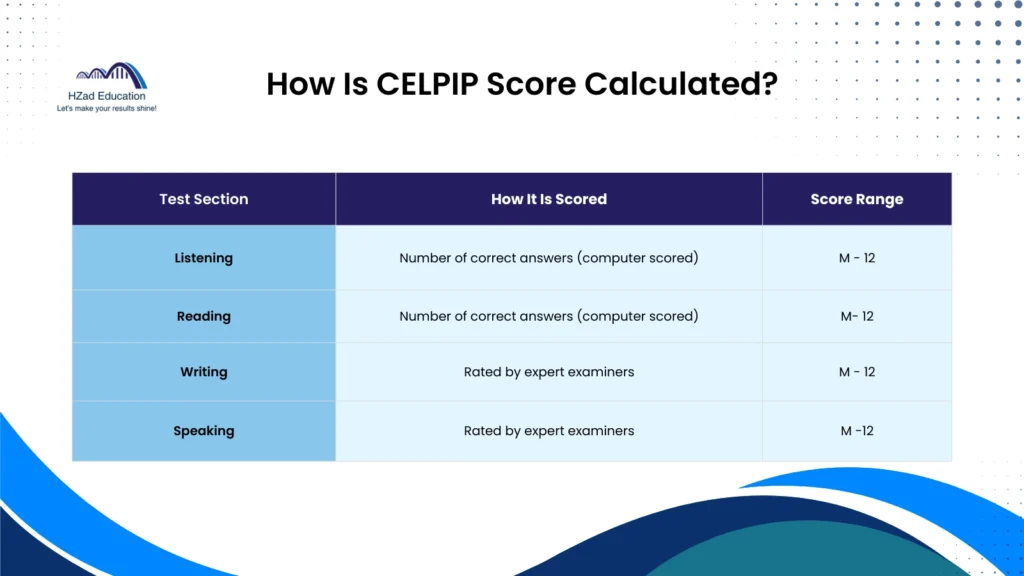
The Canadian English Language Proficiency Index Program (CELPIP) score is calculated by assessing proficiency in four components: Listening, Reading, Writing, and Speaking. The test uses a 12-level scale from M to 12, where each level reflects how effectively you can communicate in everyday Canadian situations.
Listening and Reading scores are based on the number of correct answers, which the system converts into standardized CELPIP levels. Writing and Speaking responses are evaluated by trained raters using criteria such as content organization, vocabulary use, clarity, and task fulfillment.
Instead of a single overall band like in IELTS, the CELPIP report provides four separate scores, one for each skill. Because these levels align directly with the Canadian Language Benchmark (CLB), immigration authorities and institutions can easily interpret your language proficiency.
What Is the CELPIP Scoring System?
The CELPIP scoring system is a standardized 12-level evaluation method for measuring English proficiency in everyday Canadian contexts. The test is fully digital and aligns with Canadian immigration and professional standards. It evaluates four core skills: Listening, Reading, Writing, and Speaking. The scoring system uses a hybrid evaluation method that combines automated assessment tools with trained human raters to maintain accurate and consistent results.
Each test component receives an independent score ranging from M to 12. Each level aligns directly with the Canadian Language Benchmarks (CLB). For example, CELPIP Level 7 equals CLB 7, simplifying interpretation for authorities and employers. This scoring system produces a clear performance profile that reflects a candidate’s ability to communicate effectively in English.
Immigration, Refugees and Citizenship Canada (IRCC) and many employers use CELPIP test scores to assess whether an applicant meets the language proficiency requirements for work, immigration, or settlement in Canada.
What Is the CELPIP Score Range?
The CELPIP score range runs from M to 12, providing a precise measure of English proficiency across four language components. This standard score range evaluates how effectively a candidate understands information, completes assigned tasks, and communicates ideas in both everyday and professional situations.
While Level M indicates minimal proficiency, the numeric levels align directly with the Canadian Language Benchmark (CLB) standards. This 12-point framework ensures that test results are easily interpretable for immigration authorities, employers, and educational institutions, offering a transparent reflection of a candidate’s readiness for life in Canada.
What Does Each CELPIP Level Mean?
CELPIP level means the specific performance descriptor that defines a candidate’s ability to navigate various linguistic challenges.
- M (Minimal Proficiency): Indicates very limited English ability. The candidate shows minimal understanding of the task and produces incomplete or ineffective responses.
- Level 3-4 (Basic): Demonstrate basic understanding of simple instructions and familiar information. The candidate can communicate simple ideas but uses limited vocabulary and structure.
- Levels 5–8 (Moderate): Reflect functional language ability for daily life. The candidate can understand common information, complete most tasks, and communicate ideas with reasonable clarity.
- Levels 9–12 (Advanced): Indicates strong command of English. The candidate can understand complex information, organize responses clearly, and communicate effectively in professional or academic contexts.
CELPIP Score Chart: All Levels and Descriptors at a Glance
The CELPIP test uses a 12-point scale to measure English proficiency, where each level describes a specific degree of communicative ability. Use the chart below to quickly identify what each score means for your language profile.
| CELPIP Level | Descriptor |
|---|---|
| 12 | Advanced proficiency. Communicates with strong accuracy, clear organization, and sophisticated vocabulary in complex situations. |
| 11 | Very advanced proficiency. Understands complex information and communicates ideas clearly with minor limitations. |
| 10 | Highly effective proficiency. Handles professional or academic communication with good clarity and vocabulary control. |
| 9 | Strong proficiency. Communicates effectively in most workplace and social situations with clear responses. |
| 8 | Good proficiency. Understands most information and communicates ideas clearly with occasional limitations. |
| 7 | Adequate proficiency. Communicates in everyday situations but may show some difficulty with complex information. |
| 6 | Developing proficiency. Understands basic information and completes tasks with moderate clarity. |
| 5 | Basic functional proficiency. Communicates simple ideas but with noticeable limitations in vocabulary and structure. |
| 4 | Limited proficiency. Understands simple instructions and produces short responses with restricted vocabulary. |
| 3 | Basic understanding. Communication is limited, and responses may lack clarity or completeness. |
| M | Minimal proficiency. Demonstrates very limited ability to understand or respond to tasks. |
How Is the CELPIP Overall Score Calculated?
The CELPIP overall score is calculated by evaluating English language proficiency through four independent components: listening, reading, writing, and speaking. Instead of providing a single overall band score, the CELPIP report shows four separate scores, each rated on a scale from M to 12.
Each section uses a different scoring method. Listening and Reading are computer-scored based on the number of correct answers. Writing and Speaking are evaluated by trained raters who assess responses using criteria such as content organization, vocabulary use, readability, and task fulfillment.
Your final language standing is determined by these four scores. Because CELPIP levels align directly with the Canadian Language Benchmark (CLB), a CELPIP score of 9 corresponds to CLB 9, making the results easy for immigration authorities and institutions to interpret.
How Is the CELPIP Listening Score Calculated?
The CELPIP Listening score is calculated by converting your raw score into a standardized CELPIP level from M to 12. This 47 to 55 minute section includes 38 scored questions across six tasks, measuring your ability to identify details and interpret meaning. Because the test is computer-scored, your performance maps directly to Canadian Language Benchmark (CLB) levels. While conversions vary slightly by difficulty, a raw score of 27–31 generally corresponds to Level 7, whereas a score of 33–35 corresponds to Level 9.
How Raw Scores Are Converted to CELPIP Levels?
Raw scores are converted to CELPIP levels through score equating, which maps the total number of correct answers to a standardized 12-point scale. Because different versions of the test may vary slightly in difficulty, the number of correct answers required to achieve a specific level can shift slightly. It ensures that a candidate who takes a more difficult version of the test is evaluated fairly against someone who takes an easier one.
CELPIP Listening Score Chart
The CELPIP listening score chart shows how the raw score from the listening section maps to the official CELPIP listening level, from M to 12.
| Raw Score (Approx.) | CELPIP Listening Level |
| 38–36 | 12 |
| 35–33 | 11 |
| 32–30 | 10 |
| 29–27 | 9 |
| 26–24 | 8 |
| 23–21 | 7 |
| 20–18 | 6 |
| 17–15 | 5 |
| 14–12 | 4 |
| 11–9 | 3 |
| Below 9 | M |
How Is the CELPIP Reading Score Calculated?
The CELPIP Reading score is calculated by converting the number of correct answers out of 38 into a standardized level between M and 12. While the raw score forms the basis of the result, the evaluation also reflects key reading skills such as identifying the main idea, locating supporting details, and understanding vocabulary in context. The score also considers a candidate’s ability to interpret meaning, tone, or implied information in a passage. The final result is then aligned with the Canadian Language Benchmark (CLB) levels.
Reading Section Format and Task Breakdown
The CELPIP reading score calculation is further refined by the specific demands of the four test parts.
- Part 1 (Reading Correspondence) and Part 2 (Reading to Apply a Diagram) focus on your ability to extract practical information from emails and visual data.
- Part 3 (Reading for Information) and Part 4 (Reading for Viewpoints) require a deeper analysis of factual relationships and competing opinions.
By assessing these varied cognitive skills over a 55 to 60-minute period, the system ensures that the final level is a precise measure of your functional literacy in real-world Canadian contexts.
CELPIP Reading Score Chart
The CELPIP reading score chart shows how the raw reading score from the reading component converts into the official CELPIP reading level reported on the test report.
| Raw Score (Approx.) | CELPIP Reading Level |
| 38–36 | 12 |
| 35–33 | 11 |
| 32–30 | 10 |
| 29–27 | 9 |
| 26–24 | 8 |
| 23–21 | 7 |
| 20–18 | 6 |
| 17–15 | 5 |
| 14–12 | 4 |
| 11–9 | 3 |
| Below 9 | M |
How Is the CELPIP Writing Score Calculated?
The CELPIP writing score is calculated by averaging the evaluations of two tasks, which are reviewed by human experts using a standardized rubric. Raters assess each response based on content quality, coherence, vocabulary range, and readability to ensure the candidate has fully met the task requirements. These individual ratings are then combined and converted into an official CELPIP level ranging from M to 12, representing the candidate’s ability to communicate effectively in professional and everyday scenarios.
How Are CELPIP Writing Tasks Rated?
CELPIP writing tasks are evaluated by trained experts who measure how effectively a candidate communicates in written English across two specific tasks. Using a standardized scale, raters analyze each response to ensure consistent accuracy and reliability. The final score, which ranges from M to 12, is determined by a combination of four key metrics: how well the content is organized, the range of vocabulary used, the overall grammatical readability, and how strictly the candidate followed the task instructions.
The Four Scoring Dimensions for Writing
English language experts review the writing responses across four core dimensions to ensure consistent accuracy and reliability in ratings.
- Content and Coherence
Evaluators assess how clearly the candidate presents ideas and organizes information within the response. A strong response maintains logical flow, clear structure, and a consistent connection between sentences and paragraphs.
- Vocabulary
The evaluation measures how accurately and appropriately the candidate uses vocabulary to express ideas. A higher score reflects varied word choice and correct usage in context.
- Readability
Raters evaluate how easy the response is to understand. This factor considers sentence structure, grammar accuracy, and overall clarity of the written message.
- Task Fulfillment
The response must address the task’s purpose and follow the instructions in the prompt. Candidates receive higher scores when they fully complete the required task and communicate the intended message effectively.
CELPIP Writing Score Chart
The CELPIP Writing score chart illustrates how your performance aligns directly with CELPIP writing levels to measure your English proficiency.
| CELPIP Writing Level | Content and Coherence | Vocabulary | Readability | Task Fulfillment |
| 12 | Ideas are clear, well-organized, and logically connected. | Sophisticated and accurate word choice. | Sentences are clear with strong grammar control. | Fully completes the task with a clear purpose. |
| 11 | Strong organization with minor clarity issues. | Wide vocabulary with few errors. | Mostly accurate grammar and sentence structure. | Task is completed with minor limitations. |
| 10 | Ideas are organized and mostly clear. | Good range of vocabulary. | Generally clear writing with small language errors. | Task requirements are addressed effectively. |
| 9 | Clear structure with occasional gaps in flow. | Appropriate vocabulary with some repetition. | Readable writing with moderate grammar accuracy. | The task’s purpose is mostly fulfilled. |
| 8 | Ideas are understandable but less developed. | Limited variety of vocabulary. | Some grammar errors affect clarity. | Task is completed, but with partial detail. |
| 7 | Basic organization with noticeable gaps. | Basic vocabulary with repetition. | Grammar and sentence issues appear regularly. | Task response is partially complete. |
| 6 | Ideas lack a strong structure. | Limited vocabulary range. | Frequent grammar issues reduce readability. | Task instructions are only partly addressed. |
| 5 | Weak organization of ideas. | Very limited vocabulary. | Sentences are difficult to follow. | Task completion is incomplete. |
| 4 | Ideas are poorly connected. | Very basic word use. | Frequent errors affect understanding. | The task’s purpose is unclear. |
| 3 | Very limited content organization. | Minimal vocabulary range. | Writing is difficult to understand. | Task response is largely incomplete. |
| M | Response lacks meaningful structure. | Minimal or incorrect vocabulary. | Writing cannot be clearly interpreted. | The task is not completed effectively. |
How Is the CELPIP Speaking Score Calculated?
The CELPIP speaking score is calculated by at least three independent, trained raters who evaluate your recorded responses based on a standardized 12-point scale. Unlike the multiple-choice sections, the evaluator assesses aspects of spoken communication, including content organization, vocabulary use, clarity of speech, and adherence to task instructions. These factors help determine how well you can express ideas in practical communication scenarios.
How Are CELPIP Speaking Tasks rated?
CELPIP speaking tasks are rated by measuring communicative effectiveness across 8 different real-life scenarios during a 15-20 minute session. Trained evaluators assess recorded responses using a structured scale to ensure consistent accuracy. Speaking tasks rely on four pillars: content and coherence, vocabulary use, listenability, and task fulfillment.
The Four Scoring Dimensions for Speaking
These dimensions collectively determine the candidate’s CELPIP speaking score, which is then converted to the official CELPIP speaking level.
- Content and Coherence
Evaluates how logically ideas are developed and organized. A strong response presents relevant information with a clear flow and a consistent message from beginning to end.
- Vocabulary Use
Raters measure the range and accuracy of word choices. Higher scores reflect varied, appropriate vocabulary that supports the clear expression of ideas.
- Listenability
Assesses how easily a listener understands the response. Evaluators examine pronunciation clarity, speech rhythm, and overall fluency to ensure a natural communication style.
- Task fulfillment
Performance depends on how thoroughly the candidate follows the prompt’s instructions. High scoring requires addressing the task’s purpose and providing enough detail to communicate the intended message.
CELPIP Speaking Score Chart
The combined assessment across these four dimensions determines the final CELPIP speaking score level from M to 12 reported in the candidate’s test report.
| CELPIP Speaking Level | Content and Coherence | Vocabulary | Listenability | Task Fulfillment |
| 12 | Presents ideas clearly and organizes them logically with detailed explanations. | The candidate uses sophisticated vocabulary accurately. | Speaks clearly with natural pronunciation and smooth fluency. | Fully completes the task and communicates the intended message clearly. |
| 11 | Organizes ideas well with only minor clarity limitations. | The candidate uses a wide vocabulary with minimal errors. | Maintains clear and understandable speech with slight pronunciation variation. | The candidate completes the task with minor limitations. |
| 10 | Presents ideas in a structured and mostly clear manner. | The candidate uses a good range of vocabulary appropriately. | Speaks clearly with minor fluency or pronunciation issues. | Addresses the task instructions effectively. |
| 9 | Communicates ideas clearly with some gaps in organization. | Uses appropriate vocabulary with occasional repetition. | The candidate maintains understandable speech with moderate variation in pronunciation. | Fulfills the task purpose in most parts of the response. |
| 8 | Communicates understandable ideas with limited development. | Uses a limited range of vocabulary. | Shows some pronunciation or pacing issues that affect clarity. | Completes the task but provides partial detail. |
| 7 | Shows basic organization with noticeable gaps in idea development. | The candidate uses basic vocabulary with repetition. | Speech contains several pronunciation or pacing issues. | Partially completes the task. |
| 6 | Presents ideas with weak structure. | Uses a limited vocabulary range. | Pronunciation issues frequently reduce clarity. | The candidate addresses the task instructions only partially. |
| 5 | Shows weak organization of ideas. | Uses a very limited vocabulary. | The candidate’s speech becomes difficult to follow at times. | The candidate does not fully complete the task. |
| 4 | Connects ideas poorly. | Uses very basic vocabulary. | Speech clarity remains limited. | Response does not clearly address the task. |
| 3 | Demonstrates very limited organization of ideas. | Uses minimal vocabulary. | Speech often becomes difficult to understand. | Provides an incomplete response to the task. |
| M | Does not present a meaningful organization of ideas. | Uses minimal or incorrect vocabulary. | Speech cannot be clearly interpreted. | Does not complete the task effectively. |
CELPIP Score to CLB Conversion Chart
The CELPIP Score to CLB Conversion Chart maps test results to Canada’s official 12-level proficiency standard. Because CELPIP aligns 1:1 with the Canadian Language Benchmark (CLB), a score of 9 equals CLB 9. This standardized framework allows immigration authorities and employers to easily compare CELPIP results against IELTS bands to ensure applicants meet specific language requirements.
What Is the Canadian Language Benchmark (CLB)?
The Canadian Language Benchmark (CLB) is Canada’s national standard for describing and measuring English proficiency. It uses a 12-level scale to assess how well you can communicate in real-life situations, moving from basic to advanced skills.
Because different exams (such as CELPIP and IELTS) use different scoring systems, the CLB serves as a “universal translator.” Immigration authorities and employers convert your specific test results into CLB levels to ensure everyone is evaluated fairly on the same national scale.
CELPIP to CLB Full Conversion Table
The CELPIP-to-CLB conversion chart allows you to skip calculators and verify your level directly. Since CELPIP aligns with Canadian standards, the conversion is seamless: a score of 7 in any category corresponds to CLB 7.
This 1:1 relationship makes it easy for you to manually confirm if you have met the minimum language requirements for your specific immigration pathway.
| CELPIP Score | CLB Level | Listening | Reading | Writing | Speaking |
| 12 | CLB 12 | 12 | 12 | 12 | 12 |
| 11 | CLB 11 | 11 | 11 | 11 | 11 |
| 10 | CLB 10 | 10 | 10 | 10 | 10 |
| 9 | CLB 9 | 9 | 9 | 9 | 9 |
| 8 | CLB 8 | 8 | 8 | 8 | 8 |
| 7 | CLB 7 | 7 | 7 | 7 | 7 |
| 6 | CLB 6 | 6 | 6 | 6 | 6 |
| 5 | CLB 5 | 5 | 5 | 5 | 5 |
| 4 | CLB 4 | 4 | 4 | 4 | 4 |
| 3 | CLB 3 | 3 | 3 | 3 | 3 |
| 2 | CLB 1–2 | 2 | 2 | 2 | 2 |
| 1 | – | 1 | 1 | 1 | 1 |
| 0 | – | 0 | 0 | 0 | 0 |
How Does CELPIP Score Compare to IELTS?
To compare CELPIP scores and IELTS bands, use the Canadian Language Benchmark (CLB) to standardize results. IELTS uses a band scale from 0 to 9, so its scores do not directly match CLB levels. To achieve CLB 9 through IELTS, candidates must obtain a specific combination of scores, such as 8.0 in Listening and 7.0 in Reading, Writing, and Speaking. In contrast, CELPIP scores align directly with the Canadian Language Benchmark (CLB) levels, meaning each CELPIP level corresponds exactly to a CLB level. For example, a CELPIP score of 9 equals CLB 9.
Because of this difference, immigration authorities often use CLB conversion charts to accurately compare IELTS and CELPIP results.
The following table provides a general comparison between CELPIP levels and IELTS band scores.
| CELPIP Score | IELTS Band (Approx.) | CLB Level |
| 12 | 9.0 | CLB 12 |
| 11 | 8.5 | CLB 11 |
| 10 | 8.0 | CLB 10 |
| 10 | 7.5 | CLB 10 |
| 9 | 7.0 | CLB 9 |
| 8 | 6.5 | CLB 8 |
| 7 | 6.0 | CLB 7 |
| 6 | 5.5 | CLB 6 |
| 6 | 5.0 | CLB 6 |
| 5 | 4.5 | CLB 5 |
| 4 | 4.0 | CLB 4 |
How long are CELPIP scores valid?
CELPIP scores are valid for 2 years from your test date. Organizations like the IRCC will only accept your results during this time. After two years, your score expires and cannot be used for immigration or work applications, so you would need to retake the test.
How quickly are CELPIP test results available?
CELPIP test results become available within 3 to 4 business days after the exam. You can log in to your online account to view performance across all four test components. The official report can be downloaded as a PDF or sent directly to institutions such as IRCC for application purposes.
Can I retake the CELPIP test to improve my score?
You can retake the CELPIP test as many times as you like to improve your score. Each attempt requires a full registration and payment. You must retake all sections, as individual modules cannot be repeated. The most recent CELPIP test score will appear on the new test report.
Does CELPIP provide an overall band score like IELTS?
The CELPIP test report provides independent scores from M to 12 for listening, reading, writing, and speaking. Rather than a single band score like in IELTS, this detailed breakdown helps institutions and immigration authorities accurately evaluate your proficiency in each specific communication skill.
What is the M score in CELPIP?
The M score denotes minimal proficiency and is the lowest level on the CELPIP scale. It indicates very limited English ability, typically occurring when a task is incomplete, misunderstood, or shows insufficient language skills for effective communication in that component.
Why is my CELPIP Listening or Reading score shown as a range?
The CELPIP listening or reading score appears as a range because the raw score from these sections is converted into a CELPIP level using a standardized scoring scale. The testing system uses score ranges to maintain consistent accuracy and reliability in rating.
You can also enroll in HZad Education’s CELPIP 10 Courses and get expert guidance for securing high CELPIP scores.