
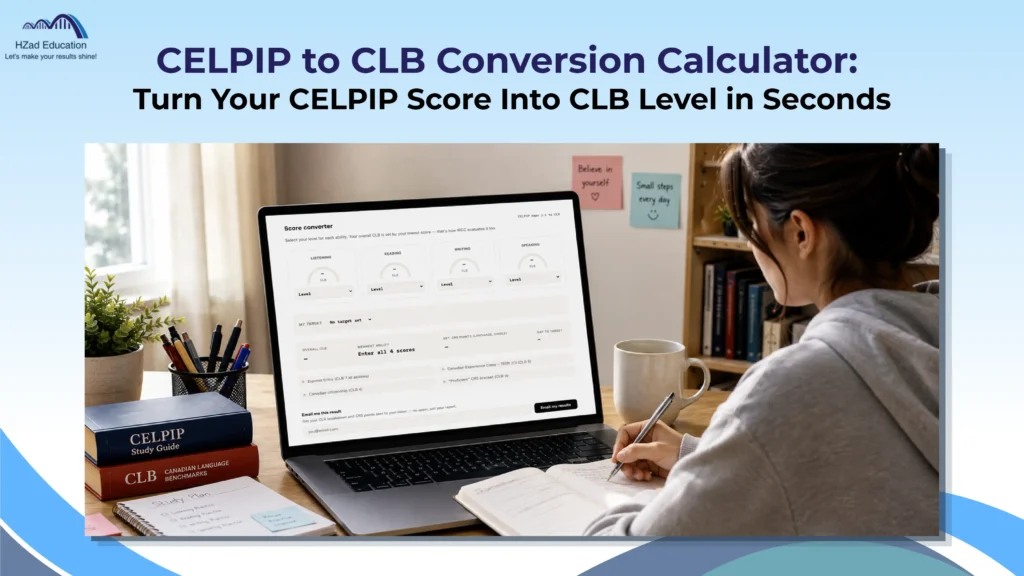
The CELPIP to CLB Conversion Calculator works by instantly converting your CELPIP test results into their official Canadian Language Benchmark (CLB) equivalents. Once you complete your CELPIP exam, understanding this translation becomes the essential next step in your Canadian immigration journey, as Immigration, Refugees and Citizenship Canada (IRCC) evaluates language proficiency strictly through the CLB framework rather than raw test scores.
By applying the latest IRCC equivalency standards, our CELPIP to CLB conversion calculator simplifies this evaluation across all four abilities, including Listening, Reading, Writing, and Speaking. Because CELPIP utilizes a direct 1-to-1 score mapping for levels 3 through 12, the tool delivers an immediate and precise breakdown of your language profile. You can also independently verify these results using our included reference chart.
Ultimately, knowing your exact CLB level allows you to confidently assess your eligibility for Express Entry, Provincial Nominee Programs (PNPs), and Canadian citizenship. It empowers you to calculate your Comprehensive Ranking System (CRS) points accurately and pinpoint any specific skill that needs improvement before you submit your final application.
CELPIP to CLB Conversion Calculator Tool
Knowing your exact CLB level is the first step toward maximizing your CRS score. Simply enter your four section scores (Listening, Reading, Writing, and Speaking) to get an accurate, instant breakdown aligned with current Canadian immigration requirements.
CELPIP → CLB score converter
CELPIP maps 1:1 to CLBSelect your level for each ability. Your overall CLB is set by your lowest score — that's how IRCC evaluates it too.
Email me this result
Get your CLB breakdown and CRS points sent to your inbox — no spam, just your report.
Full CELPIP to CLB Score Chart
Unlike test systems with complex scaling formulas, the CELPIP-General test aligns directly on a 1-to-1 basis with the Canadian Language Benchmark scale. A CELPIP score of 7 equals CLB 7, a score of 8 equals CLB 8, and so on. With the CELPIP to CLB score chart, you can instantly verify if your sub-scores satisfy the language criteria for Express Entry, Provincial Nominee Programs (PNP), or citizenship.
| CELPIP Score | CLB Level | Listening | Reading | Writing | Speaking |
| 12 | CLB 12 | 12 | 12 | 12 | 12 |
| 11 | CLB 11 | 11 | 11 | 11 | 11 |
| 10 | CLB 10 | 10 | 10 | 10 | 10 |
| 9 | CLB 9 | 9 | 9 | 9 | 9 |
| 8 | CLB 8 | 8 | 8 | 8 | 8 |
| 7 | CLB 7 | 7 | 7 | 7 | 7 |
| 6 | CLB 6 | 6 | 6 | 6 | 6 |
| 5 | CLB 5 | 5 | 5 | 5 | 5 |
| 4 | CLB 4 | 4 | 4 | 4 | 4 |
| 3 | CLB 3 | 3 | 3 | 3 | 3 |
M | below CLB 3 | <3 | <3 | <3 | <3 |
How the CELPIP to CLB Conversion Calculator Works?
The CELPIP to CLB Conversion Calculator works by comparing your Listening, Reading, Writing, and Speaking scores with the official Canadian Language Benchmark (CLB) equivalency chart published by Immigration, Refugees and Citizenship Canada (IRCC). Since CELPIP follows a direct score-to-CLB mapping for scores from 3 to 12, the CELPIP to CLB calculator instantly converts each module into its corresponding CLB level. This allows you to determine whether your language results meet the requirements for immigration programs such as Express Entry, Provincial Nominee Programs (PNPs), and Canadian citizenship.
Three steps from CELPIP band to CLB level
Enter your four bands
Input your CELPIP results for Listening, Reading, Writing, and Speaking into the calculator. Scores can be entered as M (Minimal Proficiency) or any level from 3 to 12, matching the format shown on your official CELPIP score report.
Get instant CLB levels
The calculator compares each score with the official IRCC CELPIP-to-CLB equivalency chart and converts every language skill into its corresponding Canadian Language Benchmark level. Each module is evaluated separately because IRCC assesses Listening, Reading, Writing, and Speaking independently.
Know where you stand
View your CLB level for each language skill and compare your results with the language requirements for Express Entry, Provincial Nominee Programs (PNPs), or Canadian citizenship. Knowing your per-skill CLB profile helps you identify whether you meet the minimum eligibility criteria or need to improve a specific module before submitting your application.
Why does it matter?
Your CELPIP to CLB score matters because Immigration, Refugees and Citizenship Canada (IRCC) uses Canadian Language Benchmark (CLB) levels, rather than raw CELPIP scores, to assess whether you meet the language requirements for immigration and citizenship programs. Knowing your CLB level helps you determine your eligibility, estimate your immigration points, and identify whether you need to improve a specific language skill before applying.
Express Entry & CRS points
Your CLB level directly affects your Comprehensive Ranking System (CRS) score under Express Entry. IRCC evaluates your Listening, Reading, Writing, and Speaking results separately, and higher CLB levels can increase the number of CRS points awarded for language proficiency. Knowing your CLB score allows you to determine whether your current results meet the minimum language requirements and how they may affect your overall Express Entry profile.
Provincial Nominee Programs
Beyond federal draws, each Provincial Nominee Program (PNP) sets its own language requirements based on the immigration stream and occupation. Some programs require a minimum CLB level in every language skill, while others have higher benchmarks for specific occupations. Converting your CELPIP scores into CLB levels helps you compare your results with provincial eligibility criteria and identify the immigration pathways that best match your language profile.
Canadian citizenship
If you are applying for Canadian citizenship and are between 18 and 54 years of age, IRCC requires proof of English or French language proficiency. For applicants using CELPIP-General, a minimum of CLB 4 in Listening and Speaking satisfies the language requirement. Checking your CLB level before submitting your application helps confirm that your language results meet the required standard and can prevent unnecessary delays during the application process.
Common questions about CELPIP-to-CLB conversion
How is a CELPIP score converted to a CLB level?
CELPIP score is converted to a CLB level by mapping each of your four test bands, Listening, Reading, Writing, and Speaking, on a direct, 1-to-1 scale. A CELPIP score of 7 maps directly to CLB 7, a score of 8 maps to CLB 8, and scores of 10, 11, or 12 map to CLB 10+. The tool cross-references each of your four section scores individually against official IRCC equivalency tables.
What CLB level do I need for Express Entry?
The minimum CLB level needed for Express Entry is CLB 7 for most programs, though requirements vary by stream from CLB 4 to CLB 7. However, your exact score required depends on the program and NOC/TEER category you apply under. For example, the Federal Skilled Worker Program (FSWP) and Canadian Experience Class (CEC) for TEER 0 or 1 jobs require a minimum of CLB 7 across all four abilities, while CEC for TEER 2 or 3 requires CLB 5.
Is the CELPIP score chart tool free to use?
Yes, our CELPIP score calculator and conversion chart are 100% free to use with no hidden fees or account registration required. You can check and verify your CLB breakdown as many times as you need before submitting your immigration profile.
Does my lowest skill decide my overall CLB?
Yes, your lowest skill score determines your overall profile eligibility. IRCC evaluates Listening, Reading, Writing, and Speaking independently rather than averaging them. If a program requires a minimum of CLB 7 in every skill, having a CLB 6 in just one area will make your application ineligible, even if your other three skills are CLB 9 or higher.
How long is a CELPIP score valid for immigration use?
CELPIP test results are officially valid for 2 years from the date the score report is issued. IRCC requires your test results to remain active both on the day you submit your Express Entry profile and on the date you submit your final application for permanent residence.