
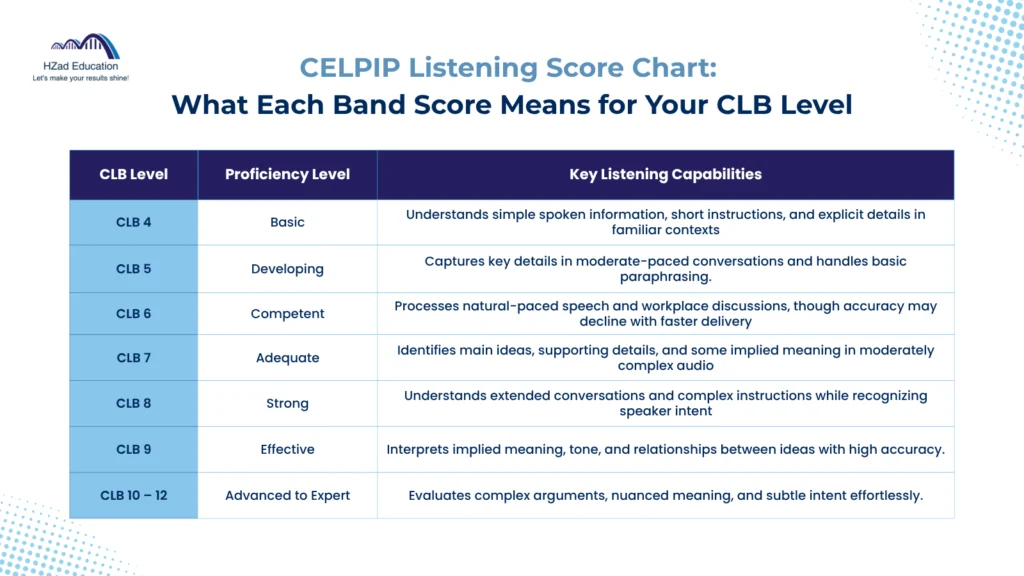
The CELPIP listening score chart defines how each band score corresponds to a CLB level, representing the candidate’s listening proficiency from basic to expert. While CLB 4–5 reflect basic comprehension, CLB 7–9 indicate strong to effective proficiency. And, CLB 10–12 represent advanced mastery, where the test taker interprets nuanced meaning and complex arguments effortlessly.
| CLB Level | Proficiency Level | Key Listening Capabilities |
| CLB 4 | Basic | Understands simple spoken information, short instructions, and explicit details in familiar contexts. |
| CLB 5 | Developing | Captures key details in moderate-paced conversations and handles basic paraphrasing. |
| CLB 6 | Competent | Processes natural-paced speech and workplace discussions, though accuracy may decline with faster delivery |
| CLB 7 | Adequate | Identifies main ideas, supporting details, and some implied meaning in moderately complex audio |
| CLB 8 | Strong | Understands extended conversations and complex instructions while recognizing speaker intent |
| CLB 9 | Effective | Interprets implied meaning, tone, and relationships between ideas with high accuracy. |
| CLB 10 – 12 | Advanced to Expert | Evaluates complex arguments, nuanced meaning, and subtle intent effortlessly. |
CLB – 4
For the CELPIP listening test, a CLB 4 score represents basic (aural) auditory proficiency. This level indicates that the test taker understands simple spoken information, short instructions, and slow-paced everyday conversations. The candidate identifies explicit details, such as names and locations, within familiar contexts.
However, the candidate often struggles with rephrased information and indirect meanings, especially in complex discussions involving multiple discussions and viewpoints. At this level, you track direct facts easily but may miss the speaker’s intent or tone shifts.
To improve, the test taker should practice identifying paraphrased content and listen to multi-speaker podcasts. Shifting your focus from literal words to implied meaning will help you bridge the gap toward higher CLB levels and improve your overall accuracy in diverse listening environments.
CLB – 5
A CLB 5 score represents a developing auditory proficiency level, where this level indicates that the candidate captures main ideas and key details in moderate-paced conversations. The test taker follows familiar topics, such as workplace discussions or service interactions, with reasonable accuracy.
While the candidate handles basic paraphrasing, they still face difficulty with unfamiliar vocabulary or multiple viewpoints. In the Information and Discussion sections, the candidate may miss connections when information is reworded.
CLB 5 reflects a transition stage, where comprehension moves beyond basic facts but remains inconsistent in handling indirect meaning or layered information. For better results, you should practice identifying reworded details and listen to structured news clips. Also, focus on linking ideas across sentences to improve listening accuracy.
CLB – 6
A CLB 6 score on the CELPIP listening test represents competent auditory proficiency. This level indicates that the test taker understands the main ideas and supporting details within moderately complex spoken communication. And follows longer conversations, workplace discussions, and informational content delivered at a natural pace.
While the candidate recognizes paraphrased information, accuracy may decline when the candidate encounters faster speech, unfamiliar vocabulary, or multiple viewpoints. This functional comprehension level allows the test taker to process explicit information, yet interpreting complex shifts in opinion remains a challenge.
The candidate should practice listening to varied accents and faster speech and work on linking ideas across longer audio segments. And focus on understanding how meaning changes through paraphrasing, to increase the CELPIP listening score.
CLB – 7
A CLB 7 score on the CELPIP listening test reflects an adequate auditory proficiency level. This level indicates that the test taker understands the main ideas, supporting details, and some implied meaning in moderately complex spoken communication. Candidate understands the main ideas, supporting details, and some implied meaning in moderately complex spoken communication.
The candidate follows extended conversations, workplace discussions, and informational content with improved consistency. While the candidate interprets paraphrased information and basic speaker intent, accuracy may decrease in the News Item and Discussion sections when multiple speakers present contrasting viewpoints.
This level marks your transition from simply tracking explicit content to actively interpreting relationships between ideas. To reach the next tier, candidates must analyze tone and intent within multi-speaker interviews. Track how ideas evolve over longer segments to sharpen your focus and improve your overall score.
CLB – 8
A CLB 8 score represents a strong auditory proficiency level on the CELPIP listening test. It indicates that the test taker understands complex spoken communication, detailed instructions, and extended conversations with high accuracy. The candidate understands complex spoken communication, detailed instructions, and extended conversations with high accuracy.
It shows the candidate interprets both explicit information and implied meaning across various contexts. While the test taker recognizes paraphrased ideas and follows the speaker’s intent, some difficulty remains during the News Item and Viewpoints sections when the speech includes dense information or rapid transitions.
This well-developed comprehension stage allows you to process detailed information and consistently interpret relationships between ideas. To progress, the test taker should practice analyzing nuanced tone and advanced vocabulary in academic discussions. Evaluating how arguments are structured will effectively improve overall CELPIP listening scores.
CLB – 9
A CLB 9 score on the CELPIP listening test score chart represents an effective auditory proficiency level. It means the test taker understands complex spoken communication, implied meaning, and detailed arguments with a high degree of accuracy.
At this level, the candidate interprets paraphrased information, detects tone and attitude, and evaluates relationships between ideas across multiple speakers. In the Discussion and Viewpoints sections, the test taker tracks contrasting opinions, identifies speaker intent, and understands how arguments are structured.
The candidate maintains accuracy even when speech includes faster delivery or layered information. To advance further, you should practice analyzing nuanced arguments in academic lectures or panel debates. Distinguishing fine differences in tone and implication will effectively support achieving higher CELPIP listening scores.
CLB – (10 – 12)
A CLB 10 to 12 score on the CELPIP listening test represents advanced to expert auditory proficiency. This level indicates that the test taker understands complex, fast-paced spoken communication, nuanced arguments, and subtle variations in tone.
While a CLB 10 candidate accurately interprets detailed discussions, they require focused attention for highly dense information. At CLB 11, the test taker processes nuanced meaning and implicit attitudes with consistency. CLB 12 reflects near-native listening ability, where the candidate evaluates complex arguments and interprets layered meaning effortlessly.
This mastery-level range ensures the test taker understands spoken content while evaluating relationships between ideas and speaker perspectives. By detecting subtle intent and argument structure, the candidate demonstrates complete proficiency within the CELPIP listening test.
How Does the CELPIP General Listening Score Differ from CELPIP General LS?
The CELPIP General test includes listening as one section within a four-part assessment, while CELPIP General LS evaluates listening as a standalone skill alongside speaking. The CELPIP General listening score and CELPIP General LS differ in test structure, scoring scope, and purpose, even though both measure listening ability.
| Attributes | CELPIP General | CELPIP General LS |
| Test Structure | 4 Components: Listening, Reading, Writing, Speaking | 2 Components: Listening and Speaking only |
| Scoring Scope | Full proficiency profile across all 4 skills | Focused profile on aural and oral skills |
| Purpose/Use Cases | Permanent Residency (PR), professional certification | Canadian Citizenship applications |
| Target Audience | Skilled workers, immigrants, and professionals | Individuals applying for Canadian citizenship |
| Test Duration | Approximately 3 hours (one sitting) | Approximately 1 hour and 10 minutes |
| Cost (Approx.) | $290 CAD + taxes | $195 CAD + taxes |
| Availability | Widely available in Canada and internationally | Primarily available within Canada |
| Test Content | Includes written tasks and complex reading passages | Strictly audio passages and verbal responses |
| Score Interpretation | Aligned with CLB levels 3–12 for all 4 skills | Aligned with CLB levels 3–12 for 2 skills |
| Evaluation Criteria | Content, vocabulary, readability, and task fulfillment | Listenability, speaking clarity, and comprehension |
How CELPIP Scores Are Evaluated?
The CELPIP listening score is evaluated by converting a candidate’s raw answers into a standardized CELPIP level from 1 to 12, which aligns with CLB levels. A CELPIP-to-CLB calculator helps interpret this conversion by showing how each correct response contributes to the final score.
The evaluation measures comprehension accuracy, interpretation of speaker intent, and response selection across different task difficulty levels, ensuring that each test-taker receives a consistent and comparable proficiency result.
How Are Raw Scores in the Listening Test Converted to Scaled CELPIP Levels?
The CELPIP listening test converts raw scores into scaled CELPIP levels (1–12) using a standardized score chart, where the number of correct answers determines the final proficiency level.
The system records each correct response, calculates the total raw score, and then maps that score to a CELPIP level. This process ensures that each candidate receives a consistent and comparable test result, regardless of minor variations in test difficulty.
| Raw Score (Approx.) | CELPIP Listening Level | CLB Level | Proficiency Interpretation |
| 38 – 36 | 12 | CLB 12 | Expert-level understanding across all contexts |
| 35 – 33 | 11 | CLB 11 | Advanced ability to interpret nuanced meaning and tone |
| 32 – 30 | 10 | CLB 10 | Strong control over complex discussions and viewpoints |
| 29 – 27 | 9 | CLB 9 | Accurately interprets intent, tone, and relationships |
| 26 – 24 | 8 | CLB 8 | Understands complex conversations and paraphrased ideas |
| 23 – 21 | 7 | CLB 7 | Interprets main ideas, details, and some implied meaning |
| 20 – 18 | 6 | CLB 6 | Understands extended speech with moderate complexity |
| 17 – 15 | 5 | CLB 5 | Understands main ideas in familiar situations |
| 14 – 12 | 4 | CLB 4 | Understands simple and explicit spoken information |
| 11 – 9 | 3 | Below CLB 4 | Limited understanding of basic listening content |
| Below 9 | M | Not Applicable | Minimal comprehension; score not assigned to CLB |
Tips to Improve Your CELPIP Listening Score
- Understand Task Variations
Improve your score accuracy by understanding how each listening section is structured. Familiarity with task types helps you predict question patterns, thereby increasing the likelihood of selecting the correct response.
- Listen for Paraphrasing
You can improve comprehension by identifying reworded sentences and synonyms. Matching questions with audio content more accurately directly improves score performance and helps you master the listening test.
- Practice with Official CELPIP Sample Tests
Identify the weak areas by simulating real exam conditions. Use official tests to evaluate performance and adjust strategies, which leads to better test results and higher accuracy.
- Focus on Weak CLB Levels First
Improve specific listening skills by reviewing performance at target CLB levels. Strengthening the understanding of implied meaning increases your overall CELPIP listening score and proficiency.
- Time Management During the Listening Section
Ensure response accuracy by managing time effectively. Practicing time control helps you avoid rushed decisions and ensures you process audio without missing key information.
- Don’t Panic on Missed Information
Prevent unnecessary score loss by staying focused after missing audio. Maintaining concentration helps you retain information later and make logical answer choices for the remaining questions.
- Daily Immersion
Build comprehension ability through daily exposure to podcasts and news. Regular practice with different accents and speeds leads to higher CELPIP listening scores over time.