

CELPIP Speaking Practice Test: 8 Tasks, Sample Questions, and High-Scoring Answers
A CELPIP Speaking Practice Test is a simulated preparation resource that helps candidates practice the CELPIP Speaking Test through realistic prompts, timed responses, and structured sample answers. It helps test-takers understand the speaking module, practice all 8 speaking tasks, and develop responses that demonstrate fluency, coherence, vocabulary range, grammar accuracy, and clear pronunciation.
The CELPIP Speaking Test evaluates a candidate’s ability to communicate effectively in real-life situations through tasks such as giving advice, describing experiences, describing scenes, making predictions, comparing options, handling difficult situations, expressing opinions, and describing unusual situations. This CELPIP speaking practice guide provides task-based questions, sample answers, response examples, and practical strategies to help candidates organize ideas and improve speaking performance.
Candidates preparing for CLB 8 to CLB 12 scores can use these CELPIP speaking samples to understand task requirements, improve response organization, and practice under computer-delivered test conditions. By working with realistic prompts and structured answers, test-takers can develop stronger speaking techniques and prepare more effectively for the official CELPIP Speaking Test.
What Is the CELPIP Speaking Test Format and Structure?
The CELPIP Speaking Test is a computer-delivered English speaking assessment that includes 8 timed tasks to evaluate a candidate’s ability to communicate in real-life situations. Test-takers respond to different speaking prompts, use limited preparation time to organize ideas, and record answers through a computer microphone. The tasks assess speaking skills such as fluency, coherence, vocabulary, grammar, pronunciation, and task fulfillment.
How Many Tasks Are in the CELPIP Speaking Test?
The CELPIP Speaking Test contains 8 tasks, and each task requires candidates to complete a different type of spoken response. The tasks represent common situations that candidates may experience in personal, professional, and community settings.
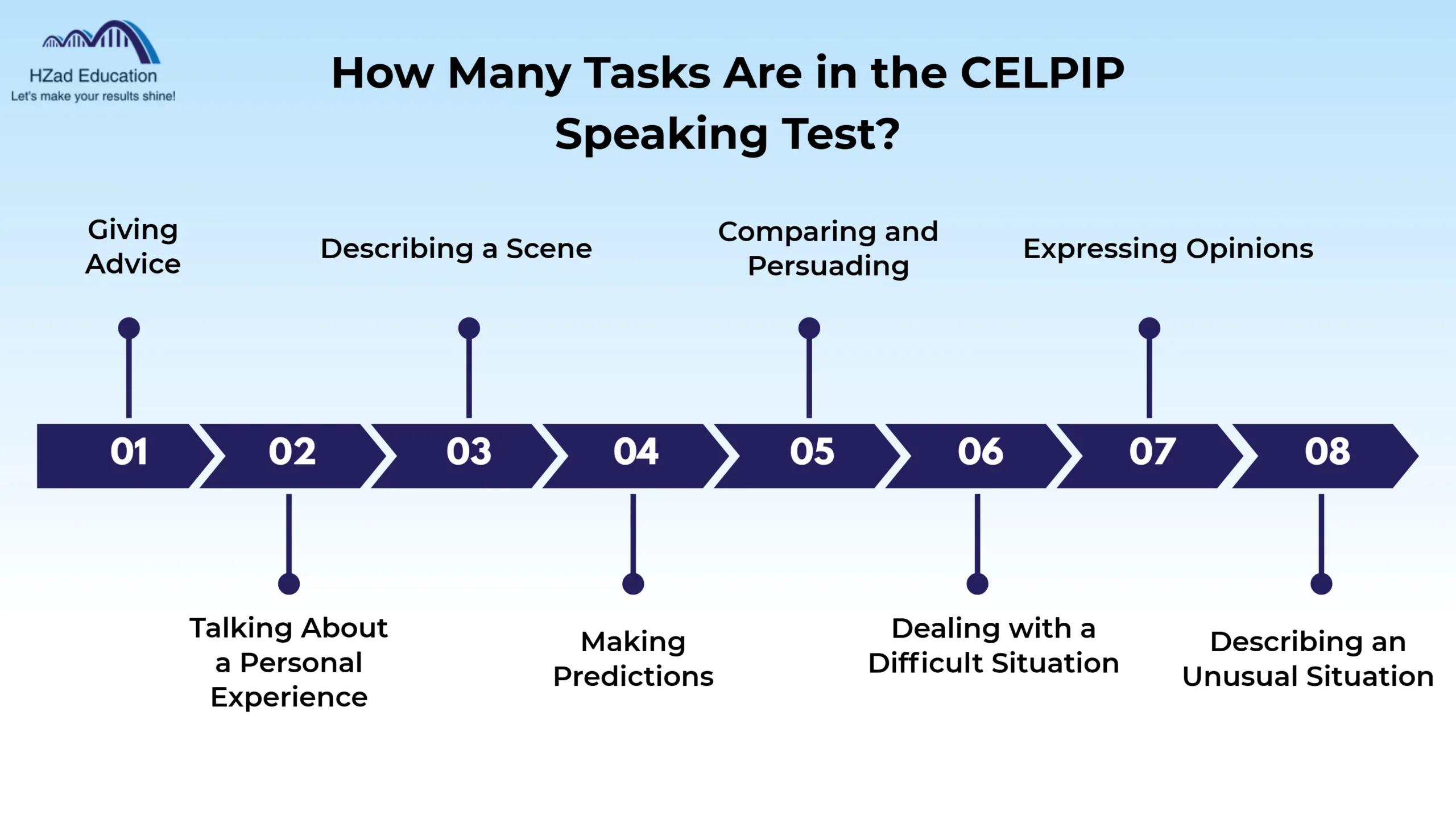
The 8 CELPIP Speaking tasks include:
- Giving Advice
Candidates recommend solutions or suggestions for a specific situation.
Example: Advising a friend about changing careers or making an important decision.
- Talking About a Personal Experience
Candidates describe a past event and explain what happened.
Example: Sharing a memorable experience or explaining how they handled a challenge.
- Describing a Scene
Candidates describe information shown in an image.
Example: Explaining people, objects, activities, and locations in a picture.
- Making Predictions
Candidates predict future events based on a given scene.
Example: Explaining what may happen next in a situation.
- Comparing and Persuading
Candidates compare two options and convince someone to choose one.
Example: Persuading someone to select a house instead of an apartment.
- Dealing with a Difficult Situation
Candidates explain a problem and provide a reasonable solution.
Example: Handling a workplace issue or requesting assistance from a service provider.
- Expressing Opinions
Candidates share their viewpoint on a topic and support it with reasons.
Example: Discussing education, environment, or social issues.
- Describing an Unusual Situation
Candidates describe a unique object, event, or situation in detail.
Example: Explaining an unusual product design or unfamiliar scene.
Understanding these CELPIP speaking task types helps candidates select the right response structure before the test. Each task requires different communication strategies, but all responses should demonstrate clear organization, accurate vocabulary, and effective idea development.
What Does Each CELPIP Speaking Task Require You to Do?
Each CELPIP speaking task requires candidates to complete a specific communication goal within a limited response time. Candidates must understand the speaking prompt, organize ideas quickly, and deliver a complete response that meets the task requirements.
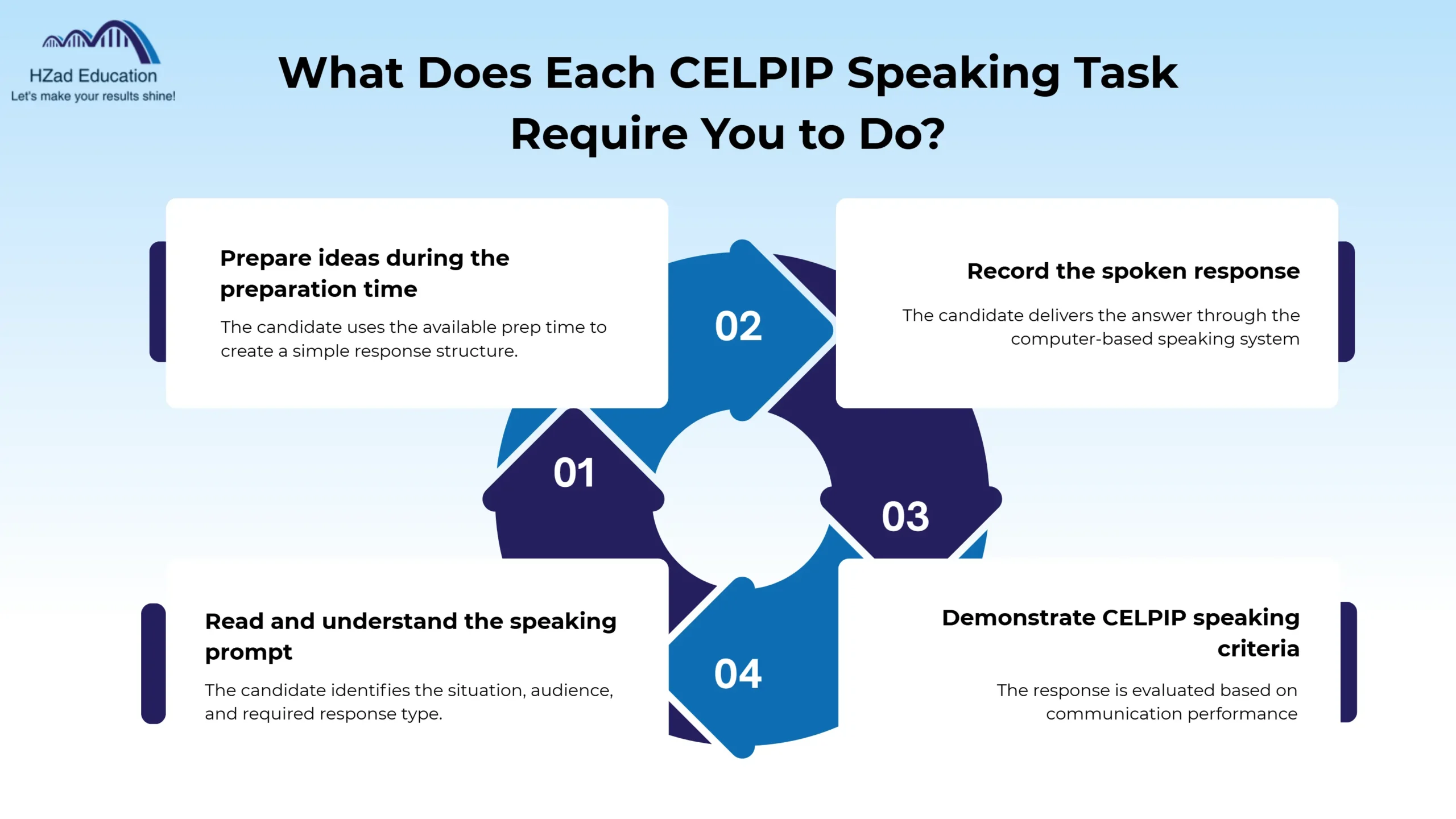
The CELPIP Speaking Test follows a structured process:
- Read and understand the speaking prompt
The candidate identifies the situation, audience, and required response type. Understanding the prompt helps the test-taker select appropriate vocabulary and organize relevant ideas.
- Prepare ideas during the preparation time
The candidate uses the available prep time to create a simple response structure. A strong preparation strategy includes identifying the main idea, supporting points, examples, and closing statement.
- Record the spoken response
The candidate delivers the answer through the computer-based speaking system. The response should maintain natural fluency, clear pronunciation, and logical organization throughout the recording period.
- Demonstrate CELPIP speaking criteria
The response is evaluated based on communication performance, including:
- Fluency: How smoothly the candidate speaks without unnecessary hesitation.
- Coherence: How logically the candidate connects ideas.
- Vocabulary: How effectively the candidate uses appropriate words and expressions.
- Grammar: How accurately the candidate forms sentences.
- Pronunciation: How clearly the candidate delivers spoken English.
- Task fulfillment: How completely the candidate answers the speaking prompt.
A CELPIP speaking practice test helps candidates simulate these conditions before the official exam. Regular practice with realistic speaking prompts helps test-takers improve response organization, manage preparation time, and build confident speaking habits across different CELPIP speaking task types.
What Does a CELPIP Speaking Practice Test Include?
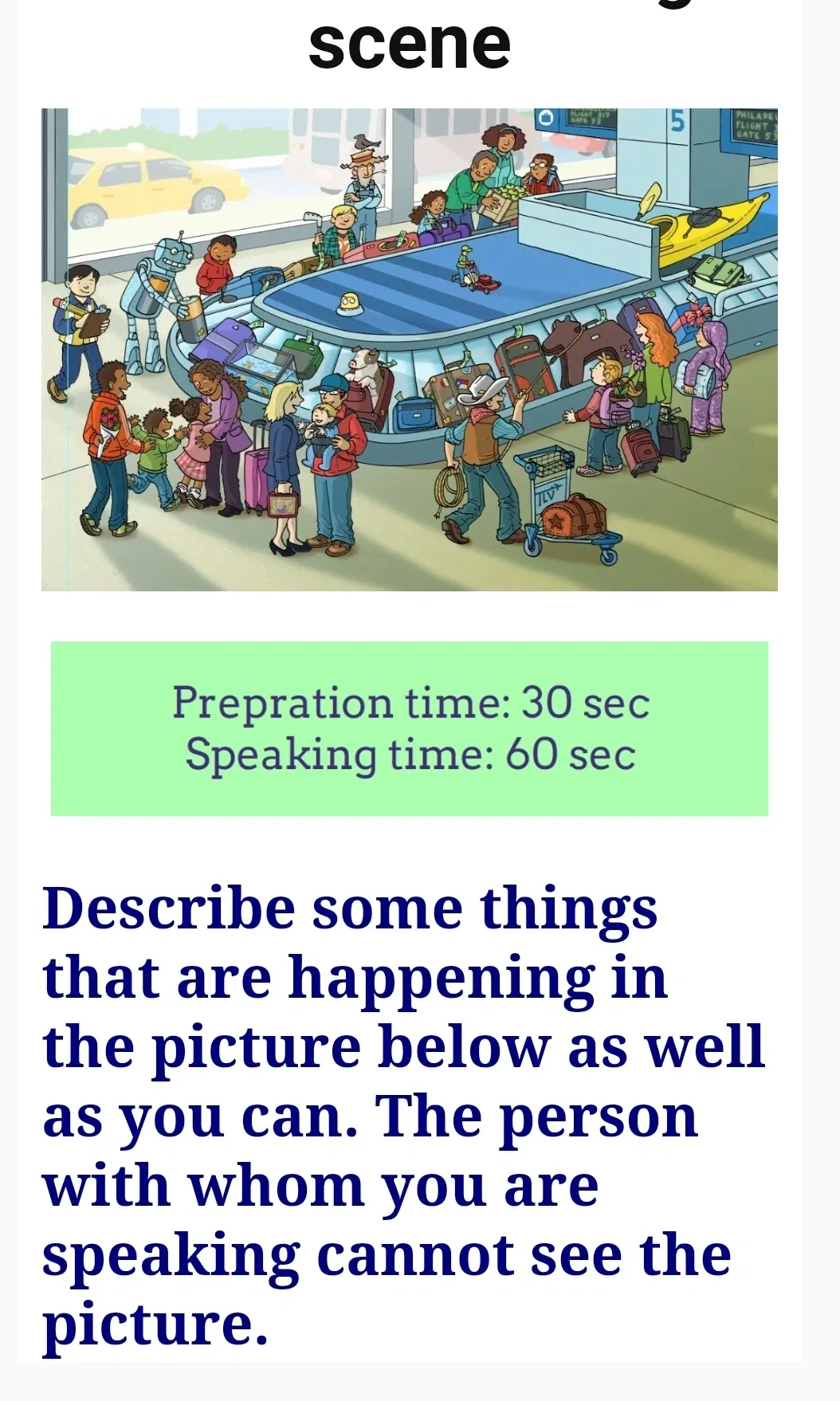

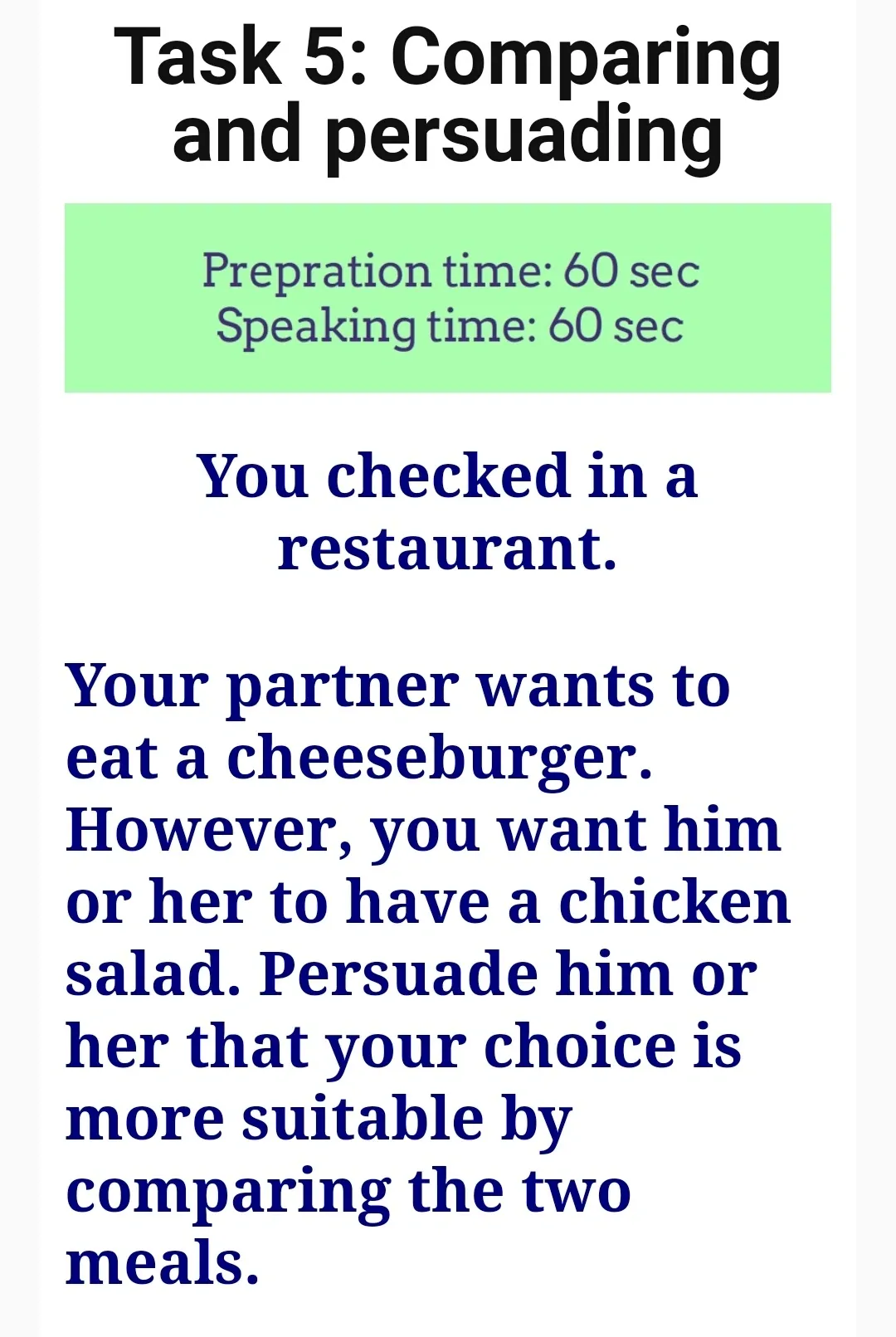
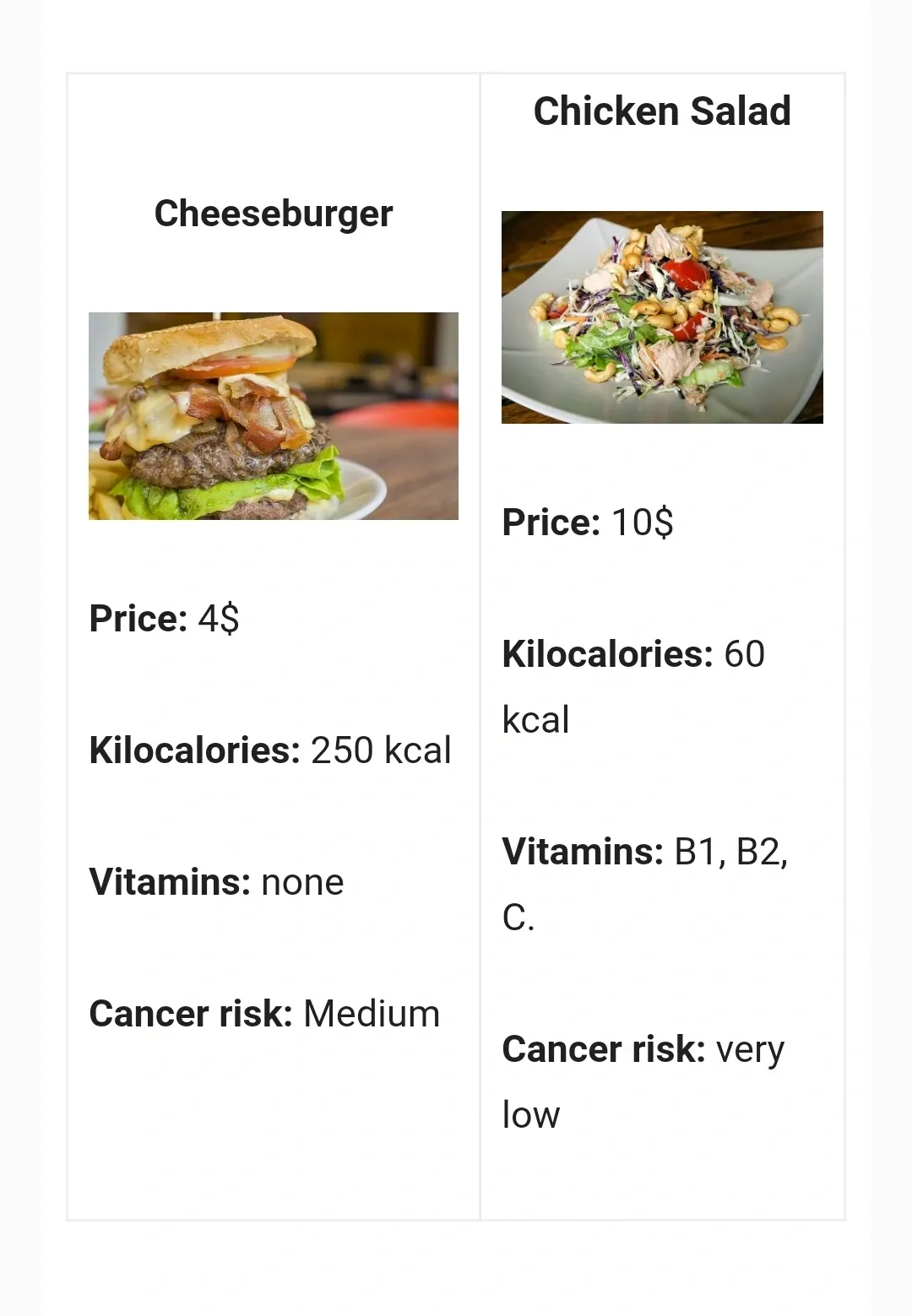
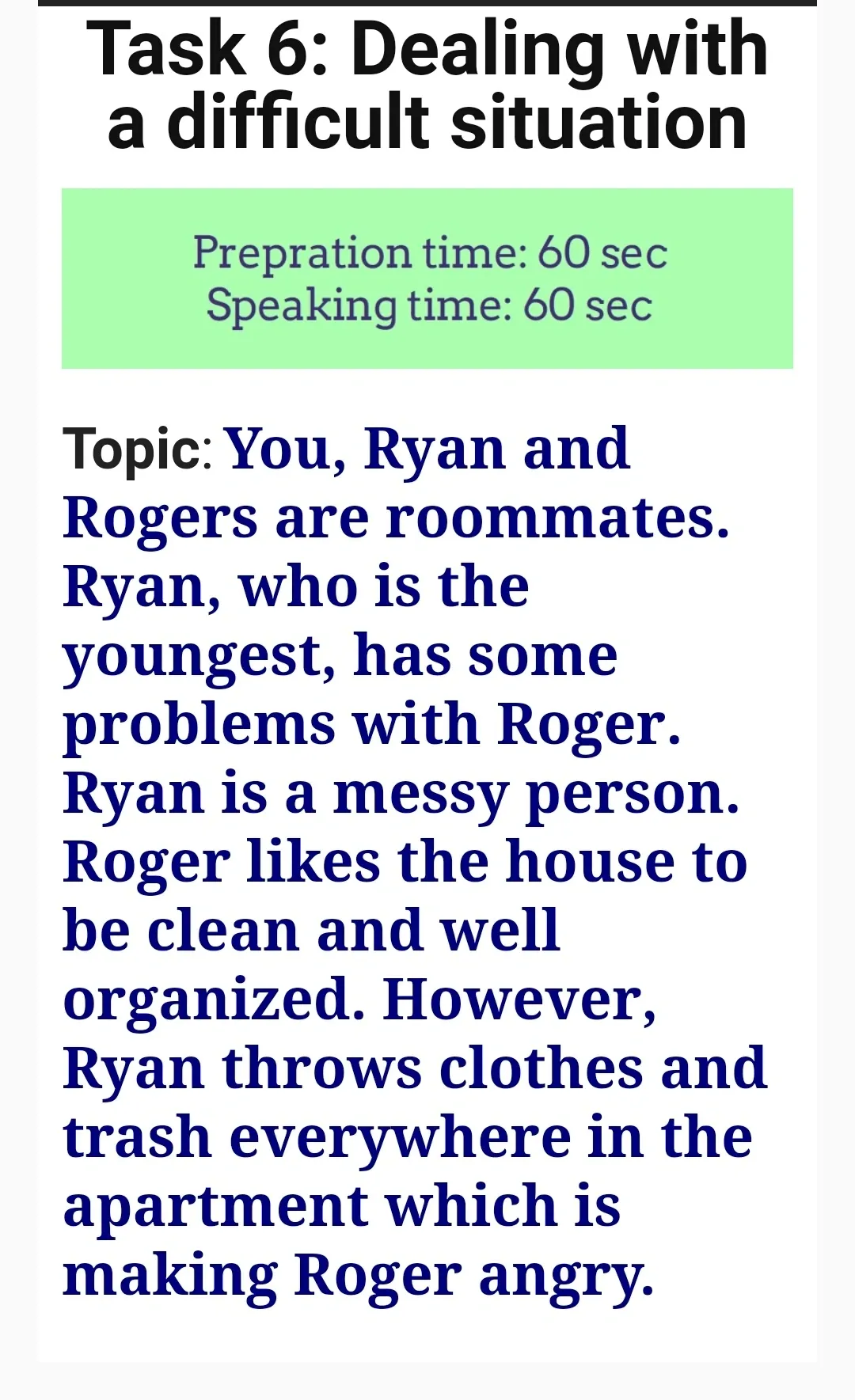
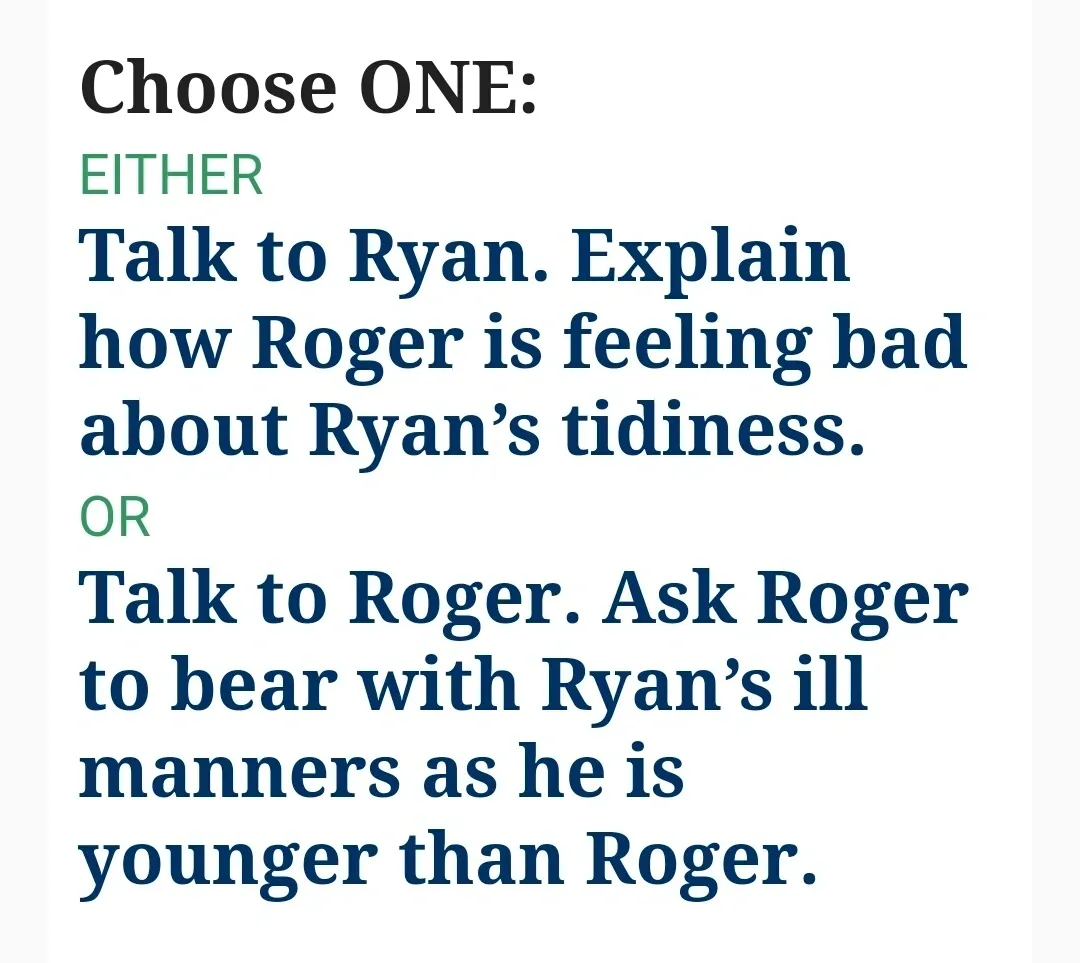
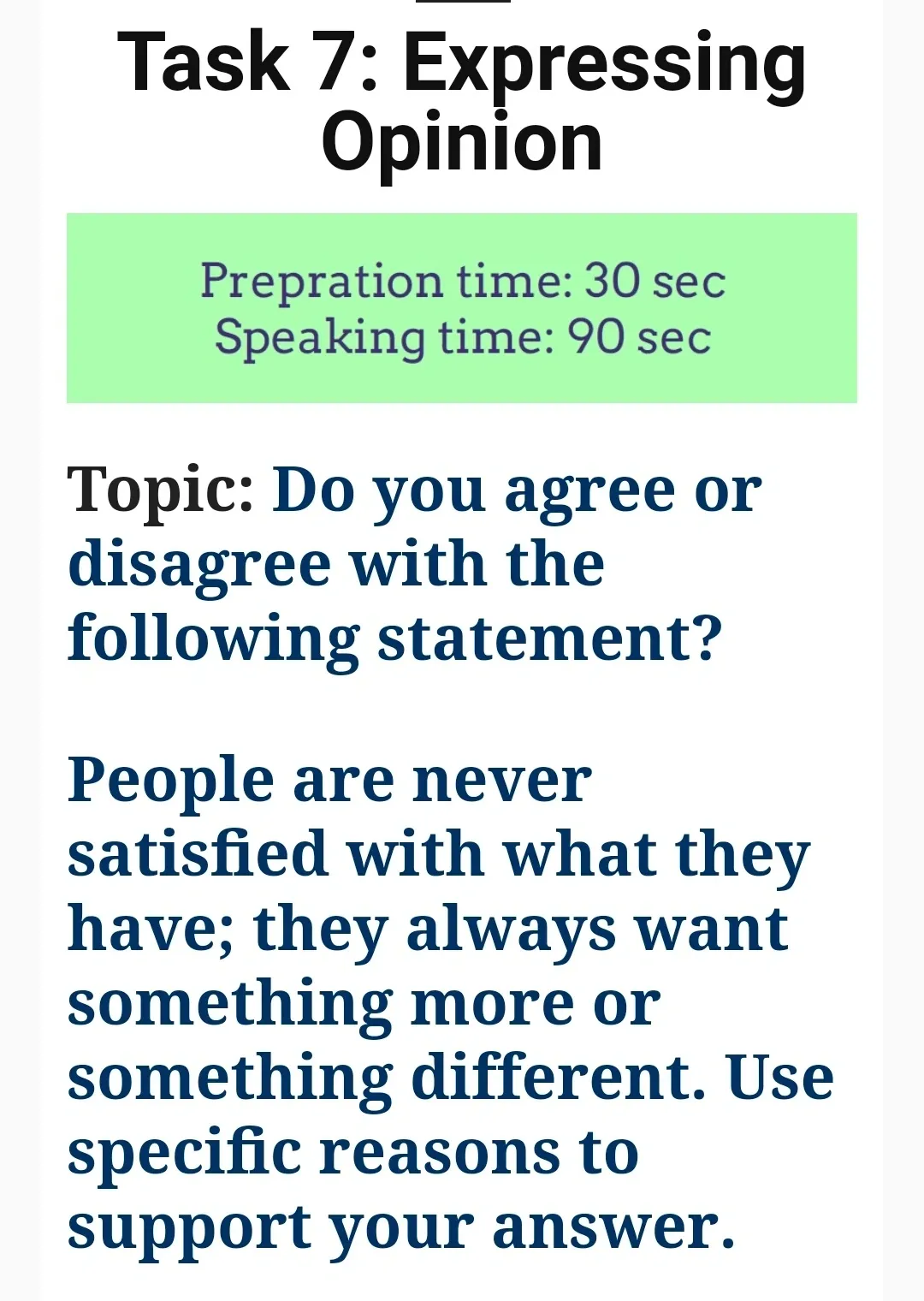
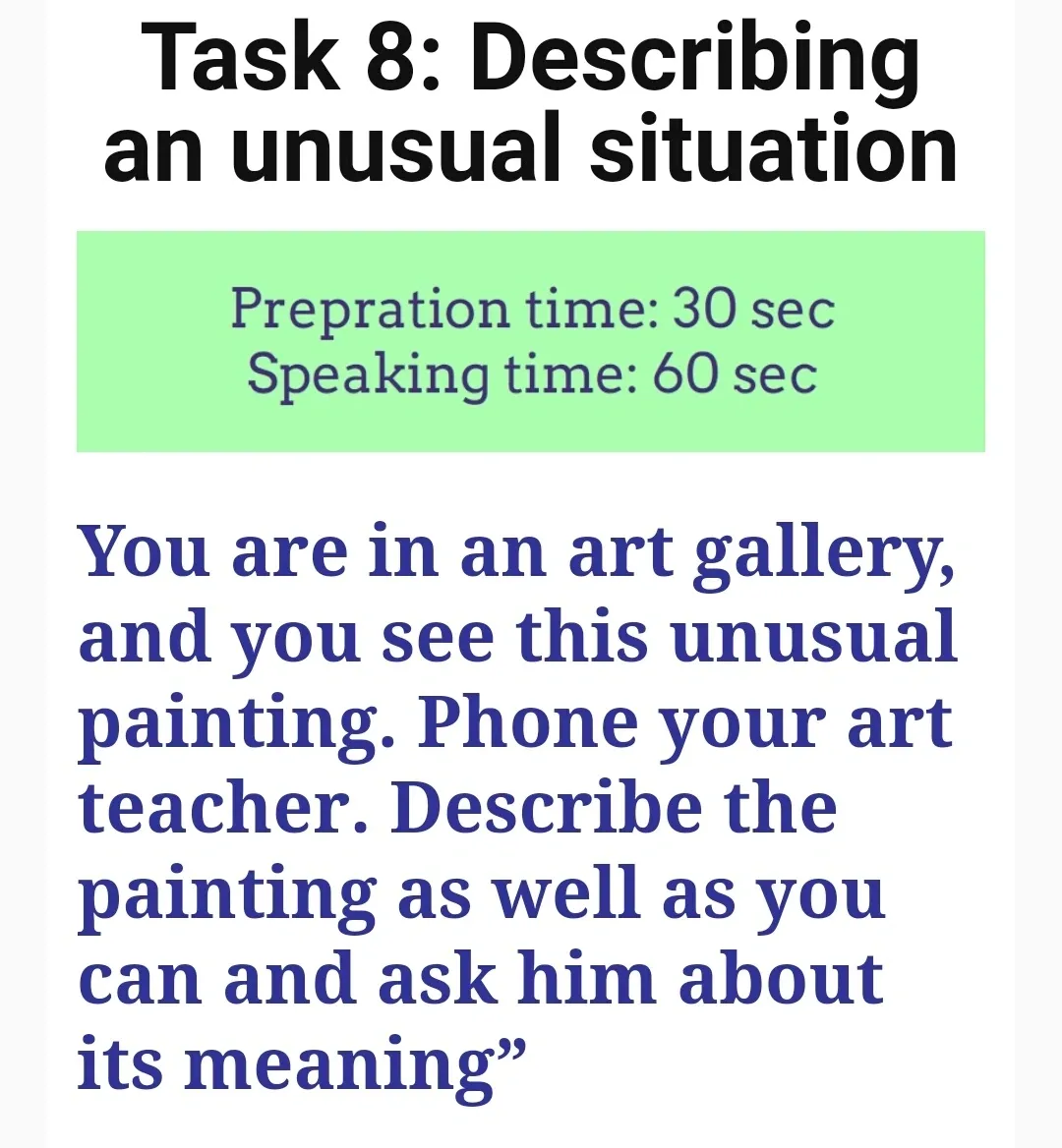
A CELPIP Speaking Practice Test includes realistic speaking prompts, sample answers, task explanations, response templates, and practice strategies for all 8 CELPIP Speaking tasks. These practice materials help candidates understand task requirements, organize ideas, improve fluency, and develop structured responses within the official preparation and recording time limits. A complete practice test simulates the CELPIP speaking experience by helping test-takers practice different situations, evaluate their response quality, and prepare for the speaking criteria used in the actual assessment.
What CELPIP Speaking Practice Questions, Topics, and Sample Answers Should You Practice?
The CELPIP Speaking practice should include questions and sample answers from all 8 speaking tasks, covering situations such as giving advice, sharing experiences, describing scenes, making predictions, comparing options, solving problems, expressing opinions, and describing unusual situations. Practicing these task-based questions helps candidates understand response requirements, organize ideas effectively, and develop structured answers within the CELPIP speaking time limits. Sample answers show useful response patterns, vocabulary choices, and connectors that test-takers can use in their preparation.
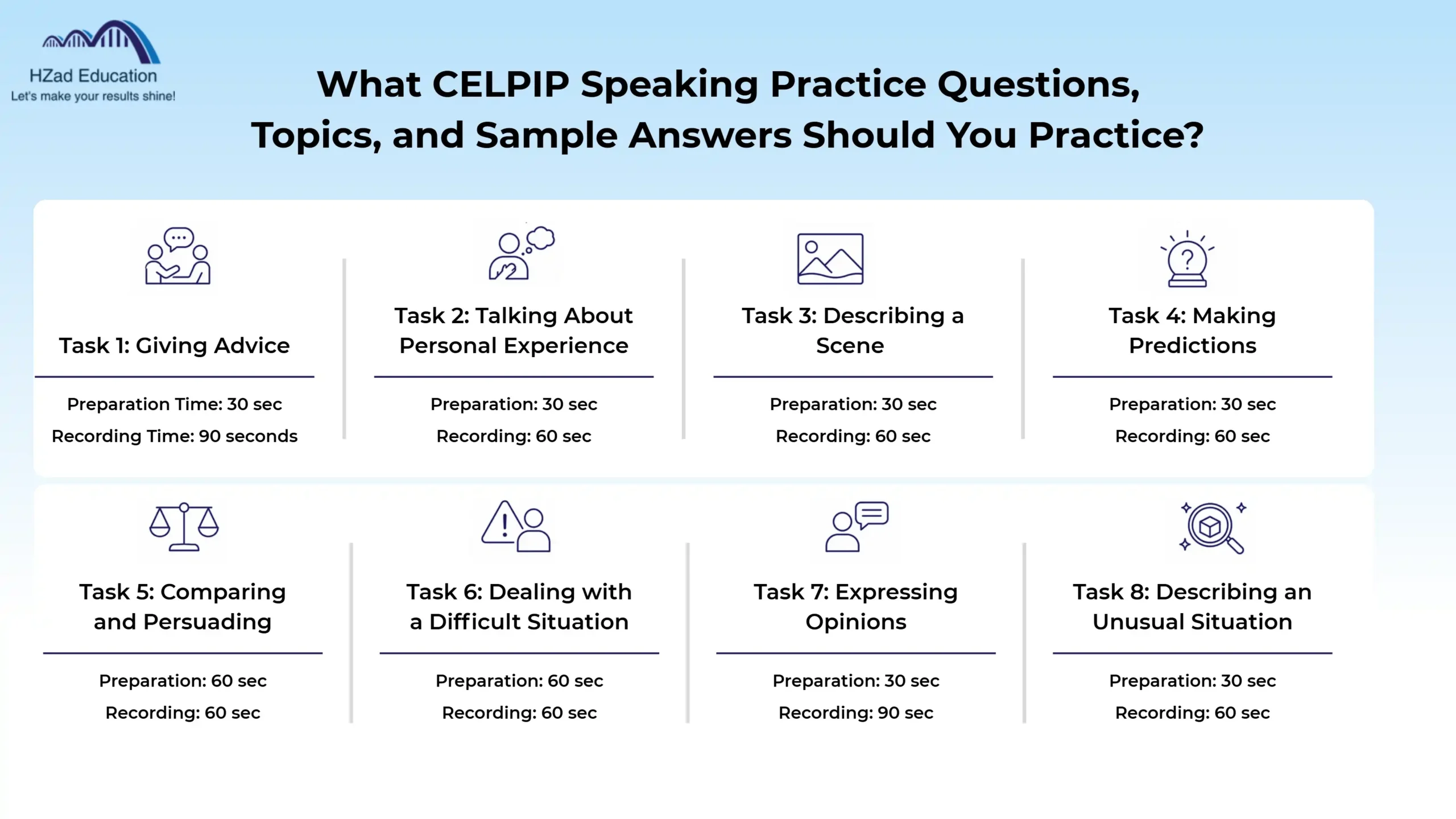
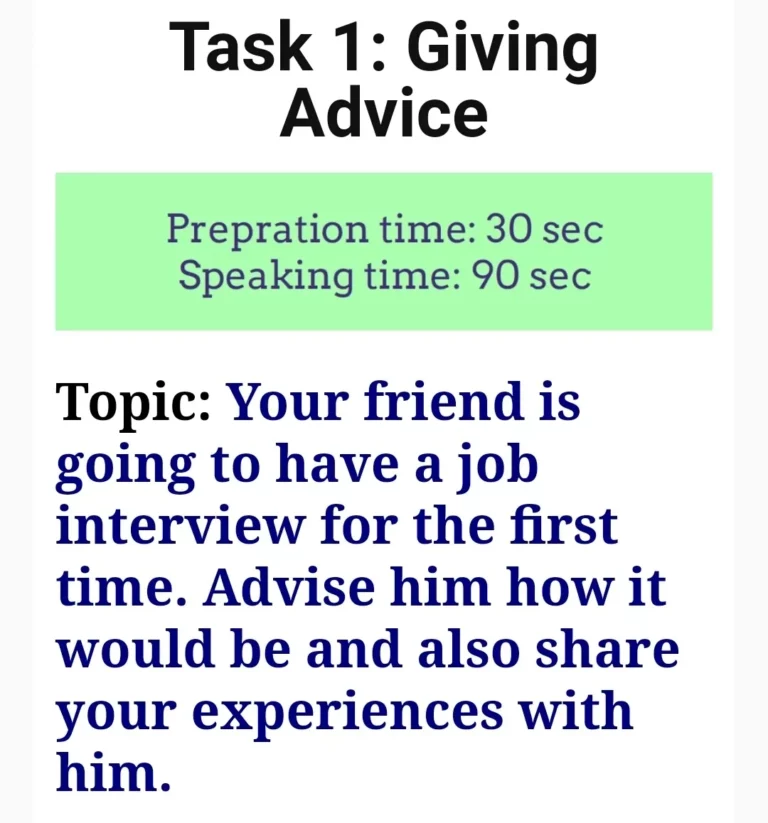
Task 1: Giving Advice (+ 3 sample questions + Sample answer)
CELPIP Speaking Task 1 requires candidates to give advice by recommending a solution for a specific situation and explaining why that recommendation is suitable. In this task, test-takers respond to a personal scenario where a friend, family member, or another person needs guidance before making a decision.
- Preparation Time: 30 seconds
- Recording Time: 90 seconds
Sample Questions:
- A friend is considering quitting their stable job to start a YouTube channel. Give them advice on what they should consider before making the move.
- Your cousin wants to buy a used car but knows nothing about mechanics. Advise them on how to ensure they get a reliable vehicle.
- A colleague is moving to a new city and is nervous about making friends. Give them advice on building a social circle.
Sample Answer (Question 1):
“Hi John, it is exciting to hear about your YouTube plans! However, before you hand in your resignation, I would strongly suggest you consider a few things. Firstly, you should build a financial cushion; since ad revenue can be unpredictable, having six months of savings is vital. Secondly, why not start part-time? While it is tempting to go all-in, testing your niche while you still have a steady income will reduce your stress. Ultimately, if you plan carefully now, your long-term success is much more likely.”
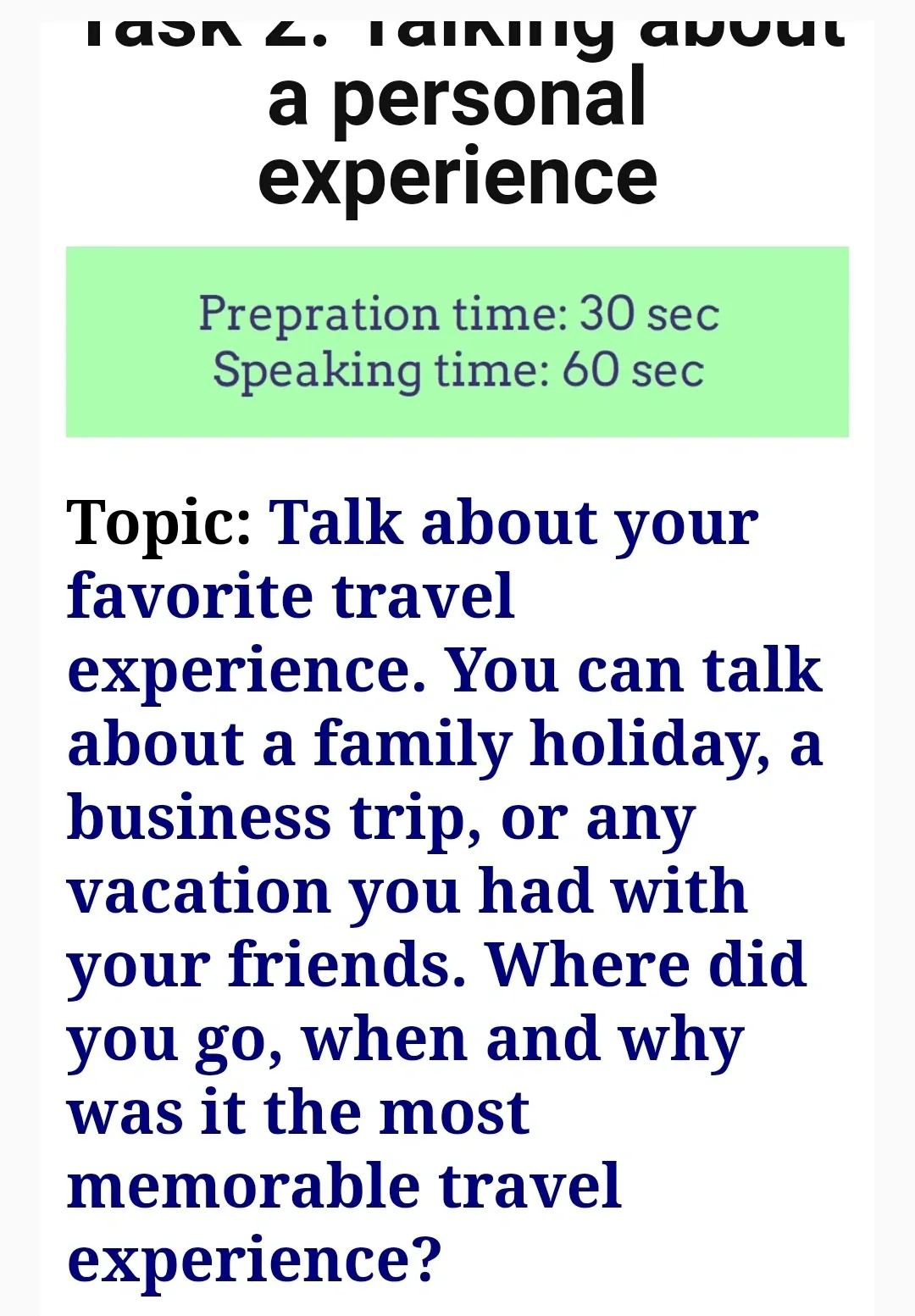
Task 2: Talking About Personal Experience (+ 3 questions + Sample answer)
CELPIP Speaking Task 2 requires candidates to describe a personal experience by explaining a past event, the surrounding situation, and the outcome. In this task, test-takers must share a real or imagined experience with clear details that help the listener understand what happened and why the event was meaningful.
- Preparation: 30 seconds
- Recording: 60 seconds
Sample Questions:
- Talk about a time you had to complete a difficult task under a tight deadline.
- Describe a memorable vacation you took with your family.
- Talk about a person who has had a significant positive influence on your life.
Sample Answer (Question 1):
“I remember a time last year when a major client moved their project launch forward by a week. Initially, I felt quite overwhelmed, but I realized that I needed to organize my team immediately. Despite the pressure, we stayed late every evening and prioritized the most critical tasks. As a result, we delivered the project flawlessly. Looking back, that experience taught me that I am much more capable of handling high-stress situations than I previously thought.”
Task 3: Describing a Scene (+ 3 questions + Sample answer)
CELPIP Speaking Task 3 requires candidates to describe a visual scene by explaining the people, objects, activities, and surroundings shown in an image. In this task, test-takers must observe the picture carefully and communicate what they see using clear descriptions, relevant vocabulary, and details about the relationships between different elements in the scene.
- Preparation: 30 seconds
- Recording: 60 seconds
Sample Questions:
- Describe a busy farmer’s market scene with various stalls and people interacting.
- Describe a scene of a child’s birthday party at an indoor playground.
- Describe a scene of people waiting at a crowded train station during rush hour.
Sample Answer (Question 1):
“In this vibrant picture, I can see a bustling outdoor farmer’s market. In the foreground, an elderly woman is carefully inspecting a crate of bright red apples at a wooden stall. To the left of her, a young couple appears to be laughing while holding a bag of fresh vegetables. In the background, there are several blue-and-white striped tents, and the sun is shining brightly, suggesting it is a beautiful summer morning. Overall, the atmosphere seems very lively and community-oriented.”
Task 4: Making Predictions (+ 3 questions + Sample answer)
CELPIP Speaking Task 4 requires candidates to predict future events based on a visual scene and explain what is likely to happen next using logical reasoning. In this task, test-takers analyze the image from Task 3, identify relevant details, and describe possible future actions or outcomes using clear explanations.
- Preparation: 30 seconds
- Recording: 60 seconds
Practice Questions:
- (Farmer’s Market): Looking at the interactions between the vendors and customers, what do you think will happen as the market prepares to close?
- (Indoor Playground): Based on the children playing at the birthday party, what activities are likely to occur once the staff brings out the food?
- (Train Station): Observing the crowd on the platform, what is going to happen the moment the express train arrives?
Sample Answer (Question 1):
“Based on this scene, I predict that the elderly woman will eventually purchase a dozen apples and move to the next stall to find some honey. Furthermore, the young couple will likely head toward the exit once their bags are full. Considering how crowded it is, more people will probably arrive soon, and some of the popular items might sell out. In a few hours, the vendors will likely start packing up their crates as the market comes to a close.”
Task 5: Comparing and Persuading (+ 3 questions + Sample answer)
CELPIP Speaking Task 5 requires candidates to compare two options and persuade someone to choose one by explaining its advantages and suitability. In this task, test-takers must consider both choices, support their preferred option with clear reasons, and deliver a convincing recommendation.
- Preparation: 60 seconds
- Recording: 60 seconds
Practice Questions:
- (Housing): Your partner wants a downtown apartment, but you prefer a suburban house. Persuade them to choose the house.
- (Travel): Your friend wants to go on a high-energy backpacking trip, but you prefer an all-inclusive resort. Convince them to book the resort.
- (Office Tech): Your team needs new computers. Persuade your manager to buy high-end laptops instead of cheaper desktop units.
Sample Answer (Question 1):
“Hey Sarah, although the downtown apartment is closer to the office, I strongly believe we should choose the suburban house. While the apartment is convenient, the house offers significantly more space for your home office. Moreover, considering that the house has a private backyard, it would be a much better environment for our dog. Even though the commute will be longer, the quiet neighbourhood will ultimately provide us with a better quality of life.”
Task 6: Dealing with a Difficult Situation (+ 3 questions + Sample answer)
CELPIP Speaking Task 6 requires candidates to explain a difficult situation, communicate the problem clearly, and provide a practical solution or justification. In this task, test-takers respond to a real-life problem involving another person and explain the situation while maintaining a clear, respectful conversation.
- Preparation: 60 seconds
- Recording: 60 seconds
Practice Questions:
- (Work): You cannot make your scheduled shift because a family member is visiting unexpectedly. Call your boss to explain and offer a solution.
- (Social): You promised to help a friend move, but you have come down with a bad case of the flu. Call them to cancel and make it up to them.
- (Service): You are at a restaurant, and your food has arrived cold for the second time. Explain the situation to the manager and ask for a resolution.
Sample Answer (Question 1):
“Hi Boss, I’m calling because I’ve run into a bit of a scheduling conflict. I know I promised to cover the Saturday shift, but my sister just surprised me with a visit from out of town. Since I haven’t seen her in three years, it’s really important that I spend time with her. However, I have already spoken to Mark, and he is more than happy to take my shift if you approve. Consequently, the store will still be fully staffed, and I’ll make sure to handle the inventory on Monday morning.”
Task 7: Expressing Opinions (+ 3 questions + Sample answer)
CELPIP Speaking Task 7 requires candidates to express an opinion on a given topic and support their viewpoint with clear reasons, explanations, and relevant examples. In this task, test-takers respond to a social, community, or everyday issue and present their perspective in a logical, organized way.
- Preparation: 30 seconds
- Recording: 90 seconds
Practice Questions:
- (Education): Should high school students be required to perform community service to graduate?
- (Environment): Should cities ban all personal vehicles in downtown cores to reduce pollution?
- (Lifestyle): Do you think a four-day work week is more effective for productivity than the traditional five-day work week?
Sample Answer (Question 1):
“From my perspective, I believe that high school students should be required to perform community service. Firstly, it instills a sense of social responsibility at a young age. Secondly, while some argue it takes away from study time, I believe it actually teaches students valuable time-management skills. Furthermore, these experiences often help students discover their career passions. Therefore, implementing this requirement would benefit both the students and the community at large.”
Task 8: Describing an Unusual Situation (+ 3 questions + Sample answer)
CELPIP Speaking Task 8 requires candidates to describe an unusual object, situation, or scene in detail so another person can understand its appearance, features, and unique characteristics. In this task, test-takers must explain something unfamiliar using clear descriptions and relevant details that help the listener visualize the subject.
- Preparation: 30 seconds
- Recording: 60 seconds
Practice Questions:
- (Shopping): You see a very unique, artistic lamp in a boutique. Describe it to your spouse so they can decide if they want it.
- (Architecture): You are looking at a futuristic building with an unusual shape. Describe it to a friend over the phone.
- (Nature): You have found a strange-looking plant in a botanical garden. Describe its features to someone who is interested in gardening.
Sample Answer (Question 1):
“Hi, I’m calling to see if you have a specific item in stock. It’s a very unique-looking lamp. The base is made of dark, twisted driftwood that looks like a small tree. Instead of a regular lampshade, it has three large, translucent glass globes that look like glowing bubbles floating between the branches. It’s quite reminiscent of something you would see in a fantasy movie. Could you please check if you have anything that fits that description?”
What CELPIP Speaking Templates Can You Use to Structure Your Answers?
CELPIP Speaking templates are structured response formats that help candidates organize answers for different task types, including giving advice, sharing experiences, describing scenes, making predictions, comparing options, handling difficult situations, and expressing opinions. These templates guide test-takers in introducing ideas, developing supporting details, connecting points logically, and completing responses clearly, which helps improve fluency, coherence, and task fulfillment during the timed speaking test.
Template for Giving Advice / Opinions Tasks
Purpose: Use this structure when you need to recommend a solution or guide someone through a decision.
Template:
Opening:
“I understand your situation, and I would suggest that you…”
Recommendation:
“The main reason I recommend this is because…”
Supporting Detail:
“For example, this would help you because…”
Additional Reason:
“Another important factor is that…”
Closing:
“Overall, I believe this would be the best option because…”
Template for Expressing Opinions Tasks
Purpose: Use this structure when you need to share your viewpoint and support it with logical reasons and examples.
Template:
Opinion Statement:
“From my perspective, I believe that…”
Reason 1:
“One important reason is that…”
Example:
“For instance, …”
Reason 2:
“Another factor to consider is…”
Opposing Viewpoint:
“Although some people may argue that…”
Closing:
“Therefore, I believe this approach would be beneficial because…”
Template for Talking About a Personal Experience
Purpose: Use this structure when describing a past event, challenge, achievement, or memorable experience.
Template:
Introduction:
“I would like to talk about a time when…”
Background:
“At that time, I was…”
Main Event:
“The situation became challenging because…”
Actions:
“To handle this situation, I decided to…”
Result and Reflection:
“As a result, … Looking back, this experience taught me that…”
Templates for Describing a Scene or Unusual Situation
Purpose: Use this structure when explaining an image, object, or unfamiliar situation to another person.
Template:
Overall Description:
“Looking at this scene/object, I can see…”
Main Details:
“In the foreground/center, there is…”
“On the left/right side, I notice…”
“In the background, there appears to be…”
Additional Description:
“One interesting detail is that…”
Closing:
“Overall, the scene/object seems…”
Template for Making Predictions
Purpose: Use this structure when predicting future events based on a picture or situation.
Template:
Prediction Introduction:
“Based on this situation, I believe that…”
Reason:
“I think this is likely because…”
Future Event:
“In the near future, they will probably…”
Additional Prediction:
“Another possible outcome is that…”
Closing:
“Overall, I expect that…”
Template for Comparing and Persuading
Purpose: Use this structure when choosing between two options and convincing another person.
Template:
Preference Statement:
“I understand both options, but I believe we should choose…”
Comparison:
“Although option A has some advantages, option B offers…”
Reason 1:
“The main benefit of this choice is…”
Reason 2:
“Another reason is that…”
Addressing Concern:
“Even though this option may have one disadvantage…”
Closing:
“Considering these points, I think this would be the better choice.”
Template for Dealing with a Difficult Situation
Purpose: Use this structure when explaining a problem and suggesting a solution.
Template:
Opening:
“I am contacting you because I need to discuss a situation…”
Problem Explanation:
“The issue is that…”
Reason or Context:
“This happened because…”
Solution:
“To resolve this problem, I would like to suggest…”
Closing:
“I hope we can find a suitable solution, and I appreciate your understanding.”
Template for Expressing Opinions
Purpose: Use this structure when sharing a viewpoint and supporting it with reasons.
Template:
Opinion Statement:
“From my perspective, I believe that…”
Reason 1:
“One important reason is that…”
Example:
“For instance, …”
Reason 2:
“Another factor to consider is…”
Opposing Viewpoint:
“Although some people may argue that…”
Closing:
“Therefore, I believe this approach would be beneficial because…”
How Can You Improve Basic CELPIP Speaking Sentences Into Advanced Responses?
Candidates can improve basic CELPIP speaking sentences by adding reasons, examples, explanations, and connecting ideas instead of giving short statements. Advanced speaking responses usually show clearer relationships between ideas, which improves fluency, coherence, vocabulary range, and grammatical variety during the CELPIP Speaking Test.
- Add Reasons and Explanations
Basic:
“I think you should join a gym.”
Advanced:
“I think you should join a gym because it will help you maintain a healthier lifestyle and create a consistent exercise routine.”
- Add Examples
Basic:
“Public transportation is useful.”
Advanced:
“Public transportation is useful because it reduces traffic problems. For example, many people can travel to work without using their own vehicles.”
- Use Contrast to Show Different Perspectives
Basic:
“I prefer living in a house.”
Advanced:
“Although living in an apartment may be more convenient, I prefer a house because it provides more space and privacy.”
- Add Conditions and Outcomes
Basic:
“You should save money.”
Advanced:
“You should save money because if unexpected expenses occur, you will have financial support available.”
- Connect Ideas Naturally
Basic:
“The course is helpful. It improves my English.”
Advanced:
“The course is helpful because it improves my English skills and allows me to communicate more confidently in professional situations.”
These sentence improvements help CELPIP candidates develop more complete responses without memorizing complicated phrases. The goal is to create clear, natural answers that explain ideas and demonstrate effective communication skills.
What Connectors Can Improve Your CELPIP Speaking Answers?
CELPIP Speaking connectors help candidates organize ideas, maintain logical flow, and create complete responses during timed speaking tasks. These words and phrases act as transitions between thoughts, allowing test-takers to show relationships between ideas such as sequence, comparison, contrast, cause, and conclusion. Effective connector usage improves coherence and helps examiners follow the development of a response more easily.
- Linking words:
Linking words help candidates arrange information in a clear sequence and develop responses without sounding like disconnected statements. They are especially useful in tasks that require multiple reasons or steps, such as Task 1 (Giving Advice) and Task 2 (Talking About a Personal Experience). These connectors allow candidates to introduce points, add supporting details, and create a smoother flow between ideas.
Examples:
- Firstly
- Secondly
- Finally
- In addition
- On top of that
- Apart from that
- As well as that
Example Sentence: “Firstly, public transportation reduces traffic congestion, and secondly, it lowers fuel consumption in large cities.”
- Comparison words:
Comparison words help candidates explain differences, similarities, and trade-offs between two choices. These connectors are particularly important for Task 5 (Comparing and Persuading) because candidates need to evaluate options and explain why one choice is more suitable than another. Using comparison language allows test-takers to acknowledge both sides while clearly supporting their preferred option.
Examples:
- While
- Whereas
- On the other hand
- As compared to
- In contrast
- Similarly
Example Sentence: “While online education offers flexibility, classroom learning provides direct interaction with teachers.”
- Contradictory words:
Contrasting connectors help candidates introduce different viewpoints, limitations, or opposing ideas within a response. They are useful for Task 7 (Expressing Opinions) because strong opinion responses often require candidates to recognize another perspective before explaining their own position. Using contrast correctly shows the ability to develop balanced, organized arguments.
Examples:
- Although
- Even though
- Nevertheless
- In spite of that
- On the contrary
Example Sentence: “Although the restaurant was expensive, the food quality was excellent.”
- Concluding words:
Concluding connectors help candidates summarize their main idea and provide a clear ending to their response. These connectors work across multiple CELPIP Speaking tasks because they prevent answers from ending suddenly and let test-takers reinforce their recommendation, opinion, or prediction.
Examples:
- Therefore
- As a result
- Consequently
- Due to that
- For this reason
Example Sentence: “The community center has seen a decline in engagement due to outdated facilities; therefore, I strongly recommend a full renovation to revitalize the space.”
- Other useful connectors:
Some connectors help candidates introduce broader context, emphasize important points, or connect multiple ideas within a response. These phrases are useful when candidates need to expand their answers naturally instead of giving short statements. Use them only when they support the meaning of the response.
Examples:
- Considering this issue
- Based on these reasons
- With this in mind
- Not only that
- Either or
- Neither nor
Example Sentence: “Considering the common worldview on environmental protection, it is apparent that not only must we recycle, but we must also actively reduce our overall consumption.”
What Useful Phrases Can Improve Your CELPIP Speaking Answers?
Useful CELPIP Speaking phrases are sentence patterns and expressions that help candidates introduce ideas, explain reasons, provide examples, compare options, and create organized responses during the speaking test. These phrases support natural communication by improving clarity, coherence, and vocabulary range when used appropriately for the situation. Candidates should focus on using phrases that match the speaking task rather than memorizing complex expressions without meaning.
- Opinion and Introduction Phrases
These phrases help candidates clearly introduce their viewpoint, especially in Task 7 (Expressing Opinions) and other tasks that require a personal position.
- “From my perspective…”
- “I strongly believe that…”
- “In my opinion…”
Example:
Basic:
“I think students should do community service.”
Improved:
“From my perspective, students should participate in community service because it helps them develop social responsibility.”
- Reason and Explanation Phrases
These phrases help candidates expand short answers by explaining why an idea is important. They are useful for Task 1 (Giving Advice), Task 5 (Comparing and Persuading), and Task 7 (Expressing Opinions).
- “The main reason is that…”
- “This is important because…”
- “One important factor to consider is…”
Example:
Basic:
“You should save money.”
Improved:
“You should save money because it can provide financial support during unexpected situations.”
- Example and Supporting Detail Phrases
These phrases help candidates add specific details instead of giving general statements.
- “For example…”
- “For instance…”
- “A good example of this is…”
Example:
Basic:
“Public transportation is useful.”
Improved:
“Public transportation is useful because it reduces traffic congestion. For instance, many workers can travel efficiently without depending on personal vehicles.”
- Comparison and Contrast Phrases
These phrases help candidates explain differences between options and present balanced ideas.
- “Although…”
- “While…”
- “On the other hand…”
Example:
Basic:
“I prefer a house.”
Improved:
“Although an apartment may be more convenient, I prefer a house because it provides more space and privacy.”
- Result and Conclusion Phrases
These phrases help candidates complete responses by explaining outcomes or summarizing their ideas.
- “As a result…”
- “Therefore…”
- “For this reason…”
Example:
Basic:
“The course improves my English.”
Improved:
“The course improves my English skills; therefore, I can communicate more confidently in professional situations.”
Using useful CELPIP Speaking phrases helps candidates develop complete and organized answers, but the quality of the response depends on how naturally these phrases connect ideas. Clear explanations, relevant examples, and logical development matter more than complicated vocabulary.
What CELPIP Speaking Tips Can Help You Perform Better on the Test?
The most effective CELPIP Speaking tips include organizing ideas before responding, maintaining natural speaking flow, practicing timed responses, using connectors effectively, and delivering clear answers with confidence. These strategies help candidates manage the computer-delivered speaking format, complete all 8 speaking tasks within the time limits, and improve important scoring areas such as fluency, coherence, vocabulary, pronunciation, and task fulfillment.
- Relax Before Starting Your Response
Managing nervousness is important because stress can affect speaking speed, pronunciation, and idea organization. Before recording begins, candidates should take a moment to understand the prompt, organize their thoughts, and start speaking with a calm and controlled delivery.
Simple breathing techniques and regular practice under exam conditions can help candidates become more comfortable with the CELPIP speaking environment.
- Predict What You Are Going to Say
Strong speakers do not create every sentence at the exact moment they speak. CELPIP candidates can improve fluency by planning the general direction of their response before recording begins.
During preparation time, think about:
- the main idea
- supporting points
- examples
- possible conclusion
A mental outline reduces hesitation and helps candidates deliver smoother responses.
- Speak Slowly and Clearly
Speaking quickly does not always demonstrate stronger English ability. A controlled speaking pace helps candidates pronounce words more clearly, organize their thoughts better, and make their responses easier for the listener to understand.
A steady pace supports:
- clearer pronunciation
- better fluency
- fewer unnecessary pauses
Candidates should focus on communicating ideas clearly rather than speaking as fast as possible.
- Use Pauses and Connectors Effectively
Natural pauses help candidates organize thoughts and make responses easier to follow. Short pauses between ideas can create a more confident speaking style instead of making the answer sound rushed.
Connectors such as:
- Firstly
- However
- For example
- As a result
help candidates connect ideas logically and improve coherence. They should support the meaning of the response rather than be added randomly.
- Practice Regularly With CELPIP Speaking Tasks
Regular practice helps candidates become familiar with the 8 CELPIP Speaking task types, improve response speed, and build confidence under timed test conditions. Recording and reviewing practice answers helps test-takers identify weaknesses in pronunciation, vocabulary, grammar, fluency, and idea development. Candidates can improve their preparation by recording responses on a phone or computer, comparing answers with sample responses, repeating challenging tasks, and tracking common mistakes.
- Keep the Response Focused and Engaging
A strong CELPIP Speaking response should answer the prompt directly, include relevant details, and avoid unnecessary information that reduces clarity. Candidates should explain their ideas clearly, support points with specific examples, and maintain a logical flow throughout the response. This approach helps the listener understand the message easily and supports better performance in areas such as coherence, task fulfillment, and overall communication.
- Start and End Your Response Strongly
A clear opening helps the examiner understand the direction of the response, while a strong ending creates a complete answer.
Candidates can begin by directly introducing their idea and finish by summarizing their recommendation, opinion, or prediction.
A complete response usually feels more organized and demonstrates better task fulfillment.
- Do Not Be Afraid of Mistakes
Small mistakes do not automatically prevent candidates from achieving a strong CELPIP Speaking score. The goal is to communicate ideas clearly and continue speaking naturally.
If a mistake occurs, candidates should correct it calmly when necessary and continue developing their response instead of losing focus.
- Maintain Natural Communication During the Test
Although CELPIP Speaking is computer-delivered, candidates should speak naturally as if explaining something to another person. Focusing on clear communication rather than memorized sentences helps create more spontaneous and authentic responses.
How Does CELPIP Speaking Practice Fit Into a Full CELPIP Practice Test?
CELPIP Speaking practice is the speaking-focused part of a full CELPIP preparation process that helps candidates improve their performance in the speaking module. While a complete CELPIP practice test evaluates Listening, Reading, Writing, and Speaking skills, targeted speaking practice helps test-takers improve response organization, fluency, pronunciation, vocabulary, and confidence. Regular practice with timed speaking tasks allows candidates to review responses, identify mistakes, and prepare more effectively for the official exam.
How Can Our CELPIP Course Help You Improve Your Speaking Skills?
Many candidates improve faster with structured feedback because it helps them identify weaknesses, correct repeated mistakes, and improve their speaking techniques. A guided CELPIP course provides focused practice and strategies to strengthen fluency, pronunciation, vocabulary, grammar, and response organization.
HZad Education provides the CELPIP ALL INCLUSIVE 10+ Course with expert instruction, practice materials, and personalized learning options to help candidates prepare effectively. Through targeted speaking practice and feedback, learners can improve response techniques, understand task requirements, and build stronger CELPIP Speaking performance.