

The Ultimate 7-Day CELPIP Study Plan For an Amazing Score!
This 7-day CELPIP prep guide will tell you everything you need to know to deliver an excellent result on exam day! Let’s get started!
If you are overwhelmed with CELPIP, I got a solution for ya!
But first, here’s the good news. You don’t need extremely superior English to nail your exam. You can make small changes – in as little as 7 days – that will have a drastic impact on your results!
At HZad Education, we recommend concentrating on one major skill each day and using the final two days for practice tests, feedback, and correction.
This guide provides a complete 7-day CELPIP study schedule you can follow from home.
Bonus: Watch Our FREE 7-Part CELPIP Crash Course on YouTube
Before beginning your study plan, we recommend saving our free YouTube playlist.c
WATCH FREE: HZad Education CELPIP Crash Course — Parts 1 to 7
You can watch the crash course alongside the daily exercises in this guide. Use the videos to learn strategies, then apply what you’ve learned through timed practice.
One more thing… You can also practice your skills and receive automated feedback through our HZad Education CELPIP AI Practice Tests. This, ladies and gentlemen, is completely free! Your welcome 🙂
…Now let’s begin
Your Complete 7-Day CELPIP Preparation Schedule
| Day | Main Focus | Recommended Study Time |
| Day 1 | Vocabulary, connectors, grammar and sentence improvement | 3 – 4 hours |
| Day 2 | CELPIP Writing: Tasks 1 and 2 | 3 hours |
| Day 3 | CELPIP Speaking: All 8 tasks | 3 – 4 hours |
| Day 4 | CELPIP Reading: All 4 parts | 3 hours |
| Day 5 | CELPIP Listening: All 6 parts | 3 hours |
| Day 6 | Practice, feedback and mistake correction | 3 – 4 hours |
| Day 7 | Final mock test, feedback and exam readiness | 3 – 4 hours |
Look, do what you can. You don’t have to grind yourself reaching these timelines, but the more, the better!
Pro tip: Focus on quality learning vs quantity
Day 1: Build Your CELPIP Vocabulary and Sentence Power
Today’s goal: Learn high-impact vocabulary, improve sentence structures, and make your English sound more precise, fluent and natural.
Let’s start with an example.
Basic sentence:
“I think this idea is good because it helps people.”
Improved sentence:
“In my perspective, this proposal would be particularly beneficial as it could improve people’s quality of life.”
See the difference?
The second sentence is not unnecessarily complicated (just some advanced wording). It then uses more precise vocabulary and a clearer explanation.
That’s what you gotta focus on.
Step 1: Study 100 Useful CELPIP Vocabulary Words
Time: 45–60 minutes
Your target is to review 100 practical words that regularly appear in workplace, community, education, lifestyle and opinion-based discussions.
Divide your vocabulary study into five groups of 20 words.
Group 1: Workplace and professional situations
Group 2: Community and public services
Group 3: Education and technology
Group 4: Opinions and persuasion
Group 5: Daily life, health and the environment
*We are working on these lists since they are common themes in the CELPIP exam
**Do 20 words per group
But here’s how you really commit these words to memory – CHANCES ARE MOST WORDS YOU LEARN WILL BE FORGOTTEN – so doing the below is absolutely essential!
Your self-practice exercise:
- Review each group of 20 words.
- Make sentences out of each word
- These sentences should relate to your daily life – that’s how your mind will remember these forever
- Do the next list
- Revise the previous list one more time before starting another one – committing this fully to your memory
For example:
Word learned “reliable”
How you used to talk: “The bus service is bad.”
How you will talk now: “The public transportation system is unreliable, particularly during peak hours.”
Important: Make sure to once again relate these sentences to your daily life. Your brain is programmed to care about things related to you more than abstract concepts!
Step 2: Learn 20 Powerful CELPIP Connectors
Time: 30 minutes
Connectors help you organize your ideas and create smoother transitions.
Study these 20 connectors and expressions:
| Purpose | Connectors |
| Adding information | Furthermore, In addition, On top of that, Equally important |
| Showing contrast | However, Nevertheless, Even so, Whereas |
| Explaining results | As a result, Consequently, For this reason, Given that |
| Giving examples | For instance, To illustrate, In particular, A case in point is |
| Organizing and concluding | To begin with, Meanwhile, Ultimately, All things considered |
Practice exercise:
Now, take five simple sentences and combine them using appropriate connectors.
Basic:
“Working from home saves time. People do not travel to work. They can spend time with family.”
Better version:
“Working from home can significantly reduce commuting time. As a result, employees may have more opportunities to spend quality time with their families.”
Don’t stop now. Practice this with topics such as public transportation, online education, neighbourhood facilities, healthy lifestyles, and workplace policies.
Also avoid forcing these or doing too many of these. They should always suit the context of what you are writing or saying.
Step 3: Learn 30 High-Impact Adjectives
Time: 25 minutes
Try using more descriptive adjectives instead of relying on basic words like good, bad, nice, big, and important.
Positive or useful: Affordable, accessible, practical, reliable, efficient, convenient, manageable, effective, worthwhile, beneficial.
Feelings and experiences: Frustrating, disappointing, overwhelming, reassuring, stressful, rewarding, exhausting, enjoyable, unpleasant, encouraging.
Decision-making and evaluation: Urgent, significant, reasonable, flexible, temporary, sustainable, competitive, suitable, essential, considerable.
Exercise: Write 10 sentences replacing basic adjectives with more precise alternatives.
For example:
Basic: “The course was very good.”
Improved: “The course was incredibly practical, well-organized, and beneficial for my professional development.”
**Adjectives also help with your task response marks as you improve your descriptions with their use.
Step 4: Review 20 Useful Idiomatic Expressions
Time: 20–25 minutes
These are not to be ignored – but they often are. Note to wise, if something is emphasized on the examiner scheme, just work on it!
Here are 20 usable idiomatic expressions you can learn:
- On the same page
- A step in the right direction
- Weigh the pros and cons
- Go the extra mile
- Keep an open mind
- Get the ball rolling
- Come up with a solution
- Make the most of something
- In the long run
- At the end of the day
- On short notice
- Under the weather
- On a tight budget
- A win-win situation
- Back to square one
- A blessing in disguise
- Learn the ropes
- Hit the nail on the head
- A lot on my plate
- Take it one step at a time
Choose 5 of these expressions and write one situation where each would sound natural.
For example:
“Although purchasing a new laptop might be expensive initially, it could save us money in the long run.”
Use idioms selectively. In a professional complaint email, for instance, a clear and polite explanation may be more appropriate than an informal idiom.
Step 5: Practice Complex Sentence Structures
Time: 40 minutes
Practice these sentence patterns:
- Although + contrast
“Although public transportation is affordable, its limited availability can inconvenience people working late shifts.”
- If + condition
“If the city invested in additional bus routes, commuters would have more reliable transportation options.”
- Which + additional information
“The company introduced a flexible schedule, which significantly improved employee satisfaction.”
- Not only … but also
“The proposal would not only reduce operational costs but also improve overall efficiency.” (You can also start sentences with “not only”)
- Given that + reason
“Given that many residents depend on public transit, extending the service hours would be a reasonable decision.”
Final Day 1 assignment:
Write a 150-word opinion paragraph about whether employees should be allowed to work from home.
Include:
- 5 vocabulary upgrades.
- 4 connectors.
- 3 descriptive adjectives.
- 2 complex sentence structures.
- 1 natural expression, if appropriate.
Read your paragraph aloud and correct anything that sounds forced or confusing.
Day 1 success target: You can explain everyday ideas using a wider range of vocabulary, natural transitions, and accurate sentence structures.
Day 2: Master CELPIP Writing Tasks 1 and 2
Here is today’s goal: Learn how to brainstorm quickly, organize responses, develop convincing ideas and write clearly under exam timing.
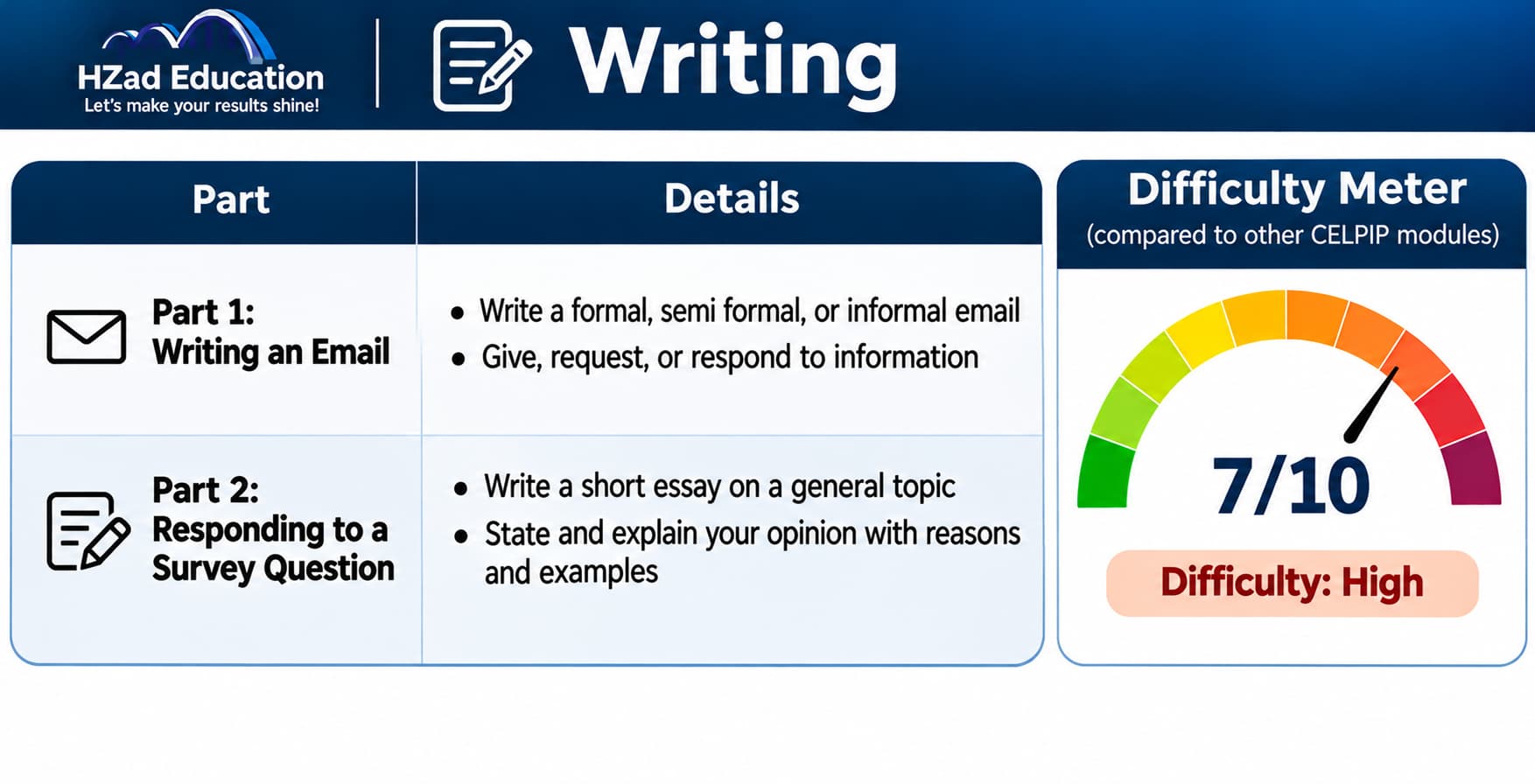
CELPIP Writing contains two tasks:
- Task 1: Writing an Email – 27 minutes
- Task 2: Responding to Survey Questions – 26 minutes
You should generally aim for approximately 150 to 200 words per task, following the instructions presented.
The official CELPIP Writing assessment considers content and coherence, vocabulary, readability, and task fulfillment based on the examiner’s marking scheme.
Step 1: Understand the Structure of Writing Task 1
Time: 30 minutes
Task 1 requires you to write an email about an everyday situation.
You might need to complain, request information, provide suggestions, apologize or explain a problem. This email can be either formal or informal.
The recommended structure is:
Paragraph 1: Opening and purpose (especially for formal emails)
Explain why you’re writing.
Paragraph 2: First bullet point
Paragraph 3: Second bullet
Paragraph 3: Third bullet
Paragraph 5: Closing
Clearly explain what outcome you would appreciate.
Practice question:
You recently joined a gym, but the equipment is frequently unavailable, and the facility is overcrowded.
Write an email to the gym manager explaining the problems, how they affect your experience, and what improvements you recommend.
- Explain when you joined the gym
- What problems are you facing?
- What solutions do you recommend?
Weak opening:
“I am writing because your gym is bad and I don’t like it.”
Improved opening:
“The purpose of my writing is to express my concerns regarding the limited availability of exercise equipment and the overcrowded conditions I have experienced during my recent visits.”
Academic and advanced wordings and direct start!
Step 2: Learn to Elaborate Instead of Listing Ideas
Time: 25 minutes
One of the most useful techniques for CELPIP Writing is:
Point → Explanation → Example → Result
For example:
Point: The gym needs more exercise equipment.
Explanation: Members frequently have to wait for machines during peak hours.
Example: Last Tuesday, I waited nearly 20 minutes to use a treadmill.
Result: Installing additional machines would reduce waiting times and improve customer satisfaction.
Always explain! You need to get into the why/how of things!
Step 3: Practice CELPIP Writing Task 2
Time: 30 minutes
In Task 2, you typically choose between two options and explain why you prefer one.
A useful structure:
Paragraph 1: State your preference clearly.
Paragraph 2: Explain your strongest reason and provide an example.
Paragraph 3: Explain your second reason and provide supporting details.
Paragraph 4: Reinforce your decision and conclude.
Practice question:
Your city has extra funding and is currently deciding where it should invest its money. It has two options:
Option A: Build a new public library
Option B: Build a sports facility
Weak response:
“I think the library is better because people can read books and students can study.”
Improved response:
“I strongly believe that constructing a new public library would be the more beneficial investment, primarily because it would provide residents with greater access to educational resources.”
… in body 1, you will then go on to expand on this further.
The second response does more than state an opinion. It explains the benefit and supports it with a relevant example.
Step 4: Complete Two Timed Writing Tasks
Time: 53 minutes
Now simulate the real Writing section.
Set a timer:
Task 1 – 27 minutes
- 3 minutes to read and brainstorm.
- 19–20 minutes to write.
- 4–5 minutes to proofread.
Task 2 – 26 minutes
- 3 minutes to plan your opinion and two reasons.
- 18–19 minutes to write.
- 4–5 minutes to proofread.
Do not use a grammar checker or AI writing assistant during the timed attempt. You want to evaluate what you can produce independently. Feel free to proofread AFTER your whole attempt.
Step 5: Review Your Writing and Get Feedback
Time: 30 – 45 minutes
Read both responses carefully.
Check:
- Did I answer every instruction?
- Is my tone appropriate for the audience?
- Does each paragraph have a clear purpose?
- Did I elaborate sufficiently?
- Are my examples relevant?
- Did I use a variety of sentence structures?
- Are my connectors natural?
- Did I make grammar, spelling or punctuation mistakes?
- Did I repeat the same vocabulary unnecessarily?
- Did I stay within the expected word range?
- Most importantly, cross-check your work with the CELPIP examiner’s marking scheme!
Submit your responses to HZad Education’s CELPIP AI Tests for additional feedback.
Alternatively, contact HZad Education teachers to arrange professional feedback on your Writing.
Day 2 success target: Complete both CELPIP Writing tasks within the time limits and identify at least five specific improvements to make in your next attempt.
Day 3: All 8 CELPIP Speaking Tasks
Today’s goal: Develop natural responses, improve fluency, manage your time and communicate confidently.
CELPIP candidates repeatedly mention things like being lost with the topics, not being able to finish on time, not coming up with ideas, getting anxious, and more!
Your goal today is to overcome these problems with structured practice.
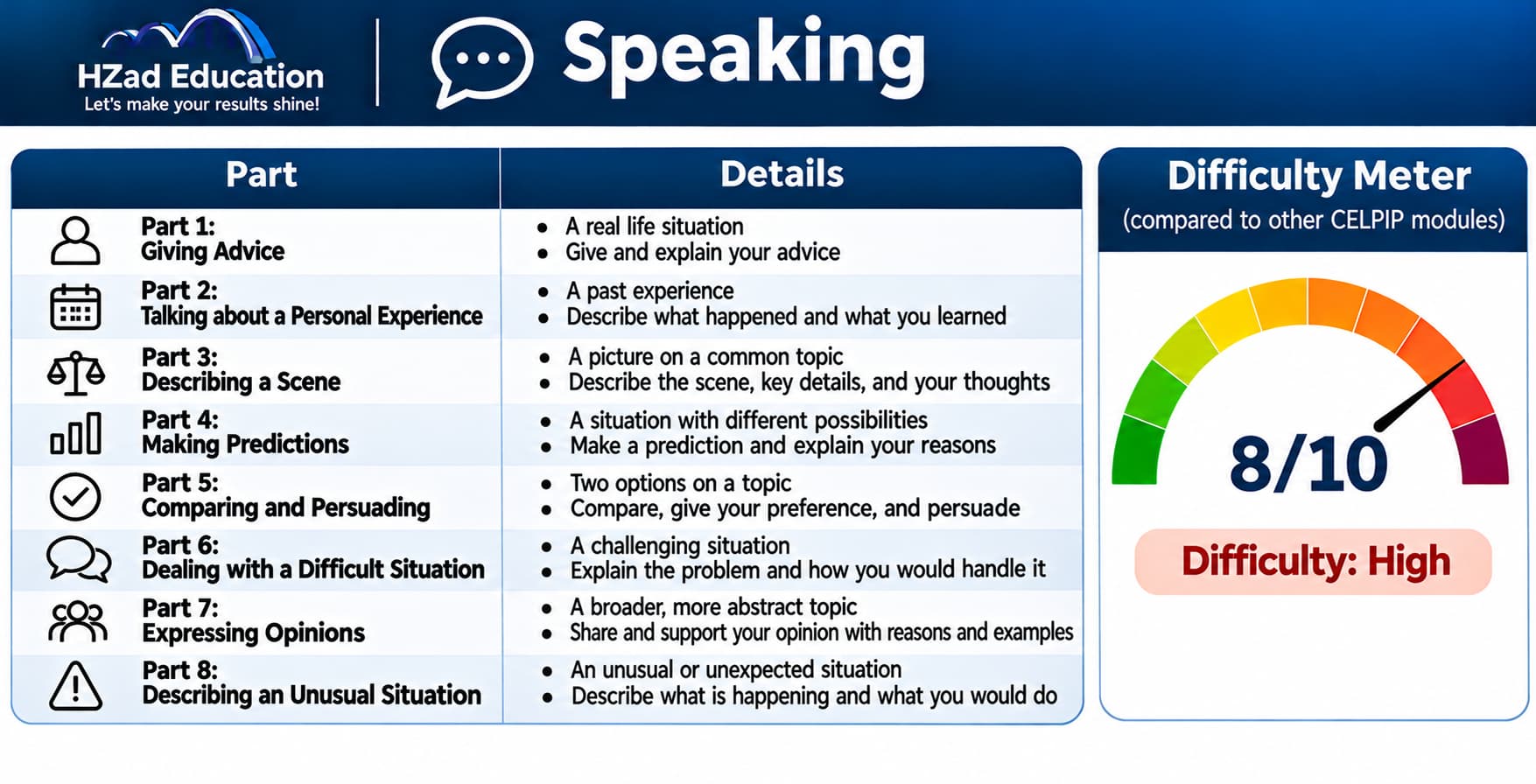
Step 1: Understand the 8 Speaking Tasks
Time: 25 minutes
| CELPIP Task | What You Should Practice |
| Task 1: Giving Advice | Offer practical suggestions with explanations |
| Task 2: Personal Experience | Tell a clear story with relevant details |
| Task 3: Describing a Scene | Describe important people, objects and activities |
| Task 4: Making Predictions | Predict realistic future events based on a picture |
| Task 5: Comparing and Persuading | Compare choices and justify your preference |
| Task 6: Difficult Situation | Explain a problem, make a decision and remain polite |
| Task 7: Expressing Opinions | State a position with reasons and examples |
| Task 8: Unusual Situation | Clearly describe something unfamiliar |
Now, here’s all you need to work on! We will break down every single task in this detailed review. Brace yourselves!
Task 1: Giving Advice
Preparation Time: 30 seconds
Speaking Time: 90 seconds
Question Type: You’re asked to give someone advice about a particular situation.
Example: Your friend would like to learn English. Offer him or her some advice.
Requirements and Tips
- Focus on the tone. If you’re talking to a friend, you want to be informal. Use words like hey, what’s up, how’s it going. If it is formal, adjust your tone accordingly.
- Focus on only two to three quality points instead of 10 quantity points. It’s 90 seconds. That does not mean you need 90 points. Focus on two to three suggestions and explain them well.
- Pace it and pause. You have a lot of time. Take a deep breath between sentences and relax. This will test your patience, your speaking and your pace.
Template
Introduction: Hey, hello, how’s it going? Or how are you doing? If it is formal, adjust accordingly. Now let’s talk about your [situation].
Body:
- Firstly, [first advice with explanation]
- Also, [second advice with explanation]
- Lastly, [third advice with explanation]
Each point should take around 20 to 30 seconds. The body should take the most amount of time.
Conclusion: Let me know your thoughts.
Task 2: Talking About a Personal Experience
Preparation Time: 30 seconds
Speaking Time: 60 seconds
Question Type: Situation-based. You’re usually asked to talk about a past event.
Example: Talk about a time when you dealt with someone with a harsh temper. What did you do, and how did you get the situation under control?
Requirements and Tips
- Use two to four points maximum. Don’t overdo it. You only have a minute. My sweet spot is three points, and I’ll describe them well.
- Use adjectives to describe your experience. Talk about how it made you feel. Did it make you feel terrible, exhausted or frustrated? This helps define your answer and shows your range of vocabulary.
- Use good connectors. Words like accordingly, moreover, similarly and likewise. A lot of people skip that and just say and, and those filler words are going to kill your marks.
- Summarize your experience. Use overall at the end and rephrase everything in one sentence.
Template
Introduction: This is surely a [difficult / interesting / controversial] topic, and I would like to talk about the time when [experience].
Body: Describe your experience using two to four main points. Connect them with words such as:
- Accordingly
- Moreover
- Similarly
- Likewise
Include adjectives that describe your feelings and experiences.
Conclusion: Overall, as we have discussed, [summarize your experience].
Example: Overall, this was a really difficult person, but I think we handled it well.
Task 3: Describing a Scene
Question Type: You’re given a picture and asked to describe what’s happening.
Requirements and Tips
- Find three to four main things first. It’s 60 seconds. You won’t be able to say everything. Find the main things, and if you have extra time, cover the rest.
- Describe feelings and expressions. Talk about what people are doing and how they appear to be feeling.
- Describe the scenery. Is it a park, residential area or industrial area? What is happening around the people?
- Use foreground and background. Foreground is whatever is happening towards the front of the picture. Background is towards the back.
- Use active and passive voice. A lot of you just use active voice, such as I can see this happening. Also say this can be seen or this can be observed. A good mixture gives you a range of sentences.
Template
Introduction: This picture is quite [chaotic / interesting / alarming / vivid].
Body:
Describe three to four main features using location words:
- On the left
- On the right
- Towards the front
- At the back
- In the foreground
- In the background
Use active and passive voices throughout your description.
Conclusion: Those would be the main features of this picture.
Task 4: Making Predictions
Question Type: You’re given the same picture as Task 3, but now you’re asked what you think will happen next.
Requirements and Tips
- Think of the next 15 minutes. What’s going to happen instantaneously? Not tomorrow or the year after. Focus on the next few minutes.
- Use prediction words. Might happen, may possibly happen, will happen, could happen.
- Give reasons behind your guesses. Don’t just say this will happen. Explain why it will happen based on what the person is currently doing.
- Use a range of connectors. On top of that, what’s more, in much the same way. These are longer connectors, showing the examiner your range of expressions.
- Use expressions like most likely and most probably. This increases your vocabulary range.
Template
Introduction: In the next few minutes, I can see that [prediction]. Or I assume this will take place next.
Body:
Make predictions about what you see, using:
- On top of that
- What’s more
- In much the same way
- Most likely
- Most probably
Explain why you think each event will happen.
Conclusion: These are the most likely outcomes based on what I can see.
Task 5: Comparing and Persuading
Preparation: 60 seconds to choose an option, followed by 60 seconds to prepare your response
Speaking Time: 60 seconds
Question Type: You’re presented with two options and you must select one. After that, you’ll see what the other person has decided, and you must convince them why your option is better.
Requirements and Tips
- Compare both sides. This is very, very important. A lot of you miss this, and that’s why you lose marks.
- Don’t just talk about your option. Talk about the other side too. You’re supposed to compare and contrast.
- Use contradictory words. However, nevertheless, nonetheless. These show the examiner you’re truly comparing.
- Acknowledge the other person’s preference. Say I understand that you like this, however, this is better. Just don’t overdo it.
- Start strong and save time. You only have 60 seconds. Mention multiple features in your first sentence.
- Use short connectors. Plus, also, likewise. You’ll be rushing to finish on time, so don’t overdo the connectors.
Template
Introduction: Hey / Hello [person], hope you’re well. I reviewed your option of [option], which comes with [one or two features]. Nevertheless, I prefer [your option] because it comes with [features].
Body:
Compare both options using:
- Nevertheless
- However
- Nonetheless
- Plus
- Also
- Likewise
Remember, you need to talk about the other person’s option as well, not just your own.
Conclusion: What are your thoughts? Or curious to know your thoughts.
Task 6: Dealing With a Difficult Situation
Preparation Time: 60 seconds
Speaking Time: 60 seconds
Question Type: You’re given a situation and usually two options. You have to pick one and explain your decision to someone.
Example: Your teenager has been offered an internship opportunity or a summer program at a university.
Requirements and Tips
- Acknowledge the other person. Don’t just talk about your benefits. Say I understand you want this, and then move to your point.
- Apologize or recommend. Sometimes you made an error or can’t attend someone’s party, so you need to apologize. Other times you need to recommend something. It depends on the question.
- Provide an alternative. What else can the person do if they cannot do what they want?
- Use a slow, sincere tone. This is where you show emotional intelligence. Don’t rush through an apology. Keep it professional, natural and sincere.
Template
Introduction: Hey / Hello [person], let’s talk about [situation], shall we?
Pause for around one second.
Acknowledgement: I fully understand that [acknowledge their preference or situation].
Apology or Recommendation: However, [explain your decision, apologize or recommend something based on the question].
Keep your tone slow and sincere.
Alternative: Let me give you an alternative. Or let me propose this.
Example: If I can’t make it this time, let me offer you something else. Let’s do another birthday party next week when I’m back.
Task 7: Expressing Opinions
Preparation Time: 30 seconds
Speaking Time: 90 seconds
Question Type: A debate type of question where you agree or disagree with an opinion.
Example: Gyms should only cater to one gender per location. Do you agree or disagree?
Requirements and Tips
- Give your opinion first. Make it clear which side you’re supporting.
- Mention two to three supporting points. Explain why you believe in your opinion.
- Use passion. It’s a debate. Don’t talk robotically. Say what you believe and make it sound like you really believe it. Real passion or fake passion, show it.
- Use examples. Real-world examples to back up your claims make your argument much better.
- Talk negatively about the opposing side. Explain the problems with the other option to strengthen your argument.
Template
Introduction: Between [option one] and [option two], [your choice] is an obvious choice due to [economic / health-related / other reasons].
Body:
First point: First of all, [explain your first argument].
Second point: What’s worse is [explain a problem with the opposing side].
Third point: Lastly, let’s not pretend that [explain another problem with the opposing side].
The expressions what’s worse and let’s not pretend that help you show passion, even if you aren’t naturally passionate about the topic.
Conclusion: Let me finish up by saying that [rephrase your opinion].
Task 8: Describing an Unusual Situation
Question Type: You’re given an unusual situation, often involving a picture. You need to describe what you see while following the specific conditions in the question.
Example: You’re at a campsite and see something unusual. You have to record your experience using a voice recorder.
Requirements and Tips
- Pay attention to the conditions. This question is always very different. Sometimes you’re recording a message, sometimes you’re calling a friend. It depends on the situation.
- Use the appropriate tone. Informal or formal, depending on who you’re addressing.
- Describe the picture, but don’t forget the conditions. It’s similar to Task 3, except here you have additional instructions to follow.
- Use active and passive voice. Don’t just use active sentences. Show the examiner your range.
- Use longer location expressions. Instead of simply on the left or on the right, say toward the left, closer to the right or moving on to the center.
- Use different connectors. In much the same way, likewise, furthermore. Show the examiner that you have a range of expressions.
- Make your conclusion condition based. Your ending depends on what the question asks you to do.
Template
Introduction: Hi, I was hoping to [formal purpose]. Or hi, I wanted to [informal purpose].
Body:
Describe the picture and the situation using:
- Toward the left
- Closer to the right
- Moving on to the center
- In much the same way
- Likewise
- Furthermore
Use a mixture of active and passive voice. Make sure you’re following the conditions of the question.
Conclusion: Your conclusion will depend on the situation.
Example for a campsite recording: Well, based on all these factors, I think this is the best campsite I’ve ever seen.
Example for a phone inquiry: I’m going to be looking forward to your phone call.
Day 4: Improve CELPIP Reading Speed and Accuracy
Today’s goal: Learn to identify relevant information quickly, handle difficult questions and avoid common answer traps.
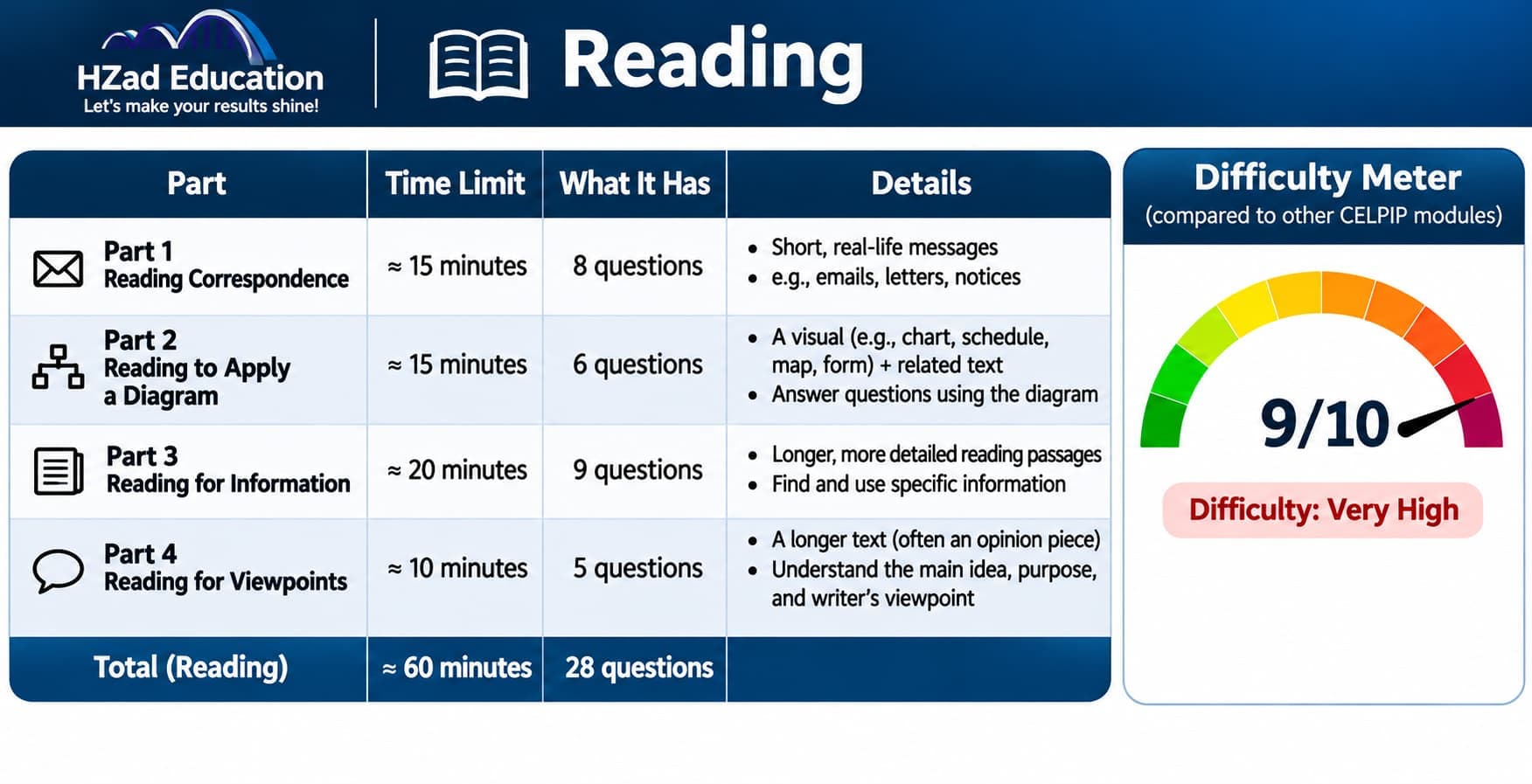
There are 4 main parts of CELPIP Reading:
- Reading Correspondence.
- Reading to Apply a Diagram.
- Reading for Information.
- Reading for Viewpoints.
Here’s what we need to do.
Step 1: Learn Strategic Skimming and Scanning
Time: 30 minutes
Skimming means reading quickly to understand the overall topic and structure.
Scanning means searching for specific information, such as names, times, dates, reasons or details.
Practice this technique:
- Read the question and identify what information it requires.
- Quickly check the passage to understand its structure.
- Locate the paragraph or section containing the relevant information.
- Read that section carefully. Important information in more detail. Rest of it much faster. This is called speed reading.
- Compare the evidence with the answer options. Really dig deep into the questions.
The goal is not to read everything faster. It’s to spend more time on the information that matters.
Step 2: Practice Reading Correspondence
Time: 25 minutes
Trust me on this: You will become a reading expert the moment you can identify text, read it, understand it, and be able to explain to yourself exactly what was written. Here’s how you do it:
Practice exercise:
Find a realistic workplace or community email.
Write a one-sentence summary of the writer’s purpose.
Then identify three important details and two implied meanings.
For example, if someone says:
“Unfortunately, I won’t be able to attend the meeting at the originally scheduled time.”
The writer is indicating unavailability at that time, not necessarily refusing to attend the meeting altogether.
Recognizing distinctions like this can help you eliminate misleading answer choices.
Step 3: Practice Reading to Apply a Diagram
Time: 25 minutes
This section often requires matching someone’s requirements with information presented in a diagram, schedule, advertisement or other visual material.
This is easy!
You just have to look at a picture with very little text instead of a whole passage.
Look at these kinds of tests in HZad Education’s CELPIP AI mock tests and practice extracting the information in the picture in less than 2 minutes. It can easily be done since it is small text.
You are mainly working on getting the overall idea of the picture and specific sections that relate to different themes. Later, when you read the questions, you will know exactly which sub-section they are talking about, and you can then be laser-focused on that alone.
Step 4: Improve Your Accuracy With Paraphrased Answers
Time: 30 minutes
One of the most important CELPIP Reading skills is recognizing paraphrases.
The correct answer may express the same meaning using different vocabulary.
Passage:
“The new parking restrictions have caused considerable frustration among local business owners.”
Possible answer:
“Shopkeepers are dissatisfied with the recently introduced parking rules.”
These sentences communicate similar ideas despite using different words.
Practice exercise:
Let’s tackle this by reading 5 short passages.
For each passage:
- Identify the central message.
- Rewrite that message using different vocabulary.
- Identify phrases that could be misleading if taken out of context.
- Explain why alternative interpretations would be incorrect. Use as many alternatives as possible. You are mainly training your brain here to paraphrase.
This is particularly useful for Reading for Information and Reading for Viewpoints.
Step 5: Practice Reading for Viewpoints
Time: 30 minutes
The final Reading part often requires you to understand different opinions, attitudes and arguments.
For every viewpoint, identify:
- Who supports the idea?
- Who opposes it?
- What reason is given?
- Is the opinion strongly expressed or cautious?
- Does the speaker agree partially or completely?
- What is the main point of disagreement?
This part would always have 2 or more people arguing on something. Finding this bone of contention is the key. Once you understand each side, you would also know how they emotionally feel about it – this is where a lot of the inference questions come from!
Step 6: Complete a Timed Reading Practice Test
Time: Approximately 45–60 minutes plus review
You are now ready! Complete a full Reading practice section under the allotted test conditions – even better, use HZad Education’s CELPIP Reading Test’s exam simulator.
After you are done with the complete test, review every incorrect answer.
- AND I LITERALLY MEAN EACH AND EVERY INCORRECT ANSWER.
Feedback, and especially, self-feedback is so crucial at this point! Most students just brush off the answer sheet and proceed without a care in the world! Don’t do this! You worked hard on this test. If you move on now without even reviewing what was wrong, you are making a major mistake!
Stay here. Review. Understand what went wrong. Ask yourself how you could avoid it in the future.
Once you fully understand the above, then move on.
Day 4 success target: Improve your ability to find supporting evidence, distinguish similar answers, and complete Reading questions within the available time.
Day 5: Master CELPIP Listening Strategies and Common Traps
Today’s goal: Improve listening comprehension, note-taking, information retention, and multiple-choice accuracy.
CELPIP Listening tests your ability to understand conversations, discussions, announcements, news reports and opinions.
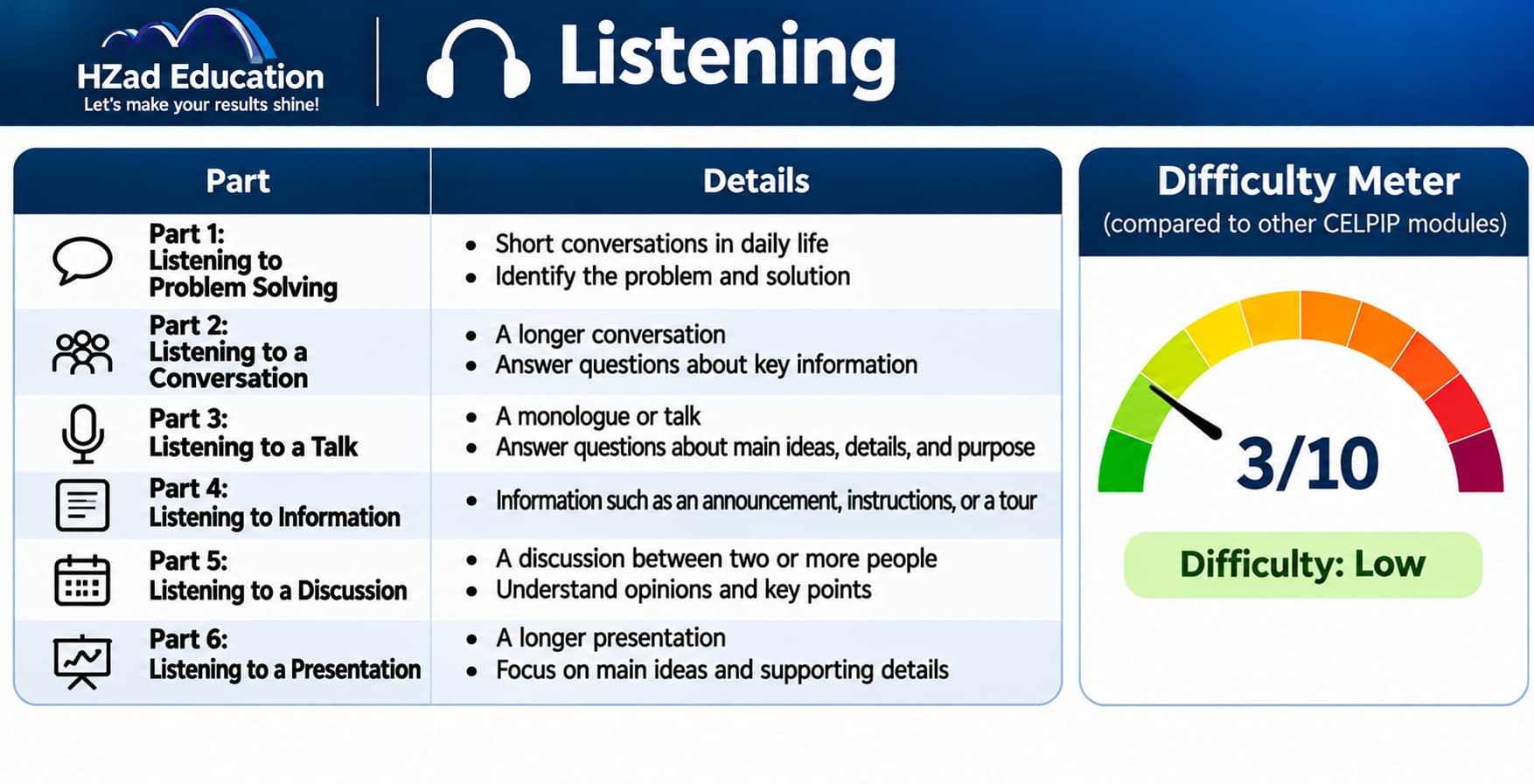
The six main parts are:
- Listening to Problem Solving.
- Listening to a Daily Life Conversation.
- Listening for Information.
- Listening to a News Item.
- Listening to a Discussion.
- Listening to Viewpoints.
Step 1: Practice Active Listening
Time: 30 minutes
Choose an English conversation, interview, or news segment lasting approximately three to five minutes. It will be to your advantage to have content in Canadian contexts.
Listen once without subtitles.
- While listening, make sure you are simply focused on understanding things naturally without taking any notes.
Replay the recording afterward to check your understanding.
The goal should be for you to be able to pretty much explain everything you heard in your own words! It’s like giving someone a summary of a conversation you heard.
Step 2: Develop an Effective Note-Taking System
Time: 30 minutes
A common mistake is attempting to write down every sentence.
Instead, record useful keywords.
For example:
“The appointment was originally scheduled for Monday morning, but the doctor had an emergency, so it was moved to Thursday afternoon.”
Your notes could be:
Appt: Mon AM → Thurs PM; reason: Dr emergency
Useful symbols include:
- ↑ = increase.
- ↓ = decrease.
- → = changed to / leads to.
- + = advantage.
- − = disadvantage.
- ? = uncertainty.
- vs = comparison.
Practice this with five short audio clips.
The objective is to capture ideas, decisions, relationships, and changes without falling behind.
Abbreivations, notes, short forms, and fast writing are your friends.
Step 3: Learn to Recognize Listening Traps
Time: 30 minutes
CELPIP Listening answer choices may contain incorrect details, partially correct interpretations or information that doesn’t reflect the speaker’s final intention.
Consider this example:
Audio:
“I initially wanted to take the train, but since the service has been delayed, I think I’ll drive instead.”
Question: How will the speaker travel?
Correct answer: By car.
The speaker mentioned the train, but the final decision was to drive.
Pay attention to phrases such as:
“Initially, I thought…”
“However, I’ve decided…”
“Actually, the plan has changed…”
“On second thought…”
“Instead of…”
These often signal an important correction or change of decision.
Step 4: Improve Your Understanding of Tone
Time: 30 minutes
Understanding the speakers’ tone and meaning behind these tones is paramount!
Compare:
“That’s absolutely wonderful.”
This might express genuine excitement.
But depending on the speaker’s tone and context, the same words could communicate sarcasm.
Practice identifying emotions such as:
- Excitement.
- Frustration.
- Uncertainty.
- Disappointment.
- Agreement.
- Skepticism.
- Concern.
- Relief.
Yes, it can even be sarcasm! So what’s said vs what it actually implies could be complete different. Watch out for that!
Step 5: Practice Multitasking and Memory Retention
Time: 25 minutes
Pick up more listening tasks and this time, really focus hard on the multitasking aspect. A successful CELPIP candidate will master multitasking in two areas. This is the formula:
Multitasking = note-taking + memory retention.
It’s simple: You cannot write everything down that you hear, and you cannot memorize everything either. So you need a COMBINATION of both. This has to be done while listening. So a lot of moving parts are involved for sure! It is overwhelming, but the right practice will get you there!
Step 6: Complete a Full Listening Mock Test
Time: Approximately 45–60 minutes plus review
Complete a Listening test in exam-style conditions.
Do not pause or replay the audio during your first attempt.
Afterward, analyze each mistake.
Identify whether the problem was:
- Missing a detail.
- Forgetting information.
- Misunderstanding the question.
- Failing to recognize a change of plan.
- Confusing speakers’ opinions.
- Misinterpreting tone.
- Choosing an option because it repeated a word from the audio.
Then replay the relevant audio during your review to locate the evidence.
Day 5 success target: Improve your ability to retain key information, understand opinions, and eliminate misleading answer choices PLUS becoming an expert in multitasking.
Don’t forget one key thing here. A lot of the questions are going to be inference-based. If you just try to remember things word-to-word without understanding concepts, you will be doomed!
Day 6: CELPIP Feedback Day — Find and Fix Your Biggest Mistakes
Today’s goal: Turn the mistakes you’ve made during the week into specific improvements.
Today should be different.
Rather than simply completing more questions, focus on understanding what you’re doing incorrectly.
Step 1: Create Your CELPIP Mistake Tracker
Time: 30 minutes
Use a notebook or spreadsheet with these columns:
| Skill | Mistake | Why It Happened | Correction |
| Writing | Weak explanations | I listed ideas without developing them | Add a reason and specific example |
| Speaking | Long pauses | I had no response plan | Use a flexible structure |
| Reading | Wrong inference | I guessed without evidence | Identify the supporting sentence |
| Listening | Missed a changed decision | I focused on the first option mentioned | Listen for corrections and final decisions |
Focus on recurring patterns rather than treating every mistake as an isolated problem.
Step 2: Revisit Your Writing Responses
Time: 40 minutes
Take the two responses you wrote on Day 2. You can review them yourself, use an AI tool like Grammarly (though it won’t point out every single mistake), or use the help of one of HZad’s CELPIP teachers.
Review them using the official assessment dimensions:
Content and coherence: Are your ideas relevant, logically developed and easy to follow?
Vocabulary: Are your words accurate, appropriate and varied?
Readability: Is your writing clear, grammatically controlled and well organized?
Task fulfillment: Have you answered all requirements and used the right tone?
Rewrite your weakest response.
Compare the original and revised versions side by side. See what you improved on!
Step 3: Review Your Speaking Recordings
Time: 40 minutes
Listen to the eight Speaking responses you recorded on Day 3. This is what most students avoid! They don’t wanna listen to themselves and embarrass themselves. BUT this very embarrassment will push you to improve yourself dramatically!
Pay attention to:
Content and coherence: Do you develop your ideas clearly?
Vocabulary: Do you use appropriate and precise expressions?
Listenability: Is your pronunciation understandable? Do your pauses and rhythm support communication?
Task fulfillment: Do you actually answer the question completely and appropriately?
Select your three weakest recordings.
Write down the corrections and then record new attempts.
Compare the recordings.
Step 4: Get Professional or AI Feedback
Time: 30–45 minutes
Self-assessment is valuable, but it can be difficult to identify every weakness in your own Speaking and Writing.
This is where external feedback becomes particularly useful.
You have two options.
Option 1: Use HZad Education CELPIP AI Tests
Practice under exam-style conditions and review the feedback on your performance.
Access HZad Education CELPIP AI Tests
Use the results to identify grammar problems, weak explanations, vocabulary limitations and task-specific mistakes.
Option 2: Contact HZad Education Teachers
If you prefer feedback from an experienced CELPIP instructor, contact HZad Education to arrange a professional assessment of your Speaking recordings or Writing submissions.
A teacher can explain why a response is weak, how to develop stronger ideas, and which mistakes deserve the most attention.
Explore HZad Education’s CELPIP Preparation and Teacher Support
Step 5: Complete Targeted Practice
Time: 45 minutes
Spend the remainder of your study session on your weakest areas.
For example:
- If Writing is your weakest skill, complete another email or survey response.
- If Speaking is your weakest skill, record three more responses.
- If Reading is your weakest skill, practice questions involving inference and paraphrasing.
- If Listening is your weakest skill, practice discussions involving different viewpoints.
Day 6 success target: Identify your five biggest recurring mistakes, understand how to fix them, and produce improved responses.
Day 7: Final CELPIP Mock Test, Feedback and Exam Preparation
So this is it. Your final day. Let’s make the most of it!
Today’s goal: Apply everything you’ve learned in realistic exam conditions and enter the test with a clear strategy.
You’ve spent 5 days developing your skills and one day reviewing your weaknesses.
Today is about checking your progress and preparing for the actual exam.
Step 1: Complete a Full CELPIP Practice Exam
Time: Approximately 3 hours
If your schedule allows, complete a full CELPIP-General mock test covering all four components.
Use exam-style timing and conditions. Always recommended to practice with an exam simulator like the one HZad Education provides.
Try to recreate the testing environment:
- Work in a loud room. Yes, I said loud. There are other candidates in the actual exam and their noises will distract you.
- Use a computer.
- Wear a headset for audio practice.
- Record your Speaking responses.
- Do not use dictionaries or translation software.
- Do not pause the test unnecessarily.
- Avoid outside assistance.
Start a CELPIP Practice Test With HZad Education
If your real exam is tomorrow and you’ve already completed a full mock recently, consider a shorter, focused review instead. Avoid exhausting yourself immediately before your test.
Step 2: Compare Your Performance With Earlier Attempts
Time: 30 minutes
Compare your Day 7 performance with the exercises you completed earlier in the week.
Focus on measurable improvements:
Writing
Are your answers better organized? Have you reduced grammar mistakes? Are your explanations more developed? Are you finishing on time? Don’t ignore task response too!
Speaking
Are you more confident? Can you organize ideas faster? Are you avoiding fillers? Have you reduced unnecessary pauses? Are you fluent? Don’t ignore task response too!
Reading
Are you finding supporting evidence more quickly? Are you making fewer errors involving paraphrased answers? Can you explain concepts to yourself better?
Listening
Are you retaining important details? Can you identify different speakers’ viewpoints more accurately? Are you multitasking effectively?
Write down your improvements and remaining weaknesses.
Step 3: Review the Feedback
Time: 30 minutes
Review your practice results and identify the highest-impact corrections you can still make.
You may wish to submit your final Writing and Speaking responses to the HZad Education AI assessment platform or seek feedback from a CELPIP teacher.
Do not try to memorize dozens of unfamiliar advanced words at the last minute.
Instead, reinforce the sentence structures, vocabulary and strategies that you’re already using correctly.
Step 4: Create Your Personal Exam-Day Strategy
Time: 20 minutes
Prepare a brief checklist for each section.
CELPIP Writing
- Read every instruction carefully.
- Brainstorm before typing.
- Give relevant reasons and examples.
- Maintain an appropriate tone.
- Leave time to proofread.
CELPIP Speaking
- Start with a clear response.
- Organize ideas quickly.
- Develop relevant points.
- Use natural transitions.
- Monitor the time and finish appropriately.
CELPIP Reading
- Understand what each question asks.
- Locate supporting evidence.
- Watch for paraphrased answers.
- Eliminate incorrect choices.
- Avoid spending excessive time on one question.
CELPIP Listening
- Focus on the main message and key details.
- Use short notes where permitted.
- Track changes in plans and decisions.
- Listen for tone and attitude.
- Read and compare all available answer choices carefully.
Step 5: Prepare for Test Day
Check your examination confirmation and the test centre’s current requirements.
Confirm your appointment time, location and accepted identification.
Prepare everything you need in advance.
Get sufficient sleep, arrive according to the test centre’s instructions, and avoid unnecessary last-minute studying.
Also, on the exam day, remember to breath and relax! Anxiousness can be a big enemy. Don’t let it win!
Day 7 success target: Finish your preparation with a stronger understanding of your abilities, a practical strategy for each section, and greater confidence in your exam readiness.
Want Faster Improvement? Join HZad Education’s 7-Day CELPIP Sprint
While this free study plan is designed for independent learners, some students prefer structured instruction and expert guidance.
HZad Education also runs an intensive 7-Day CELPIP Sprint for students who want to make focused improvements within one week.
Our accelerated approach concentrates on the skills that matter most:
- Practical vocabulary and sentence improvement.
- Structured CELPIP Writing practice.
- CELPIP Speaking strategies and response development.
- Reading shortcuts and accuracy techniques.
- Listening comprehension and common answer traps.
- Practice assignments and targeted feedback.
- Identifying weaknesses and correcting mistakes.
The biggest advantage of structured preparation is having guidance on what to improve instead of guessing.
Explore HZad Education’s CELPIP Training and Live-Class Options
Whether you prefer self-study or guided training, the most important thing is to practice consistently and use feedback to improve.
Bonus: Save 5% on Your CELPIP Exam Booking With HZad Education
Did you know you may also be able to save money when registering for your official CELPIP exam?
HZad Education offers a 5% discounted CELPIP exam voucher, helping eligible test takers reduce the cost of their registration.
GET YOUR 5% CELPIP EXAM DISCOUNT VOUCHER HERE
Here’s how it works:
- Visit HZad Education’s CELPIP voucher page.
- Purchase the discounted exam voucher.
- Receive your individual CELPIP voucher code.
- Use that code at the official CELPIP booking checkout, following the voucher instructions.
The voucher offer also advertises a seven-day CELPIP preparation package, subject to the terms shown on the voucher page.
Save on your exam booking and invest that saving into preparing more effectively.
Frequently Asked Questions About Preparing for CELPIP in 7 Days
1. Can I really prepare for the CELPIP exam in 7 days?
Yes, seven days can be enough for focused exam preparation, particularly if you already have a reasonable level of English and mainly need to improve your test-taking strategies.
However, seven days cannot guarantee a particular score. Your results will depend on your starting level, daily practice, weaknesses and target CELPIP score.
2. How many hours should I study for CELPIP every day?
We recommend approximately 3–4 hours of focused study each day for an intensive seven-day preparation plan.
If you have limited time, concentrate on your weakest skills and use timed practice rather than spending hours passively watching videos.
3. How can I improve my CELPIP score from 7 to 9?
Start by identifying why you’re currently losing marks.
For Speaking and Writing, common priorities include idea development, task fulfillment, vocabulary precision, grammatical accuracy and overall clarity.
For Reading and Listening, work on comprehension, inference, paraphrasing, timing and identifying misleading answer choices.
Use practice tests and feedback to determine which skills require the most attention.
4. What is the best free CELPIP crash course?
HZad Education offers a free seven-part CELPIP crash course playlist on YouTube.
Watch All 7 CELPIP Crash Course Videos for FREE
Combine the videos with the daily exercises in this guide to make your preparation more productive.
5. Can I practice CELPIP Speaking and Writing at home?
Absolutely.
You can record your Speaking answers, complete timed Writing tasks, review your mistakes and compare your responses with strong sample answers.
For additional evaluation, use HZad Education CELPIP AI Tests or contact our teachers for professional feedback.
6. Should I memorize CELPIP Writing and Speaking templates?
It is better to learn flexible response structures rather than memorize entire answers.
A useful template helps you organize your ideas, but an overly memorized response may sound unnatural or fail to address the actual question.
Practice adapting your structure to different topics.
7. Which CELPIP skill should I focus on the most?
That depends on your current performance and the scores you need.
If you’re comfortable with Reading and Listening but struggle with Speaking, allocate additional time to recorded responses and feedback.
If you’re frequently running out of time in Reading, focus on evidence-finding, question analysis and timed practice.
The best study plan is one that responds to your actual weaknesses.
Your CELPIP Preparation Resources
FREE 7-Part CELPIP Crash Course:
Watch the Complete HZad Education YouTube Playlist
CELPIP AI Mock Tests and Feedback:
Start Practicing With HZad Education
7-Day CELPIP Sprint and Teacher Support:
Explore HZad Education CELPIP Training
5% CELPIP Exam Booking Discount:
Get Your CELPIP Discount Voucher
Start today. Practice with purpose. Review every mistake. And make the most of your seven days with HZad Education.