
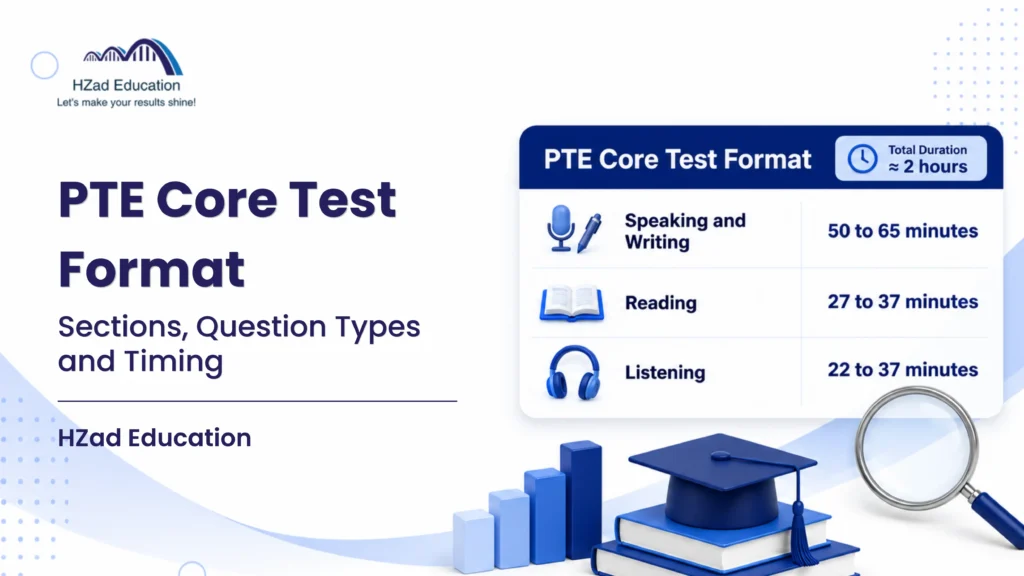
The PTE Core test format contains 19 question types across three sections, each with an allocated time range, to measure speaking, writing, reading, and listening skills. Speaking and Writing include tasks such as read aloud, repeat sentence, describe image, respond to a situation, summarize written text, and write email. Reading focuses on fill-in-the-blanks, multiple-choice questions, and paragraph ordering, while Listening uses audio-based tasks such as summarizing spoken text, selecting missing words, highlighting incorrect words, and writing from dictation.
Together, these sections take about two hours, with task numbers and timing varying by question type. Understanding this structure helps candidates interpret the scoring system, plan PTE Core preparation, and distinguish PTE Core from PTE Academic. It also provides context for using PTE Core results as English proficiency evidence for eligible Canadian immigration pathways, including Canada PR and other migration purposes.
What Is the PTE Core Test Format and Structure?
The PTE Core is a two-hour, fully computer-based English proficiency test with three sections and 19 question types. Test takers complete Speaking and Writing, Reading, and Listening in a fixed order. Speaking and Writing take about 50 to 65 minutes, Reading takes 27 to 37 minutes, and Listening takes 22 to 37 minutes. The test assesses speaking, writing, reading, and listening through single-skill and integrated-skill tasks that measure practical English communication in everyday situations.
What Skills Does the PTE Core Test Assess?
PTE Core assesses 4 English skills, including speaking, writing, reading, and listening. Speaking measures the ability to communicate information clearly through spoken responses, while writing measures the ability to express ideas accurately in written English. Reading assesses the ability to understand written information, while listening measures comprehension of spoken English. These skills reflect communication abilities used in daily and workplace contexts and are measured through task types involving spoken responses, written summaries, reading activities, audio recordings, and dictation.
How Is the PTE Core Test Structured?
The PTE Core test is structured into 3 sections completed in a fixed order, starting with Speaking and Writing, followed by Reading and Listening. It is fully computer-based, takes about two hours to complete, and assesses speaking, writing, reading, and listening through 19 question types. Some tasks are integrated, meaning one question can contribute to assessing more than one communication skill.
| PTE Core Section | Approximate Duration | Question Types | Main Skills Assessed |
| Speaking and Writing | 50–65 minutes | 7 | Speaking and Writing |
| Reading | 27–37 minutes | 5 | Reading, with some integrated Writing |
| Listening | 22–37 minutes | 7 | Listening, with some integrated Writing and Reading |
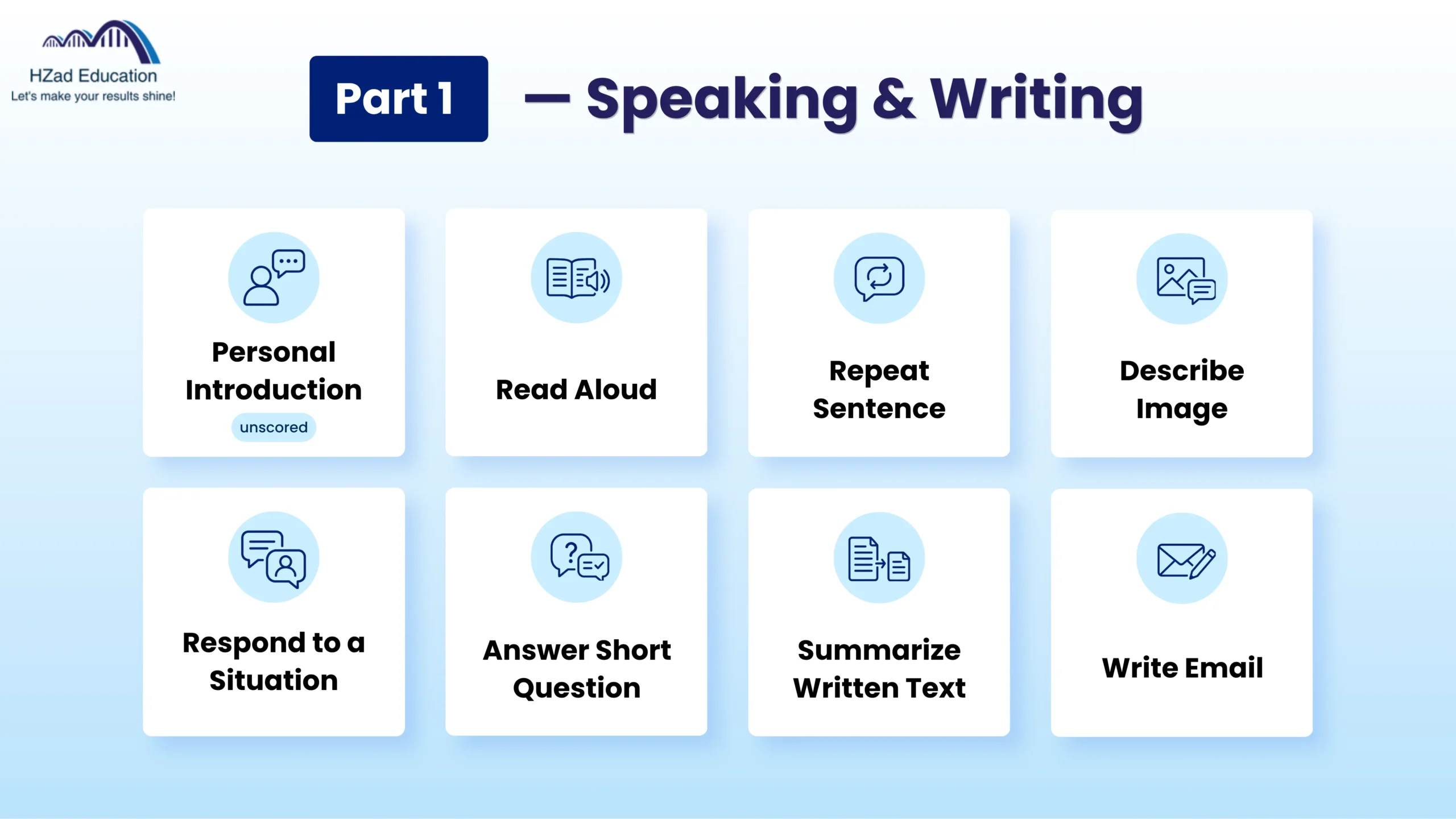
Part 1 — Speaking & Writing
Part 1 is the longest section of the PTE Core test, taking about 50 minutes to measure speaking and writing skills through practical tasks including a personal introduction, read aloud, repeat a sentence, describe an image, respond to a situation, answer a short question, summarise a written text, and write an email. These task types assess how effectively test takers communicate through spoken and written English in practical contexts.
Personal Introduction
The unscored personal introduction takes place before the scored questions to help candidates familiarize themselves with the PTE Core recording system. Test takers provide a short recorded introduction about themselves. Pearson states this response is used strictly for technical familiarisation and does not contribute to the overall PTE Core test score.
Read Aloud
Read Aloud consists of 6 to 7 items requiring test takers to read a written passage of up to 60 words aloud into the microphone. Candidates receive 30 to 40 seconds to review the text before recording begins once. This task assesses both speaking and reading, evaluating the ability to reproduce written information clearly, accurately, and fluently.
Repeat Sentence
In the repeat sentence task, test takers complete 10 to 12 items by listening to a recorded sentence and repeating it as accurately as possible. Each recording lasts 3 to 9 seconds, plays only once, and requires an immediate spoken response. The task assesses listening and speaking skills, with a focus on reproducing the correct word sequence while maintaining natural spoken delivery and rhythm.
Describe Image
For Describe Image, candidates complete 3 to 4 items by examining a visual graphic and giving a spoken description. They have 25 seconds to study the material before receiving up to 40 seconds to record their response. This question type measures speaking proficiency by focusing on how well candidates identify and communicate the main information, supporting details, and relationships presented in charts or diagrams.
Respond to a Situation
In the Respond to a Situation task, test takers review a prompt that presents an everyday scenario through text and audio, then explain what they would say in that situation. After the audio plays automatically, candidates receive 20 seconds to prepare and 40 seconds to give their spoken response. A short tone indicates that the microphone is active and signals when they should begin speaking.
Answer Short Question
Across 5 to 6 answer short question items, test takers listen to brief audio prompts lasting 3 to 9 seconds, which cannot be replayed, and have up to 10 seconds to respond with one or a few words. The format measures listening and speaking skills by requiring concise, accurate, and directly relevant answers rather than extended explanations or conversational filler.
Summarize Written Text
In the Summarize Written Text task, candidates complete 1 to 2 items by reading a passage of up to 200 words and writing a 25 to 50 word summary. With 10 minutes per task, test takers must combine the main ideas concisely. This integrated task assesses reading and writing skills, including comprehension, organization, grammar, vocabulary, and strict adherence to word limits.
Write Email
Candidates complete 2 to 3 write email items, each requiring them to read a prompt of up to 100 words and compose an 80 to 120 word email within nine minutes. The response should address the stated purpose, recipient, and required details. This question type measures writing proficiency through content, organisation, grammar, vocabulary, spelling, and appropriate email formatting.
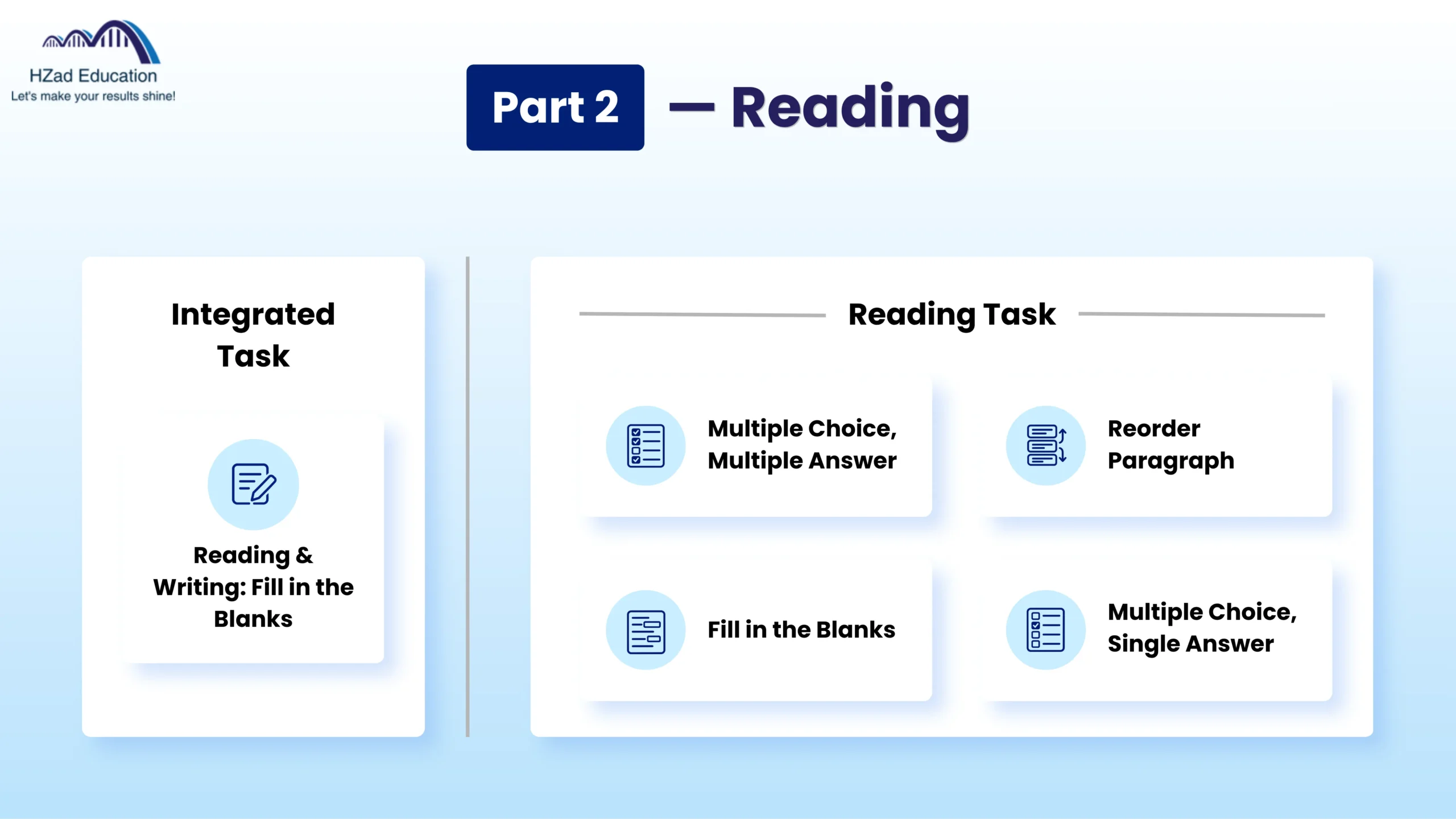
Part 2 — Reading
Part 2 is the reading section, taking 27 to 37 minutes and covering five question types including reading and writing fill in the blanks, multiple choice multiple answer, reorder paragraph, fill in the blanks, and multiple choice, single answer. These tasks measure how well test takers understand, interpret, and organise written English.
Reading & Writing: Fill in the Blanks
Reading and writing fill in the blanks consists of 5 to 6 items where test takers complete passages by selecting missing words from drop-down menus. Each blank provides multiple options that test vocabulary, grammar, and word collocations. This integrated task measures both reading comprehension and writing proficiency and carries substantial scoring weight in the PTE Core test.
Multiple Choice, Multiple Answer
In multiple-choice, multiple-answer, test takers complete 1 to 2 items by reading a passage and selecting more than one correct response. Each option must be evaluated against information in the text. The task uses partial credit with negative marking for incorrect selections, which rewards accurate choices and discourages random guessing.
Reorder Paragraph
In the reorder paragraph task, test takers see several text boxes presented in a random sequence and must arrange them into the correct order across 2 to 3 items. Candidates use logical flow, topic development, transition words, and sentence references to reconstruct the paragraph. Partial credit awards 1 point for each correctly ordered adjacent pair, and the task contributes only to the reading score.
Fill in the Blanks
Fill in the blanks includes 4–5 items where test takers drag words from a word bank into gaps within a passage. More words are provided than are needed, so some options act as distractors. Each correctly completed blank earns 1 point, while incorrect answers receive no credit. This Reading-only task measures the ability to use context, vocabulary, grammar, and sentence meaning to select the appropriate missing words.
Multiple Choice, Single Answer
Multiple choice, single answer includes 1–2 items where test takers read a passage and select one correct response from the available options. The task uses correct-or-incorrect scoring, with 1 point awarded for a correct answer and 0 for an incorrect or unanswered response. It contributes only to the Reading score and measures the ability to identify specific information, interpret meaning, and understand the main purpose of a written text.
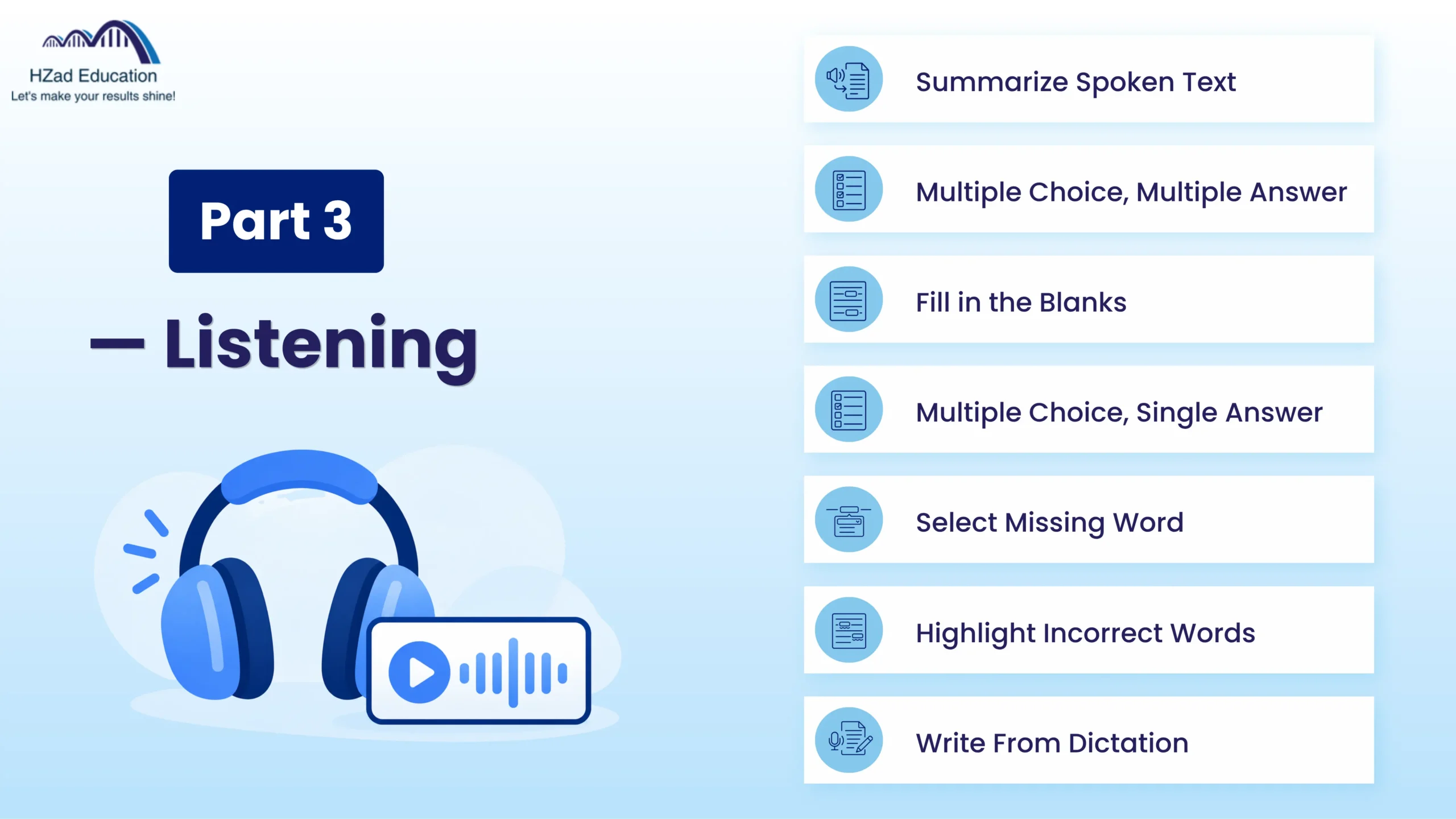
Part 3 — Listening
Part 3 is the listening section, taking 22 to 37 minutes and covering seven question types, including summarise spoken text, multiple choice, multiple answer, fill in the blanks, multiple choice, single answer, select missing word, highlight incorrect words, and write from dictation. Depending on the task, PTE uses either correct-or-incorrect or partial-credit scoring. Some integrated tasks contribute to Listening plus Reading or Writing.
Summarize Spoken Text
Summarize spoken Text includes 1 to 2 items where test takers listen to a 45 to 75 second recording, extract the main information, and write a 20 to 30 word summary within eight minutes. The task uses partial-credit scoring and measures both listening and writing. Responses are assessed for content, form, grammar, vocabulary, and spelling, requiring accurate comprehension and concise written communication.
Multiple Choice, Multiple Answer
Candidates complete multiple-choice, multiple-answer questions by listening to a recording and selecting all responses that correctly reflect its meaning, content, or purpose. The PTE Core test includes 1–2 items of this type. More than one response may be correct, so candidates need to compare each option carefully with what they hear. This task contributes only to the Listening score.
Fill in the Blanks
While following an on-screen transcript, candidates complete fill in the blanks by listening for words removed from the text. PTE Core includes 2 to 3 items, and candidates type the missing words into the appropriate gaps. The task measures detailed listening, vocabulary recognition, and the ability to accurately reproduce spoken information in written form.
Multiple Choice, Single Answer
After hearing a recording, test takers complete multiple-choice, single-answer questions by selecting the one option that correctly answers the question. PTE Core includes 1 to 2 items of this type. Candidates may need to identify the main idea, specific information, speaker’s purpose, or meaning conveyed in the recording, making accurate listening comprehension central to the task.
Select Missing Word
In select missing word, test takers listen to a 20–70 second recording and choose the word or phrase that best completes the ending. For example, if the recording ends with “The meeting was moved to ___,” candidates select the most logical option based on the context. PTE Core includes 1–2 items, and the task contributes only to the Listening score.
Highlight Incorrect Words
While listening to a recording, candidates complete highlight incorrect words by comparing the audio with a written transcript and selecting words that differ from what is spoken. PTE Core includes 1–2 items of this type. The task measures detailed listening and the ability to compare spoken and written information accurately. It contributes to both the Listening and Reading scores.
Write From Dictation
In write from dictation, candidates listen to a short sentence and type it into the response box as accurately as possible. PTE Core includes 3 to 4 items of this type, with each recording played only once. The task measures listening and writing by requiring candidates to understand, remember, and reproduce spoken language with accurate wording and spelling.
How Long Is the PTE Core Test Duration?
The PTE Core test takes around 2 hours to complete in one computer-based session. It has three parts completed in order, starting with Speaking and Writing, followed by Reading and Listening. Pearson lists approximate section times of 50 to 65 minutes for Speaking and Writing, 27 to 37 minutes for Reading, and 22 to 37 minutes for Listening.
How Much Time Is Allocated to Each PTE Core Section?
PTE Core allocates approximately 50 to 65 minutes to Speaking and Writing, 27 to 37 minutes to Reading, and 22 to 37 minutes to Listening. These section time ranges reflect the different question types and tasks candidates complete during the test.
- Speaking and Writing section duration
The Speaking and Writing section takes approximately 50 to 65 minutes. During this time, candidates complete spoken and written tasks such as read aloud, repeat a sentence, describe an image, respond to a situation, summarise written text, and write an email.
- Reading section duration
The Reading section is about 27 to 37 minutes long. Test takers use this time to complete passages with missing words, answer multiple-choice questions, and arrange text segments into a logical order.
- Listening section duration
The Listening section runs for approximately 22 to 37 minutes, with candidates completing audio-based tasks involving answer selection, written responses, transcript comparison, and dictation. The section measures how accurately test takers understand spoken information, identify key details, and convert what they hear into appropriate responses.
How Does Timing Work During Each PTE Core Task?
Timing for each PTE Core task can include preparation time to review the prompt, response time to provide an answer, and task completion time that determines how long candidates have to finish the required activity. These timing limits vary by question type and help candidates manage each response within the available test time.
- Preparation time
Preparation time gives candidates a set period to prepare their response before speaking or writing in certain PTE Core tasks. It allows them to review the prompt, identify what is required, and plan their response. The amount varies by task. For example, Read Aloud provides 30–40 seconds to prepare, Describe Image provides 25 seconds, and Respond to a Situation provides 20 seconds.
- Response time
Candidates complete different actions within a set response time, which may require them to speak, type, select an option, or enter missing information. The time limit varies according to the response requirements of each question type. For instance, describe image and respond to a situation allow up to 40 seconds for speaking, while answer short question allows up to 10 seconds.
- Task completion time
Task completion time is the total time available for a question when Pearson sets a specific limit. Some tasks have a fixed completion period, such as Summarise Spoken Text, which allows 8 minutes, while others show “not applicable” because candidates work within the overall section time rather than a separate item timer.
How Many Tasks Are Included in the PTE Core Test?
The PTE Core test includes 19 different question types across three sections: 7 in Speaking & Writing, 5 in Reading, and 7 in Listening. These task types assess speaking, writing, reading, and listening through both single-skill and integrated-skill questions. The Personal Introduction is separate and unscored, so it is not included in the 19 scored question types.
The 19 question types do not mean candidates answer only 19 questions. Several task types appear multiple times during the test, such as Read Aloud, Repeat Sentence, Fill in the Blanks, and Write from Dictation. The exact number of individual questions can therefore be higher, while the overall PTE Core format remains based on these 19 task types.
How Are PTE Core Questions Distributed Across Sections?
PTE Core questions are distributed across three sections with 19 scored question types in total. Speaking & Writing has 7 question types, Reading has 5, and Listening has 7. The Personal Introduction appears before the scored Speaking & Writing tasks but is only for familiarisation and does not contribute to the score.
Each section uses different task formats to assess the four language skills. Speaking & Writing includes spoken responses and written tasks, Reading focuses on understanding and organising written text, and Listening uses audio-based questions.
| Part 1 Speaking and Writing | ||
| Task | No. of Tasks | Skills / Purpose |
| Personal Introduction | 1 | Unscored practice task used to introduce yourself |
| Read Aloud | 5–6 | Reading and speaking |
| Repeat Sentence | 10–12 | Listening and speaking |
| Describe Image | 3–4 | Speaking |
| Respond to a Situation | 2–3 | Practical speaking |
| Answer Short Question | 5–6 | Listening and speaking |
| Summarise Written Text | 1–2 | Reading and writing |
| Write Email | 2–3 | Practical writing |
| Part 2 Reading | ||
| Task | No. of Tasks | Skills / Purpose |
| Reading and Writing Fill in the Blanks | 5–6 | Reading and writing |
| Multiple Choice, Multiple Answers | 1–2 | Reading comprehension |
| Reorder Paragraph | 2–3 | Reading and text organisation |
| Fill in the Blanks | 4–5 | Reading and vocabulary |
| Multiple Choice, Single Answer | 1–2 | Reading comprehension |
| Part 3 Listening | ||
| Task | No. of Tasks | Skills / Purpose |
| Summarize Spoken Text | 1–2 | Listening and writing |
| Multiple Choice, Multiple Answers | 1–2 | Listening comprehension |
| Fill in the Blanks | 2–3 | Listening and writing |
| Multiple Choice, Single Answer | 1–2 | Listening comprehension |
| Select Missing Word | 1–2 | Listening and contextual understanding |
| Highlight Incorrect Words | 1–2 | Listening and reading |
| Write From Dictation | 3–4 | Listening and writing |
How Does PTE Core Format Differ from PTE Academic?
PTE Core is designed for Canadian immigration purposes, whereas PTE Academic is mainly used for university study, professional registration, and some migration pathways. PTE Core focuses on everyday communication in work and daily-life situations, while PTE Academic focuses on English used in academic and university settings.
| Feature / Aspect | PTE Core | PTE Academic |
| Test Purpose | Used for Canadian permanent residency and citizenship applications. | Used mainly for university study, professional registration, and some migration pathways. |
| Communication Context | Tests everyday English used in work, community, and daily-life situations. | Tests English used in academic and university settings. |
| Task Differences | Includes tasks such as Write Email and Respond to a Situation. | Includes tasks such as Write Essay and Retell Lecture. |
| Target Users | Intended mainly for people using English for Canadian immigration purposes. | Intended mainly for students and applicants needing academic English assessment. |
What’s Next After Understanding the PTE Core Format?
After understanding the PTE Core format, candidates should learn how the scoring system evaluates their responses, prepare for each task through targeted practice, and understand how PTE Core scores are used for Canadian immigration. These topics form the next stages of the PTE Core journey, moving from understanding the test structure to interpreting scores, preparing effectively, and applying results to eligible Canadian immigration programs.
How Does the PTE Core Scoring System Work?
The PTE Core scoring system reports an overall score and four communicative skill scores on a 10–90 scale. Pearson uses automated scoring, with some questions scored as correct or incorrect and others receiving partial credit or being assessed against additional response features.
| Score Component | Score Range | How It Is Calculated | Where It Applies |
| Overall Score | 10–90 | Based on performance across the complete test. It is not the average of the four skill scores. | Shows overall English performance. |
| Listening | 10–90 | Based on Listening-only and integrated tasks involving Listening. | Used for Listening proficiency and CLB comparison. |
| Reading | 10–90 | Based on Reading-only and integrated tasks involving Reading. | Used for Reading proficiency and CLB comparison. |
| Speaking | 10–90 | Based on spoken-response tasks, including tasks assessing pronunciation and oral fluency. | Used for Speaking proficiency and CLB comparison. |
| Writing | 10–90 | Based on written-response and integrated tasks involving writing. | Used for Writing proficiency and CLB comparison. |
How Can You Prepare for the PTE Core Test?
You can prepare for the PTE Core test by taking practice tests, learning each task type, improving your Speaking, Writing, Reading, and Listening skills, and practising under timed conditions. A PTE Core course can provide structured preparation, while Pearson’s official materials can help you understand the test format, question types, and scoring system.
- Practice Tests
Take full-length PTE Core practice tests to become familiar with the real test format, timing, question sequence, and scoring. Official scored practice tests also help identify which skill areas need more attention.
- Task Familiarity
Learn what each PTE Core question type asks you to do, how responses are given, and which skills are assessed. Understanding the task structure reduces confusion and helps you respond more efficiently during the test.
- Skill Improvement
Work on Speaking, Writing, Reading, and Listening using everyday English because PTE Core focuses on practical communication. Use targeted exercises, model responses, and question-bank practice to strengthen weaker skills.
- Time Management
Practise completing tasks within their actual time limits and learn how to pace yourself across the three test sections. Timed mock tests help you become comfortable with the two-hour test format and avoid spending too long on individual questions.
What Is the Purpose of the PTE Core Test for Canada Immigration?
The purpose of the PTE Core test for Canada immigration is to assess practical English proficiency for Canada PR, permanent residency, work visa, and other migration purposes, making it a recognised PTE English test in Canada. The test measures speaking, writing, reading, and listening skills to demonstrate English language ability for eligible Canadian immigration pathways.
- PTE English test Canada
The purpose of the PTE English test in Canada is to provide standardised evidence of English proficiency for eligible Canadian immigration pathways. PTE Core measures speaking, writing, reading, and listening skills so applicants can demonstrate practical English ability when their selected immigration program requires an approved language test.
- Canada PR
For Canada PR, the PTE Core test provides proof of an applicant’s English proficiency for eligible permanent residence pathways. The PTE Core scores are converted into Canadian Language Benchmark levels, which help immigration authorities determine whether applicants meet the language requirements of their specific immigration program.
- Permanent residency
In permanent residency applications, PTE Core serves as documented proof of an applicant’s ability to communicate in English across speaking, writing, reading, and listening. Applicants can use their results in eligible permanent residence pathways where meeting a specified English language level forms part of the application requirements.
- Work visa
For work visa or work permit applications, the PTE Core test can provide proof of English proficiency when the specific Canadian pathway accepts the test and requires language evidence. PTE Core results demonstrate whether applicants meet the required English language level, although requirements vary across work-related immigration pathways.
- Migration purposes
Individuals applying through eligible Canadian immigration programs may use PTE Core for migration purposes when their selected pathway requires approved proof of English proficiency. The results demonstrate practical communication skills across speaking, writing, reading, and listening and help applicants meet the language requirements of their selected immigration program.