

The PTE Core score chart shows how overall and individual Speaking, Writing, Reading, and Listening performance is measured and reported on the 10–90 scoring scale. PTE Core scoring considers factors such as correctness, content and relevance, pronunciation and oral fluency, grammar and vocabulary, spelling, and written discourse, depending on the task type.
Because PTE Core reports each skill separately, a higher score in one skill does not replace a lower PTE Core score when specific minimum skill requirements apply. These skill scores can then be converted into Canadian Language Benchmark (CLB) levels, providing a common benchmark for comparing PTE Core with CELPIP and IELTS General Training.
CLB levels connect PTE Core scores with Express Entry, Canada PR, PGWP requirements, and CRS points. Results are available through myPTE within 2 business days and remain valid for two years. Candidates below their target can practise weaker skills, take mock tests, and retake PTE Core.
PTE Core Score Chart and Scoring Scale
The PTE Core score chart shows how individual Listening, Reading, Speaking, and Writing scores. The PTE scoring guide highlights the question types that contribute most to overall performance. Repeat Sentence, Write From Dictation, Read Aloud, and R&W: Fill in the Blanks have the highest prioritisation values. Focusing on these integrated tasks can support improvement across Speaking, Writing, Reading, and Listening scores.
| Section | Question Type | # of Questions | Speaking | Writing | Reading | Listening | Prioritisation |
|
Speaking Section |
Read Aloud | 6-7 | 22 | – | 22 | – | 44 |
| Repeat Sentence | 10-12 | 32 | – | – | 20 | 52 | |
| Describe Image | 6-7 | 22 | – | – | – | 22 | |
| Re-Tell Lecture | 3-4 | 12 | – | 10 | 22 | ||
| Answer Short Question | 10-12 | 2 | – | – | 6 | 8 | |
| Writing Section | Summarise Written Text | 2-3 | – | 10 | 10 | – | 20 |
| Write Essay | 1-2 | – | 12 | – | – | 12 | |
|
Reading Section |
R & W: Fill In The Blanks | 5-6 | – | 22 | 22 | – | 44 |
| MCQ Multiple Answers | 2-3 | – | – | 3 | – | 3 | |
| Re-Order Paragraphs | 2-3 | – | – | 6 | – | 6 | |
| R: Fill In The Blanks | 4-5 | – | – | 15 | – | 15 | |
| MCQ Single Answer | 2-3 | – | – | 1 | – | 1 | |
|
Listening Section |
Summarise Spoken Text | 2-3 | – | 12 | – | 13 | 25 |
| MCQ Multiple Answers | 2-3 | – | – | – | 3 | 3 | |
| Fill In The Blanks | 2-3 | – | 7 | – | 7 | 14 | |
| Highlight Correct Summary | 2-3 | – | – | 2 | 1 | 3 | |
| MCQ Single Answer | 2-3 | – | – | – | 1 | 1 | |
| Select Missing Word | 2-3 | – | – | – | 1 | 1 | |
| Highlight Incorrect Words | 2-3 | – | – | 9 | 8 | 17 | |
| Write From Dictation | 3-4 | – | 27 | – | 20 | 47 | |
| Total Scores | – | 90 | 90 | 90 | 90 | – |
PTE Core Score Range
The PTE Core score range is 10 to 90 points. Higher scores indicate stronger English-language performance, so test takers can use the 10–90 scale to see where their result falls within the PTE Core scoring system. Test takers receive an overall score plus separate scores for Listening, Reading, Speaking, and Writing.
The overall score reflects performance across the entire test and is not calculated as an average of the four skill scores. For Canadian immigration purposes, you can also compare individual skill scores with Canadian Language Benchmark (CLB) levels.
Overall and Individual PTE Core Scores
PTE Core reports an overall score and four individual communicative skill scores for Speaking, Writing, Reading, and Listening, allowing test takers to assess both their combined English-language performance and performance in each skill. Each skill score provides a separate measure of language ability, which helps test takers identify stronger and weaker areas within their skills profile.
- Speaking
The PTE Core Speaking score represents a candidate’s ability to communicate effectively in spoken English and is reported separately on a scale of 10 to 90. It reflects performance on test tasks that require candidates to produce spoken responses, with scoring based on relevant speaking abilities such as pronunciation, oral fluency, content, and appropriacy depending on the task type.
| CLB Level | PTE Core Speaking Score | Proficiency Level |
| CLB 10 | 89–90 | Advanced |
| CLB 9 | 84–88 | Advanced |
| CLB 8 | 76–83 | Intermediate |
| CLB 7 | 68–75 | Intermediate |
| CLB 6 | 59–67 | Intermediate |
| CLB 5 | 51–58 | Intermediate |
| CLB 4 | 42–50 | Basic |
| CLB 3 | 34–41 | Basic |
- Writing
The PTE Core Writing score measures a test taker’s ability to communicate in written English and is reported separately on the 10–90 scale. Writing performance is assessed through tasks that require written responses, with some integrated tasks also contributing to Reading or Listening.
| CLB Level | PTE Core Writing Score | Proficiency Level |
| CLB 10 | 90 | Advanced |
| CLB 9 | 88–89 | Advanced |
| CLB 8 | 79–87 | Intermediate |
| CLB 7 | 69–78 | Intermediate |
| CLB 6 | 60–68 | Intermediate |
| CLB 5 | 51–59 | Intermediate |
| CLB 4 | 41–50 | Basic |
| CLB 3 | 32–40 | Basic |
- Reading
A test taker’s Reading score in PTE Core reflects how well they understand and interpret written English across the reading tasks. Reading tasks assess the ability to use contextual and grammatical cues, identify relevant information, interpret texts, and understand connected ideas.
| CLB Level | PTE Core Reading Score | Proficiency Level |
| CLB 10 | 88–90 | Advanced |
| CLB 9 | 78–87 | Advanced |
| CLB 8 | 69–77 | Intermediate |
| CLB 7 | 60–68 | Intermediate |
| CLB 6 | 51–59 | Intermediate |
| CLB 5 | 42–50 | Intermediate |
| CLB 4 | 33–41 | Basic |
| CLB 3 | 24–32 | Basic |
- Listening
The PTE Core Listening score measures how effectively a test taker understands spoken English and is reported separately on the 10–90 scale. Audio-based tasks assess the ability to understand information, identify relevant details and meaning, and respond accurately. Some tasks integrate Listening with another skill, allowing performance to contribute to both relevant skill scores.
| CLB Level | PTE Core Listening Score | Proficiency Level |
| CLB 10 | 89–90 | Advanced |
| CLB 9 | 82–88 | Advanced |
| CLB 8 | 71–81 | Intermediate |
| CLB 7 | 60–70 | Intermediate |
| CLB 6 | 50–59 | Intermediate |
| CLB 5 | 39–49 | Intermediate |
| CLB 4 | 28–38 | Basic |
| CLB 3 | 18–27 | Basic |
How Is the PTE Core Score Calculated?
The PTE Core score is calculated using correctness, content, pronunciation, fluency, grammar, vocabulary, spelling, and written discourse, with some tasks contributing to multiple skill scores. The scoring criteria applied depend on the question type and the language skills assessed by each task.
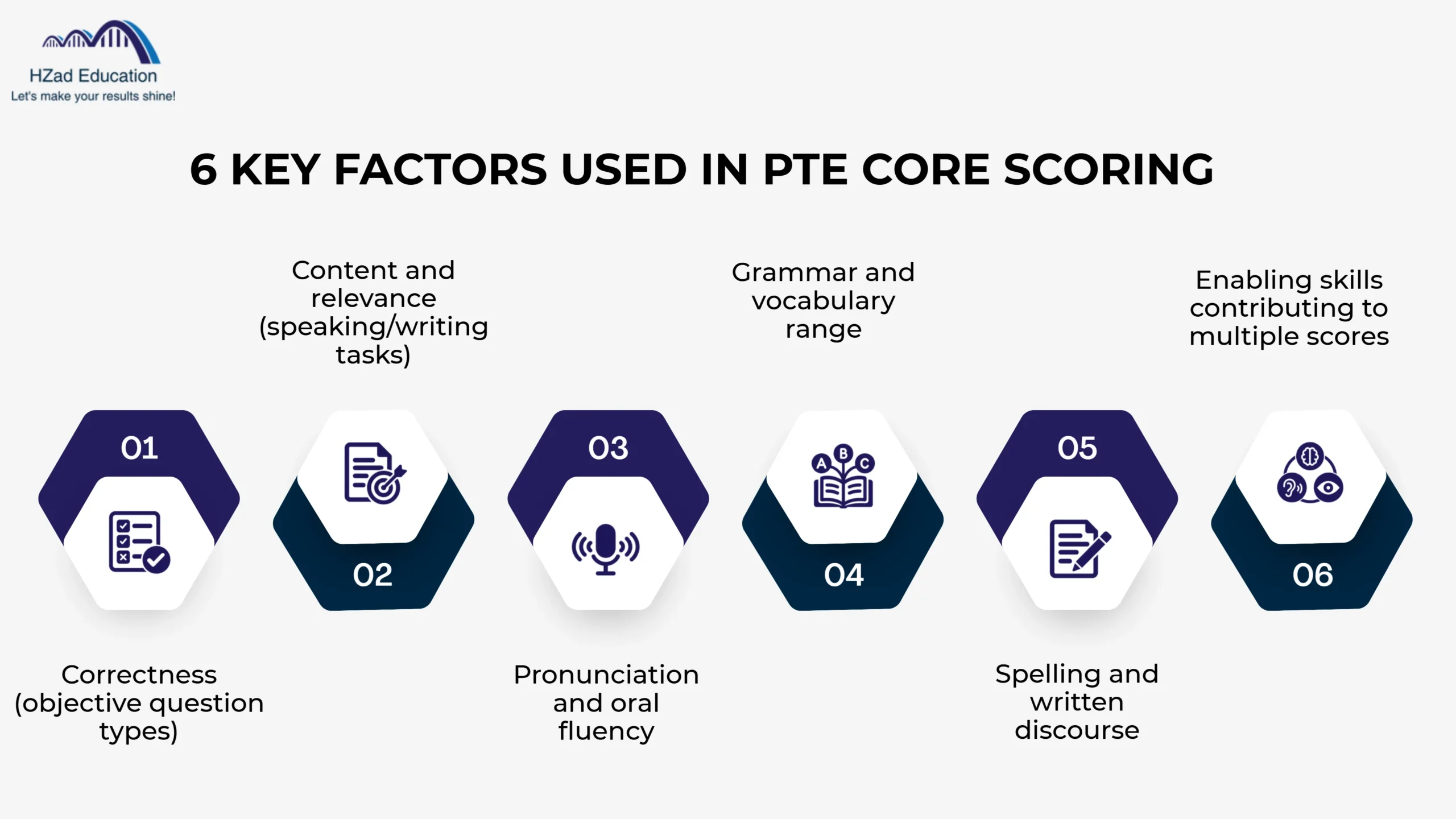
Below are the 6 key factors used in PTE Core scoring:
- Correctness (objective question types)
PTE Core uses correct-or-incorrect and partial-credit scoring, depending on the question type. In correct-or-incorrect tasks, a correct response generally receives 1 point, and an incorrect response receives 0 points. Some multiple-answer question types use +1 for each correct selection and -1 for each incorrect selection, subject to the task’s scoring rules. Partial-credit tasks award points for each correctly completed response element.
- Content and relevance (speaking/writing tasks)
Content and relevance contribute to PTE Core scores in applicable Speaking and Writing tasks. Content criteria assess whether the response includes the required information and addresses the prompt. Depending on the task, content may use scoring ranges such as 0-2, 0-3, or 0-5. Missing information, irrelevant material, or an incomplete response can reduce the task score.
- Pronunciation and oral fluency
The PTE Core score uses pronunciation and oral fluency in applicable spoken-response tasks to assess speech clarity and smooth delivery. Pronunciation is scored from 0-5, based on how understandable the candidate’s speech is. Oral fluency is also scored from 0-5, based on rhythm, phrasing, continuity, and appropriate pauses. These criteria contribute to the relevant Speaking task scores.
- Grammar and vocabulary range
Candidates are assessed on grammar and vocabulary in applicable PTE Core tasks to determine the accuracy, range, and appropriateness of the language used in their responses. Grammar and vocabulary are commonly scored from 0-2 each where assessed, although the exact criteria depend on the question type. Grammar measures control of language structures, while vocabulary measures appropriate word choice and lexical range.
- Spelling and written discourse
The PTE Core score measures spelling and written discourse in applicable writing tasks by checking word accuracy and the clear organisation of ideas. Correct spelling shows accurate word use, whereas written discourse shows whether ideas follow a clear structure and connect logically. Performance in both areas contributes to the score for relevant writing tasks.
- Enabling skills contributing to multiple scores
Supporting language abilities can contribute to more than one PTE Core communicative skill score when a task combines skills such as Listening and Writing or Reading and Speaking. Performance on these integrated tasks can contribute to the relevant skill scores rather than being limited to one area. This scoring approach reflects how candidates use multiple language abilities together when completing certain PTE Core tasks.
Can a Higher Score in One PTE Core Skill Offset a Lower Score in Another?
No, a higher score in one PTE Core skill cannot offset a lower score in another because Speaking, Writing, Reading, and Listening are reported separately, and programs can set minimum requirements for each skill. The overall PTE Core score reflects performance across the test, but it does not replace individual skill results. If a program requires a specific minimum in each skill, candidates must reach that level in all four areas. A high Speaking score, for example, cannot compensate for a Reading score that falls below the program’s required minimum.
PTE Core to CLB Conversion
The PTE Core CLB equivalency table shows which Canadian Language Benchmark (CLB) level corresponds to a test taker’s Reading, Writing, Listening, and Speaking scores. Since the required PTE Core score range differs across the four skills, candidates should match each individual skill score with its corresponding CLB level.
PTE Core CLB Equivalency Table
The PTE Core CLB equivalency table maps individual PTE Core scores to Canadian Language Benchmark (CLB) levels. Each language skill has its own score range for a given CLB level, so candidates should compare their Speaking, Listening, Reading, and Writing results separately.
| CLB Level | PTE Speaking | PTE Listening | PTE Reading | PTE Writing |
| CLB 10 | 89–90 | 89–90 | 88–90 | 90 |
| CLB 9 | 84–88 | 82–88 | 78–87 | 88–89 |
| CLB 8 | 76–83 | 71–81 | 69–77 | 79–87 |
| CLB 7 | 68–75 | 60–70 | 60–68 | 69–78 |
| CLB 6 | 59–67 | 50–59 | 51–59 | 60–68 |
| CLB 5 | 51–58 | 39–49 | 42–50 | 51–59 |
| CLB 4 | 42–50 | 28–38 | 33–41 | 41–50 |
| CLB 3 | 34–41 | 18–27 | 24–32 | 32–40 |
For example, CLB 7 requires a PTE Core score of 68–75 in Speaking, 60–70 in Listening, 60–68 in Reading, and 69–78 in Writing. Candidates can use the table to identify the CLB benchmark associated with each individual PTE Core skill score.
PTE Core vs CELPIP Score Comparison
PTE Core scores are reported as different score ranges for Listening, Reading, Speaking, and Writing, whereas CELPIP scores generally correspond numerically to the same Canadian Language Benchmark (CLB) level.
For example, CLB 7 corresponds to CELPIP 7 in each skill, while PTE Core requires 60–70 in Listening, 60–68 in Reading, 68–75 in Speaking, and 69–78 in Writing. Therefore, PTE Core and CELPIP results are compared through their shared CLB benchmark rather than by matching raw test scores directly.
| CLB Level | CELPIP | PTE Listening | PTE Reading | PTE Speaking | PTE Writing |
| CLB 10 | 10 | 89–90 | 88–90 | 89–90 | 90 |
| CLB 9 | 9 | 82–88 | 78–87 | 84–88 | 88–89 |
| CLB 8 | 8 | 71–81 | 69–77 | 76–83 | 79–87 |
| CLB 7 | 7 | 60–70 | 60–68 | 68–75 | 69–78 |
| CLB 6 | 6 | 50–59 | 51–59 | 59–67 | 60–68 |
| CLB 5 | 5 | 39–49 | 42–50 | 51–58 | 51–59 |
| CLB 4 | 4 | 28–38 | 33–41 | 42–50 | 41–50 |
| CLB 3 | 3 | 18–27 | 24–32 | 34–41 | 32–40 |
PTE Core vs IELTS Score Comparison
PTE Core uses different score ranges for Listening, Reading, Speaking, and Writing at each CLB level, whereas IELTS General Training uses band scores for the four language skills. For example, CLB 7 requires PTE Core scores of 60–70 in Listening, 60–68 in Reading, 68–75 in Speaking, and 69–78 in Writing, compared with an IELTS band score of 6.0 in each skill. Using CLB as the common benchmark allows candidates to cross-reference their language proficiency between PTE Core and IELTS General Training.
| CLB Level | PTE Core (L / R / S / W) | IELTS General (L / R / S / W) |
| CLB 10 | 89-90 / 88-90 / 89-90 / 90 | 8.5 / 8.0 / 7.5 / 7.5 |
| CLB 9 | 82-88 / 78-87 / 84-88 / 88-89 | 8.0 / 7.0 / 7.0 / 7.0 |
| CLB 8 | 71-81 / 69-77 / 76-83 / 79-87 | 7.5 / 6.5 / 6.5 / 6.5 |
| CLB 7 | 60-70 / 60-68 / 68-75 / 69-78 | 6.0 / 6.0 / 6.0 / 6.0 |
| CLB 6 | 50-59 / 51-59 / 59-67 / 60-68 | 5.5 / 5.0 / 5.5 / 5.5 |
| CLB 5 | 39-49 / 42-50 / 51-58 / 51-59 | 5.0 / 4.0 / 5.0 / 5.0 |
| CLB 4 | 28-38 / 33-41 / 42-50 / 41-50 | 4.5 / 3.5 / 4.0 / 4.0 |
PTE Core Score Requirements for Canada
PTE Core score requirements for Canada vary by immigration or work permit pathway, with Express Entry, permanent residence (PR) programs, and the Post-Graduation Work Permit (PGWP) applying specific language proficiency requirements based on CLB levels. Candidates need to identify the CLB level required for their specific pathway and ensure their PTE Core scores meet the corresponding requirements in each language skill.
PTE Core Score for Express Entry
PTE Core is an approved English test for Express Entry, with individual Speaking, Listening, Reading, and Writing scores converted to Canadian Language Benchmark (CLB) levels. The required CLB depends on the Express Entry program.
The Federal Skilled Worker Program requires CLB 7 in all four skills. Canadian Experience Class requires CLB 7 for TEER 0 or 1 occupations and CLB 5 for TEER 2 or 3 occupations. The Federal Skilled Trades Program requires CLB 5 in Speaking and Listening and CLB 4 in Reading and Writing.
| Express Entry Program | Minimum CLB | Minimum PTE Core Scores |
| Federal Skilled Worker | CLB 7 in all skills | Speaking 68, Listening 60, Reading 60, Writing 69 |
| Canadian Experience Class, TEER 0 or 1 | CLB 7 in all skills | Speaking 68, Listening 60, Reading 60, Writing 69 |
| Canadian Experience Class, TEER 2 or 3 | CLB 5 in all skills | Speaking 51, Listening 39, Reading 42, Writing 51 |
| Federal Skilled Trades | CLB 5 Speaking/Listening, CLB 4 Reading/Writing | Speaking 51, Listening 39, Reading 33, Writing 41 |
PTE Core Score for Canada PR
There is no single PTE Core score required for Canadian permanent residence because language requirements vary by PR program. IRCC accepts PTE Core for many economic immigration pathways and converts each Listening, Reading, Speaking, and Writing score to a Canadian Language Benchmark (CLB) level. Applicants must meet the minimum CLB required by their specific pathway in each applicable skill. For example, CLB 7 equals at least 60 in Listening, 60 in Reading, 68 in Speaking, and 69 in Writing. Some PR programs may accept lower CLB levels.
PTE Core Requirement for PGWP
The PTE Core requirement for a PGWP is CLB 7 for university graduates and CLB 5 for graduates of other college, polytechnic, or non-university programs. For PGWP applications submitted on or after November 1, 2024, CLB 7 requires at least 68 in Speaking, 60 in Listening, 60 in Reading, and 69 in Writing. CLB 5 requires at least 51 in Speaking, 39 in Listening, 42 in Reading, and 51 in Writing. PGWP-eligible flight school graduates are exempt from the language requirement.
How Does Your PTE Core Score Affect CRS Points?
Your PTE Core score affects your CRS points by determining your CLB level in each language skill, which directly determines the language points you receive and can also contribute to skill transferability points. CRS awards first-official-language points for each ability separately, with higher CLB levels generally earning more points.
For a candidate without an accompanying spouse, each ability earns 17 points at CLB 7, 23 at CLB 8, 31 at CLB 9, and 34 at CLB 10 or higher. Reaching CLB 9 or above in all four abilities can also increase skill-transferability points when combined with qualifying education or foreign work experience.
PTE Core Result and Score Validity
PTE Core results are available through the myPTE account within 2 business days, and the scores remain valid for 2 years from the test date. Candidates should check their Score Report when notified and ensure their results remain valid when submitting a Canadian immigration or visa application.
How Can You Check Your PTE Core Result?
You can check your PTE Core result through your myPTE account once Pearson notifies you that your Score Report is available. Most test takers receive results within 2 business days, although processing can take up to five business days.
Follow the key steps below to access and review your PTE Core result:
- Pearson emails you when your PTE Core Score Report is released and ready to view.
- Log in to the same myPTE account used to book and manage your PTE Core test.
- Go to My Activity and locate the relevant PTE Core test. You may also see a View Score button directly on your account homepage.
- Click View Score to open your digital Score Report. It displays your overall PTE Core score and separate scores for Speaking, Writing, Reading, and Listening.
- Check your individual skill results and Skills Profile for more detailed performance feedback. You can also select View as PDF to save a copy of your Score Report.
How Long Does a PTE Core Result Take?
Most PTE Core results are available within 2 business days after the test, although Pearson states that processing can take up to 5 business days. Test takers receive an email when their Score Report is ready and can then access it through their myPTE account. If more than 5 working days have passed without a result, Pearson recommends checking the account and spam folder before contacting customer support.
How Long Is a PTE Core Score Valid?
A PTE Core score is valid for 2 years from the date you take the test. After this period, the Score Report expires and can no longer be used for visa applications. For Canadian immigration, language test results must be less than 2 years old when you submit the relevant application. Express Entry candidates need valid results both when completing their profile and when submitting their permanent residence application, so the score should remain valid throughout the application process.
What to Do If Your PTE Core Score Is Below Your Target
If your PTE Core score is below your target, identify the gap between your current and required scores, focus on improving weaker skills, and track your progress through targeted practice and mock tests. A structured PTE Core course can support your preparation by helping you address specific skill gaps before deciding when to retake the test
How Can You Improve Your PTE Core Score?
You can improve your PTE Core score by checking your weak skills, using your Skills Profile to review task performance, practising relevant question types, taking mock tests, and tracking your progress against your required PTE Core score or CLB level. A targeted study plan helps you spend more time on specific skill gaps and measure whether your practice scores consistently reach your required benchmark.
Follow these 5 key steps to improve your PTE Core score.
- Check your weak skills: Identify which Speaking, Writing, Reading, or Listening scores are below your target CLB level.
- Use your Skills Profile: Review your performance feedback to identify specific areas and tasks to improve.
- Practise relevant question types: Focus your preparation on PTE Core tasks connected to your weaker skills.
- Take mock tests: Complete timed mock tests to measure progress and practise under test conditions.
- Track your target score: Compare your practice results with your required PTE Core score or CLB level and focus on closing remaining gaps.
When Should You Retake PTE Core?
You should retake PTE Core if your current score does not meet your required target or CLB level and you are ready to improve the skills where you fell short. Before choosing a retake date, consider your score gap, your progress in practice tests, and your application deadline.
Pearson lets you book another PTE Core test after you receive your previous score. Pearson also states that candidates can take the test up to 12 times within a 12-month period, unless an exception is approved. Schedule your retake when your mock test results show consistent improvement, while leaving enough time to receive your new scores before your application deadline.