
A CELPIP Express Entry checklist is a step-by-step guide that helps candidates prepare for the CELPIP General test while meeting Canadian immigration language requirements. It covers important preparation areas such as selecting the correct test type, setting a target CLB score, understanding the exam format, practicing each test section, completing mock tests, and preparing required documents before test day.
While preparing for CELPIP Express Entry, candidates should understand that language results can affect both Express Entry eligibility and CRS ranking. Avoid treating CLB 7 as a universal target, relying on expired results, overlooking weak sections, or choosing the wrong CELPIP test version. Each Listening, Reading, Writing, and Speaking score converts into a CLB level, and higher qualifying CLB levels can provide greater CRS value. Identifying preparation gaps early helps you focus your practice, strengthen weaker skills, and reduce the chance of a retake.
Nine checkpoints, in the order they actually matter
A clear CELPIP General preparation sequence starts with the decisions that shape everything that follows. Confirm your required CLB target, book your test 8–10 weeks before your deadline, learn the exact test format and timing, build reusable Writing templates, rehearse all eight Speaking tasks, complete at least three full timed mock tests, review the scoring criteria, confirm your ID and test-day logistics, and set a retake plan. This sequence keeps your score target, preparation, test timing, and retake window aligned with your Express Entry deadline.
-
Confirm your CLB target, not just a “good score”
Set a specific CLB target for each CELPIP ability based on the Express Entry program you qualify for. Federal Skilled Worker requires at least CLB 7 in all four abilities, while Canadian Experience Class requires CLB 7 for TEER 0–1 occupations and CLB 5 for TEER 2–3. Federal Skilled Trades requires CLB 5 in speaking/listening and CLB 4 in reading/writing. After establishing the minimum, assess whether targeting higher levels could improve your CRS score rather than simply aiming to “pass.”
-
Book your test 8–10 weeks before your deadline
Aim to schedule CELPIP about 8–10 weeks before your immigration deadline when your circumstances allow. This is a planning recommendation, not an official CELPIP or IRCC requirement. The extra time can give you room to prepare, receive and review your results, address weaknesses, and potentially retake the test if one ability falls below your target. Work backward from the date you need valid language results and choose a test date that leaves enough flexibility for unexpected delays or additional preparation.
-
Learn the exact format and timing
Become familiar with the CELPIP-General structure before beginning intensive timed practice. The current test includes Listening (46–55 minutes), Reading (43–56 minutes), Writing (53 minutes), and Speaking (15 minutes), with the entire test completed in one sitting. Writing includes two tasks, Speaking includes eight tasks, Listening includes six parts, and Reading includes four parts. Practicing according to these time limits helps you develop realistic pacing and become comfortable with CELPIP’s computer-delivered format.
-
Build reusable Writing templates
Create flexible writing frameworks for CELPIP’s two Writing tasks that help organize responses, structure ideas clearly, and adapt to different question types instead of memorizing complete answers. Task 1 involves writing an email, while Task 2 requires responding to survey questions. Prepare structures that help you introduce your purpose or position, develop supporting points, provide specific details or examples, and finish clearly. Adapt each framework to the actual prompt, including its required tone, audience, and content, so your response remains natural and directly addresses the task.
-
Rehearse all eight Speaking tasks
The eight tasks include giving advice, discussing a personal experience, describing a scene, making predictions, comparing and persuading, dealing with a difficult situation, expressing opinions, and describing an unusual situation. Practice each task within its preparation and response limits while focusing on clear organization, relevant supporting details, appropriate vocabulary, and steady delivery rather than concentrating only on your strongest task types.
-
Sit at least three full mock tests, timed
Complete at least 3 full timed mock tests as a practical preparation target and use each one to diagnose weaknesses. Three tests are not an official CELPIP requirement, so continue practicing if your performance remains inconsistent. Complete Listening, Reading, Writing, and Speaking under realistic conditions without unnecessary pauses or extra response time. Afterward, identify recurring errors, pacing difficulties, and weaker components, then focus your preparation on those areas before attempting another full simulation.
-
Review examiner scoring criteria directly
Use CELPIP’s official performance standards to understand what strong Writing and Speaking responses require. Instead of judging practice answers only by how fluent they sound, evaluate them using the CELPIP scoring criteria that measure response quality across content and coherence, vocabulary, readability or listenability, and task fulfillment. This helps identify whether your response is clearly organized, uses appropriate language, provides relevant details, maintains clarity for the reader or listener, and fully addresses the requirements of the task
-
Confirm ID and test-day logistics
Check your identification, test centre, arrival time, and registration details before test day. CELPIP requires the original, valid identification used during registration, and candidates are instructed to arrive 45 minutes before the test. Check-in closes 15 minutes before the scheduled start, and candidates arriving after that point can be denied entry. Confirm your route to the test centre and other logistical details beforehand so preventable administrative issues do not interfere with your test.
-
Set a retake plan before you need one
Plan for a possible retake before your first CELPIP attempt, so a lower score does not unexpectedly disrupt your Express Entry timeline. Compare each result, including Listening, Reading, Writing, and Speaking, with the CLB target you established for your program. If one or more abilities fall short, use the results to focus your next preparation period. Also account for language-test validity. IRCC requires results to be less than two years old when you create your Express Entry profile and when you submit your PR application.
Get the checklist in your inbox
Why most Express Entry applicants never get invited?
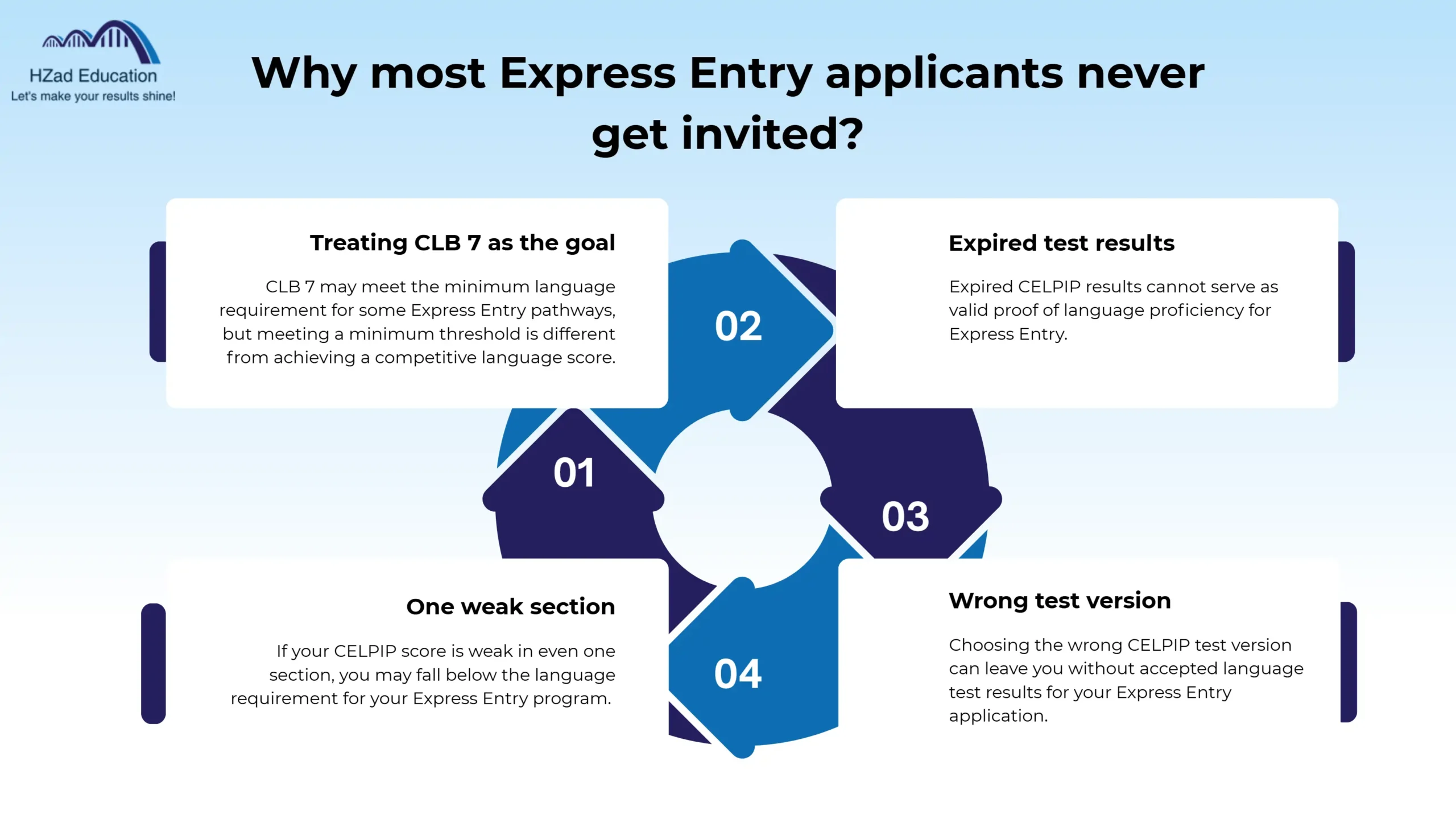
Most Express Entry applicants never get invited because they make common CELPIP mistakes, such as targeting only CLB 7 without considering higher CRS benefits, allowing their language results to expire, failing to meet the required CLB level in one or more abilities, or selecting the wrong CELPIP test version. These issues can affect Express Entry eligibility, CRS ranking, and the overall immigration application process.
Applicants must meet their program-specific language requirements and have a CRS score competitive enough for the applicable draw. These are key language-related reasons, but other factors can also affect whether an applicant receives an Invitation to Apply (ITA).
Treating CLB 7 as the goal
CLB 7 may meet the minimum language requirement for some Express Entry pathways, but meeting a minimum threshold is different from achieving a competitive language score. Your CELPIP scores convert to CLB levels, which can affect both program eligibility and the CRS points used to rank your Express Entry profile. A higher CLB level may provide greater CRS value, depending on your profile. Set your target CLB according to your specific Express Entry program requirements and CRS ranking objective rather than treating CLB 7 as a universal goal.
Expired test results
Expired CELPIP results cannot serve as valid proof of language proficiency for Express Entry. IRCC requires language test results to be less than 2 years old when you create your Express Entry profile and when you submit your permanent residence application. If your results expire before either point, you may need to retake CELPIP and provide current scores. Compare your test date and two-year validity period with your expected profile and application deadlines before relying on your existing results.
One weak section
If your CELPIP score is weak in even one section, you may fall below the language requirement for your Express Entry program. Each Listening, Reading, Writing, and Speaking score converts to its own CLB level. For example, if your program requires CLB 7 in all four abilities and your scores meet CLB 7 in Listening, Reading, and Speaking but only CLB 6 in Writing, you do not meet that language threshold. Compare every ability with the required CLB level rather than relying on your strongest scores.
Wrong test version
Choosing the wrong CELPIP test version can leave you without accepted language test results for your Express Entry application. CELPIP-General is the version used as IRCC-approved language evidence for Canadian permanent residence through Express Entry. When registering, check the full test name and make sure you have selected CELPIP-General for your immigration purpose before paying and booking a test date. Verify the accepted test and current requirements with both IRCC and CELPIP before registration.
Every CLB level is worth real CRS points
Your CELPIP-General score converts directly to a CLB level, and each qualifying CLB level can contribute a different number of CRS points to your Express Entry profile. For your first official language, IRCC awards points separately for Listening, Reading, Writing, and Speaking.
| CLB level | CELPIP score per ability | CRS points per ability with spouse | CRS points per ability without spouse |
| CLB 4 or 5 | 4 or 5 | 6 | 6 |
| CLB 6 | 6 | 8 | 9 |
| CLB 7 | 7 | 16 | 17 |
| CLB 8 | 8 | 22 | 23 |
| CLB 9 | 9 | 29 | 31 |
| CLB 10+ | 10+ | 32 | 34 |
The progression shows why your target CLB matters. For example, moving from CLB 8 to CLB 9 increases first-official-language CRS points from 23 to 31 per ability for an applicant without a spouse, while reaching CLB 9 in all four abilities can also increase points available through applicable skill transferability factors. Your final CRS gain depends on the rest of your Express Entry profile.
FAQs
What CELPIP score do I need for PR?
You need a CELPIP General score that meets the CLB requirement for your specific Canadian PR program, as there is no single score for every Express Entry applicant, for example, CELPIP 7 equals CLB 7, which meets the minimum requirement for some pathways. Programs such as Federal Skilled Worker, Canadian Experience Class, and Federal Skilled Trades have different language thresholds. Targeting CELPIP 9 or higher can earn more CRS points than simply meeting the minimum requirement.
How long does the CELPIP test take?
The CELPIP-General Test takes about 3 hours to complete in one sitting and covers Listening, Reading, Writing, and Speaking. The shorter CELPIP-General LS Test, used for citizenship purposes, takes approximately 1 hour and 10 minutes to 1 hour and 30 minutes.
Can I reschedule my CELPIP exam if I am not ready?
Yes, you can reschedule your CELPIP exam through your CELPIP Account at least 7 calendar days before the test date by paying a $50 CAD non-refundable transfer fee plus applicable taxes. You can change the date, time, or location by selecting “Transfer to a different sitting.” If fewer than 7 days remain, online transfers close, and changes generally require an approved, documented emergency through customer support.
Is the checklist enough on its own, or do I need the full course?
Use the checklist for independent planning, requirement verification, and identifying preparation gaps, whereas the full course is better suited for structured instruction, guided practice, Writing and Speaking support, and feedback on weak areas. If your mock-test results show persistent skill gaps or you need more guidance to reach your target CLB level, the full course may provide the preparation depth you need.
Will Hzad share or sell my email?
No, Hzad does not share or sell your email address. Your email is collected to deliver the requested checklist and can be used for marketing communications if you provide consent. Hzad handles third-party sharing according to its published privacy terms, and you can control future marketing emails through the available unsubscribe option.
Don’t let a preparation gap cost you a retake.
An unresolved preparation gap can leave one or more CELPIP sections below your required CLB target and lead to another test attempt. Identify weak areas early, whether it is an unclear CLB target, limited Writing or Speaking preparation, insufficient timed practice, incomplete scoring review, or missed test-day checks. Use the free checklist to verify these gaps, complete targeted preparation, and confirm your readiness before test day. If you need structured instruction and deeper support, consider the full course.