
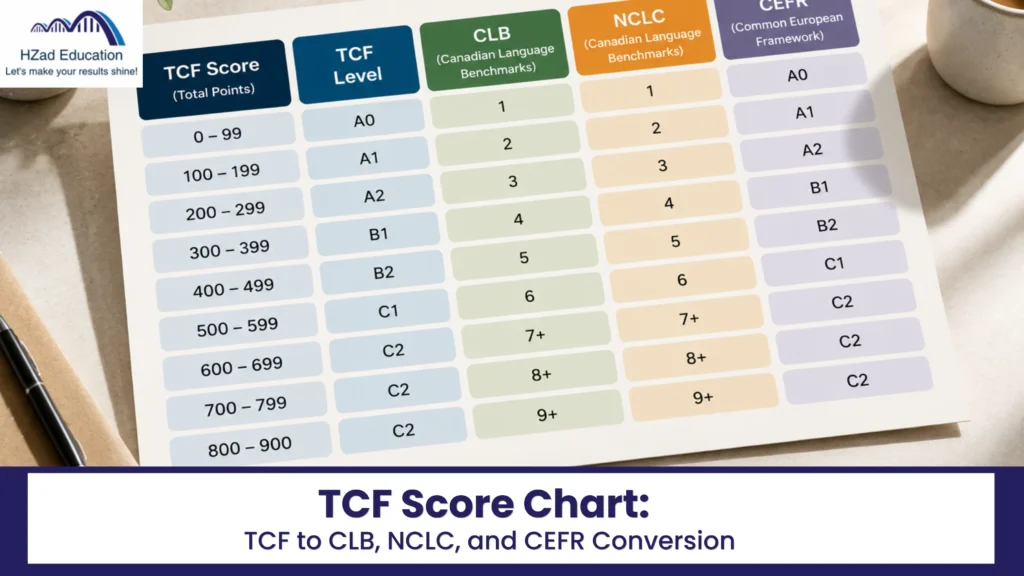
TCF scores measure French language proficiency across listening comprehension, reading comprehension, oral expression, and written expression, with each skill receiving a separate result. These scores are calculated using different scoring methods and can be converted into Canadian NCLC benchmarks or international CEFR levels to understand proficiency. Scores can be mapped to Canadian NCLC benchmarks and international CEFR levels, making it easier to determine the corresponding proficiency level and assess whether specific language requirements have been met.
For Canadian immigration, TCF Canada scores are used for pathways such as Express Entry, permanent residence applications, and French-language streams. Candidates must meet the required NCLC level in each ability, while strong French results can also contribute to CRS points. Factors such as correct answers, assessment criteria, language control, fluency, coherence, and vocabulary range influence final scores. If results fall below the required level, candidates should identify weaker skills, use targeted preparation, and retake the test after improvement.
What Do TCF Scores Measure?
TCF scores measure a non-native speaker’s level of proficiency in the French language across four core skills: listening comprehension, reading comprehension, oral expression, and written expression. Listening and reading are receptive skills, while oral and written expression are productive skills. Each skill receives a separate result, so performance in one section does not determine another.
The results are mapped to the international CEFR language levels, ranging from A1 (beginner) to C2 (advanced/mastery), providing a standardised indication of a candidate’s French proficiency. These results indicate a candidate’s language level but do not automatically confirm immigration or program eligibility. The next step is understanding how each TCF skill score is calculated and reported. Comprehension results use a 0-699 scale, while expression results use a 0-20 scale, with results corresponding to CEFR and Canadian NCLC benchmarks.
How Are TCF Scores Calculated for Each Skill?
TCF (Test de connaissance du français) scores are calculated using two distinct scoring scales: reading and listening use a 0–699-point scale based on performance on multiple-choice questions, while speaking and writing use a 0–20-point scale based on evaluator assessments. Each skill is scored separately, and the four results are not averaged into a single overall score.
Comprehension Skills (Listening and Reading)
- Correct multiple-choice answers determine raw performance.
- Raw performance is converted into an official section score from 0 to 699 points.
- Each section receives its own reported score.
Expression Skills (Speaking and Writing)
- Trained evaluators assess candidate performance.
- Assessment criteria include task completion, vocabulary, language control, fluency, and coherence.
- Each section receives a separate score from 0 to 20 points.
Candidates should use the officially reported result for each skill rather than averaging scores or applying unofficial scoring formulas.
Which TCF Sections Have Separate Scores?
TCF sections have separate scores for four language skills, with listening comprehension and reading comprehension measuring receptive abilities, while oral expression and written expression measure productive abilities. Each result reflects performance in that specific skill and is reported independently from the other sections.
Below are the TCF sections that have separate scores:
- Listening Comprehension
Listening comprehension measures how well a candidate understands spoken French and functions as a receptive skill. Candidates respond to questions after listening to recorded material, and their performance is reported on a 100-to-699-point scale. This result represents listening ability independently of the other TCF sections.
- Reading Comprehension
As a receptive skill, reading comprehension assesses the ability to understand information presented in written French. Candidates work with different texts and respond to questions involving meaning, vocabulary, and context. The section scores range from 100 to 699 points and are reported separately from other skill results.
- Oral Expression
Oral expression focuses on a candidate’s productive ability to communicate through spoken French. Speaking tasks are evaluated according to factors such as fluency, vocabulary, grammar, coherence, and task completion. Unlike the comprehension sections, oral expression uses a 0-to-20-point scale and receives its own independent result.
- Written Expression
Written expression evaluates productive French through structured writing tasks. Assessors examine factors such as vocabulary, grammatical control, organization, coherence, and completion of the assigned task. Candidates receive a score from 0 to 20, which reflects written performance independently of their listening, reading, or speaking results.
How Do TCF Scores Convert to CLB and NCLC Levels?
TCF Canada scores are converted into Niveaux de compétence linguistique canadiens (NCLC) or Canadian Language Benchmarks (CLB) levels by comparing the candidate’s result in each language ability with IRCC’s official equivalency table. Listening, reading, speaking, and writing are assessed separately, meaning a candidate can receive a different NCLC level for each skill. For example, a candidate could achieve NCLC 8 in Listening but NCLC 7 in Writing.
These levels are then used by Canadian immigration programs to determine whether the applicant meets language requirements and, where applicable, how many language-related points they receive.
| NCLC Level | Reading | Writing | Listening | Speaking |
| NCLC 4 | 342-374 | 4-5 | 331-368 | 4-5 |
| NCLC 5 | 375-405 | 6 | 369-397 | 6 |
| NCLC 6 | 406-452 | 7-9 | 398-457 | 7-9 |
| NCLC 7 | 453-498 | 10-11 | 458-502 | 10-11 |
| NCLC 8 | 499-523 | 12-13 | 503-522 | 12-13 |
| NCLC 9 | 524-548 | 14-15 | 523-548 | 14-15 |
| NCLC 10+ | 549-699 | 16-20 | 549-699 | 16-20 |
What TCF Scores Are Needed for NCLC 5?
To achieve NCLC 5 on the TCF Canada test, candidates need a Listening score of 369-397, a Reading score of 375-405, a Speaking score of 6, and a Writing score of 6. Each skill is evaluated separately, so achieving NCLC 5 in one ability does not mean the candidate has reached NCLC 5 across all four skills. For example, Listening 380, Reading 390, Speaking 6, and Writing 6 meet NCLC 5 in every tested ability.
According to Immigration, Refugees and Citizenship Canada (IRCC), the TCF scores needed for NCLC 5 are:
| TCF Canada Skill | Score Required for NCLC 5 |
| Listening | 369-397 |
| Reading | 375-405 |
| Speaking | 6 |
| Writing | 6 |
The Canadian Experience Class requires NCLC 5 for TEER 2 or 3 occupations, while the Federal Skilled Worker Program requires NCLC 5 when French is the second official language. The Federal Skilled Trades Program requires NCLC 5 for speaking and listening.
What TCF Scores Are Needed for NCLC 7?
TCF scores needed for NCLC 7 (the Canadian benchmark level B2) are 458-502 in Listening, 453-498 in Reading, 10-11 in Speaking, and 10-11 in Writing. Each TCF Canada skill must meet its required score range separately to achieve NCLC 7.
NCLC 7 is particularly important for Canadian immigration. It is the minimum French-language level in all four abilities for the Federal Skilled Worker Program when French is the first official language. For the Canadian Experience Class, applicants whose occupations fall under NOC TEER 0 or 1 also require at least NCLC 7 in all four French abilities.
| TCF Canada Skill | Score Required for NCLC 7 |
| Listening | 458-502 |
| Reading | 453-498 |
| Speaking | 10-11 |
| Writing | 10-11 |
When Does NCLC Apply Instead of CLB?
NCLC applies instead of CLB when Canadian immigration authorities assess a candidate’s French-language proficiency, while CLB applies to English-language proficiency. IRCC explicitly uses CLB for English and NCLC for French across programs such as Express Entry. Both frameworks assess language ability across listening, speaking, reading, and writing, so TCF Canada results are interpreted using NCLC levels.
For example, a candidate who takes TCF Canada or TEF Canada will have their French test results matched to NCLC levels. A candidate who takes an approved English test such as IELTS General Training, CELPIP-General, or PTE Core will have their results matched to CLB levels. The benchmark used, therefore, depends on the language being assessed, not the applicant’s immigration program or whether it is their first or second official language.
How Do TCF Scores Convert to CEFR Levels (A1-C2)?
TCF scores are converted to CEFR levels by matching the score or mark obtained in each language skill to a predefined CEFR score band. For TCF Canada, Listening and Reading results are reported on a numerical scale and then assigned a CEFR level, while Speaking and Writing are marked out of 20 and converted separately.
France Éducation international confirms that each TCF Canada result is translated into a CEFR level ranging from A1 to C2, so candidates can have different CEFR levels across the four skills.
| CEFR Level | Listening & Reading | Speaking & Writing |
| A1 | 100-199 | 1/20 |
| A2 | 200-299 | 2-5/20 |
| B1 | 300-399 | 6-9/20 |
| B2 | 400-499 | 10-13/20 |
| C1 | 500-599 | 14-17/20 |
| C2 | 600-699 | 18-20/20 |
Why Does CEFR Matter Alongside CLB and NCLC?
CEFR matters alongside CLB and NCLC because it establishes a universally recognized international scale that contextualizes French language proficiency across global standards. Understanding how these frameworks work together ensures you can easily map your language skills to both international measures and official Canadian requirements.
- Universal Proficiency Scale: Maps language ability from A1 to C2 across basic, independent, and proficient stages.
- Global Portability: Provides an internationally recognized measure of French fluency beyond exclusively Canadian contexts.
- Framework Distinction: Clarifies the difference between general international proficiency (CEFR) and official Canadian benchmarks for English (CLB) and French (NCLC).
How Should You Read the TCF Score Conversion Chart?
To read the TCF score conversion chart correctly, identify your score for each TCF skill, match each score to the corresponding CLB, NCLC, or CEFR level, interpret the proficiency level achieved, and compare each result with your target requirement. Since each language skill is scored separately, check listening, reading, speaking, and writing individually rather than treating the results as one combined score.
Identify Your Score for Each TCF Skill
Start by identifying your reported TCF scores for listening, reading, speaking, and writing. Check each result separately because the four language abilities are assessed independently and use different scoring scales. Do not average or combine the scores when determining your NCLC level. Once you have identified each result, you can match it with the appropriate proficiency level. IRCC assesses TCF Canada results separately across speaking, listening, reading, and writing.
Match Each Score to the Correct CLB, NCLC, or CEFR Level
Match each TCF skill score to the corresponding NCLC or CEFR level shown in the relevant conversion chart. Use the score range for the specific skill because listening, reading, speaking, and writing can have different thresholds. For French proficiency in Canada, use NCLC rather than CLB, which applies to English. This step establishes the benchmark or proficiency level for each result.
| CEFR Level | NCLC / CLB Level | Listening Score(Scale: 0-699) | Reading Score(Scale: 0-699) | Writing Score(Scale: 0-20) | Speaking Score(Scale: 0-20) |
| C2 | Level 10+ | 549 – 699 | 549 – 699 | 16 – 20 | 16 – 20 |
| C1 | Level 9
Level 8 |
523 – 548
503 – 522 |
524 – 548
499 – 523 |
14 – 15
12 – 13 |
14 – 15
12 – 13 |
| B2 | Level 7
Level 6 |
458 – 502
398 – 457 |
453 – 498
406 – 452 |
10 – 11
7 – 9 |
10 – 11
7 – 9 |
| B1 | Level 5
Level 4 |
369 – 397
331 – 368 |
375 – 405
342 – 374 |
6
4 – 5 |
6
4 – 5 |
| A2 / A1 | Level 3 and below | 0 – 330 | 0 – 341 | 0 – 3 | 0 – 3 |
Interpret What Each Proficiency Level Means
Understand the matched level to determine the French proficiency represented by your TCF result. CEFR classifies proficiency from A1 and A2 for basic users, B1 and B2 for independent users, and C1 and C2 for proficient users, while NCLC describes French ability within the Canadian benchmark system. Review each skill independently because your proficiency level can differ across listening, reading, speaking, and writing. These levels provide a clearer measure of your language ability before you compare each result with a specific requirement.
Compare Your Results Against Your Target Requirement
Check each achieved benchmark against the minimum level required for your specific purpose or program. For example, NCLC 7 requires TCF Canada scores of 458-502 in listening, 453-498 in reading, and 10-11 in both speaking and writing. Review all four skills individually because a higher result in one ability does not compensate for a score below the required threshold in another. This assessment identifies which requirements you meet and which language skills need improvement.
What TCF Score Is Required for Canadian Immigration?
The required TCF Canada score for Canadian immigration depends on the Express Entry program and French-language requirement, ranging from NCLC 4 to NCLC 7. Each skill is assessed separately, so candidates must meet the required level in listening, reading, speaking, and writing.
For Canadian permanent residence and French-language Express Entry categories, the common benchmark is NCLC 7 in all four skills, requiring 458-502 in listening, 453-498 in reading, and 10-11 in both speaking and writing. Once converted into NCLC levels, TCF Canada results can contribute to CRS official-language points and additional French-language CRS points when candidates meet the required threshold.
What Is the Minimum TCF Score for Express Entry?
The minimum TCF Canada score for Express Entry is generally NCLC 7 in all four language abilities, including listening, reading, speaking, and writing. This level is required for federal economic programs such as the Federal Skilled Worker Program and can also help candidates qualify for additional CRS points for strong French proficiency. Candidates must meet the required NCLC level in each applicable language ability because listening, reading, speaking, and writing are assessed separately.
Below are the minimum TCF scores for Express Entry:
- NCLC 7: Listening 458-502, Reading 453-498, Speaking 10-11, Writing 10-11
- NCLC 5: Listening 369-397, Reading 375-405, Speaking 6, Writing 6
- NCLC 4: Listening 331-368, Reading 342-374, Speaking 4-5, Writing 4-5
What TCF Score Is Needed for Permanent Residence?
The TCF scores needed for Canadian permanent residence are NCLC 7, which corresponds to a minimum score of 458 in Listening, 453 in Reading, 10 in Writing, and 10 in Speaking. Candidates must meet the required score in each language ability separately.
To meet the NCLC 7 requirement, your TCF Canada scores must fall into the following ranges for every single skill:
| TCF Canada Skill | Minimum Score Required for NCLC 7 | Scale Type |
| Listening (Compréhension de l’oral) | 458 – 502 | 0 – 699 scale |
| Reading (Compréhension de l’écrit) | 453 – 498 | 0 – 699 scale |
| Writing (Expression écrite) | 10 – 11 | 0 – 20 scale |
| Speaking (Expression orale) | 10 – 11 | 0 – 20 scale |
How Do TCF Scores Affect CRS French-Language Points?
TCF Canada scores affect the Comprehensive Ranking System (CRS) after each listening, reading, speaking, and writing score is converted into its corresponding NCLC level. IRCC uses these NCLC levels to calculate official-language points, while candidates who meet the required French proficiency threshold may also receive additional CRS points for French-language skills.
The most important threshold is NCLC 7 in all four French skills. Once you reach this level, you can qualify for additional French-language CRS points:
| French proficiency | English proficiency | Additional CRS points |
| NCLC 7+ in all four French skills | CLB 4 or lower, or no English test | 25 points |
| NCLC 7+ in all four French skills | CLB 5+ in all four English skills | 50 points |
Which Immigration Programs Accept TCF Canada?
TCF Canada is accepted for eligible Canadian immigration pathways, including the Federal Skilled Worker Program, Canadian Experience Class, Provincial Nominee Programs, and French-language immigration streams, with specific NCLC requirements varying by program. Applicants must meet the language benchmark required by their chosen immigration pathway and, where applicable, by each tested language ability.
4 immigration programs that are accepted by TCF Canada are:
- Federal Skilled Worker Program
The Federal Skilled Worker Program (FSWP) is an Express Entry pathway for skilled workers with qualifying experience. Applicants using French as their first official language need at least NCLC 7 in all four abilities. TCF Canada scores are assessed separately for Listening, Reading, Speaking, and Writing. Applicants must also meet other program requirements and score at least 67 out of 100 points on the FSWP selection grid.
- Canadian Experience Class
Canadian skilled workers with qualifying work experience can apply through the Canadian Experience Class (CEC) and use TCF Canada to demonstrate French proficiency. Candidates need NCLC 7 in all four abilities for TEER 0 or 1 occupations and NCLC 5 for TEER 2 or 3 occupations. Each language skill is evaluated separately, and applicants must also meet the CEC’s Canadian skilled-work-experience and other eligibility requirements.
- Provincial Nominee Programs
Provincial Nominee Programs (PNPs) allow provinces and territories to nominate candidates according to their economic and labour-market needs. French-language requirements vary by province, territory, and individual stream, so there is no universal TCF Canada or NCLC threshold for all PNPs. Applicants should check the specific requirements of their chosen stream and determine whether French proficiency is required, preferred, or rewarded.
- French-language streams
French-speaking candidates can qualify for the French-language proficiency category, which is part of Express Entry’s category-based selection, not a separate immigration program. Candidates must first qualify for an underlying Express Entry program and meet the French-category requirements. Strong TCF Canada results can also increase CRS scores through official-language and additional French-language points, supporting both eligibility and competitiveness within Express Entry.
What Factors Influence Your TCF Score?
The factors that influence your TCF score include the number of correct answers, the language skill being tested, section-specific score scales, oral and written assessment criteria, accuracy, language control, fluency, coherence, and vocabulary range. Each component affects how performance is measured within its specific TCF section and contributes to the final reported score for that skill.
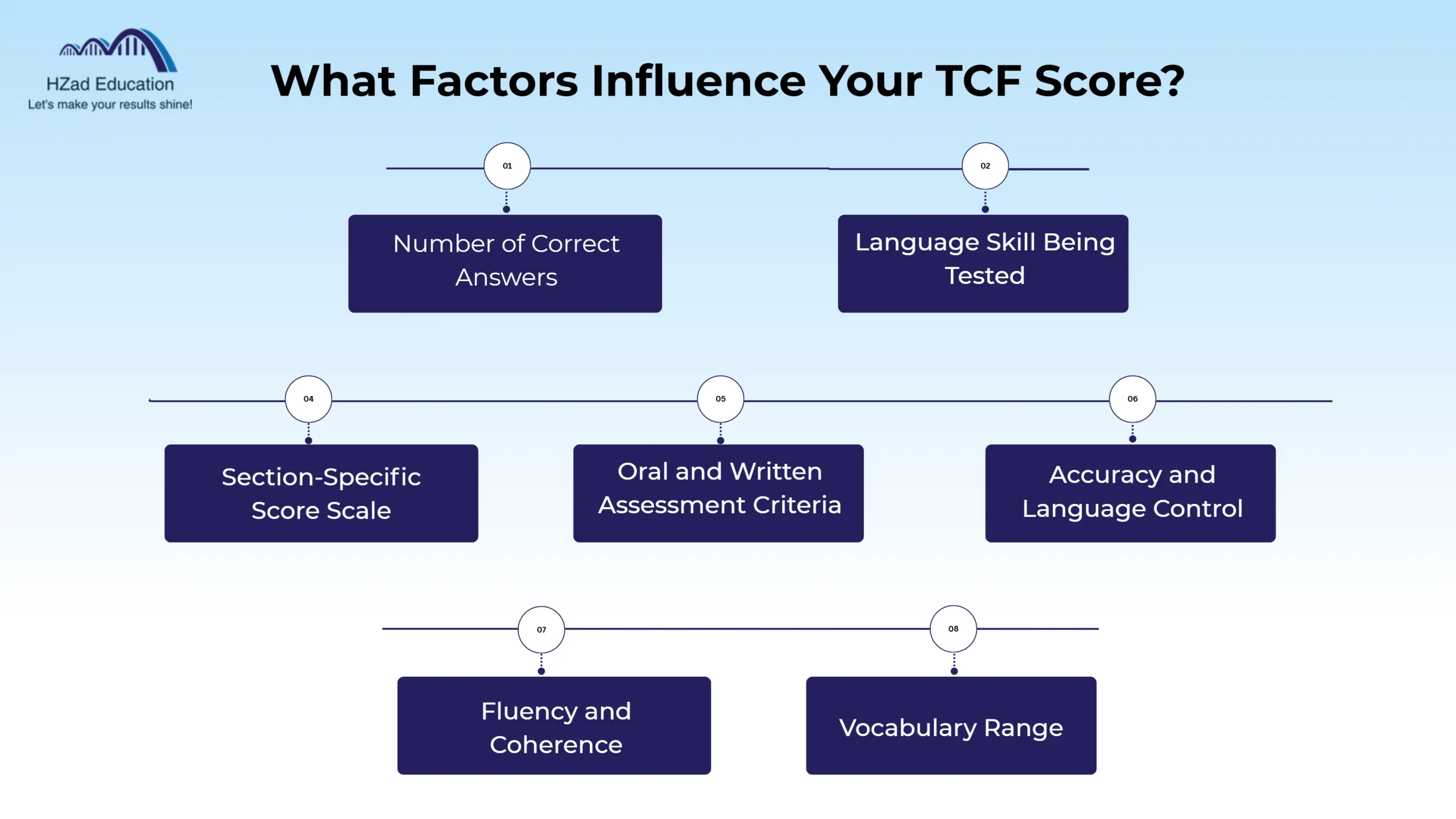
7 factors that influence your TCF Score are:
- Number of Correct Answers
The number of correct answers establishes a candidate’s raw performance in the TCF listening and reading sections. These sections use multiple-choice questions, with raw results converted into official TCF scores. More correct responses generally reflect stronger comprehension, but candidates should rely on official results rather than calculating scores with a simple percentage formula.
- Language Skill Being Tested
The language skill being tested directly influences the TCF score because listening, reading, speaking, and writing measure different areas of French proficiency. Listening and reading assess receptive comprehension, while speaking and writing evaluate productive communication. Performance can therefore vary between skills, which is why each ability receives a separate result.
- Section-Specific Score Scale
Different scoring scales affect how TCF performance is reported across the four skills, including Listening and Reading use a numerical comprehension scale, while Speaking and Writing use a separate expression scale. Since these scales represent different assessment methods, candidates should interpret each result independently rather than directly comparing or averaging the scores.
- Oral and Written Assessment Criteria
When a candidate completes speaking or writing tasks, the quality of the response influences the TCF score through standardized assessment criteria. Evaluators consider factors such as task completion, organization, linguistic quality, and effective communication. Consistently meeting these criteria supports a higher oral or written expression score, while weaker performance can lower it.
- Accuracy and Language Control
Errors in grammar or sentence construction can reduce a TCF score when they affect the clarity and precision of a response. Candidates demonstrate language control by using French structures accurately and appropriately. Consistent control supports stronger speaking and writing performance, while frequent or significant errors can weaken communication quality and affect assessment.
- Fluency and Coherence
A response that develops smoothly and connects ideas logically can contribute to stronger TCF performance. Fluency reflects a candidate’s ability to maintain effective spoken communication, while coherence shows how clearly ideas are organized and connected. Frequent hesitation, fragmented ideas, or unclear progression can reduce communication quality and influence the assessment of productive skills.
- Vocabulary Range
Using varied and appropriate vocabulary helps candidates express meaning precisely and can strengthen their TCF performance. A broader lexical range allows candidates to discuss different topics, develop ideas, and select words appropriate to the task. Repetitive, limited, or inappropriate vocabulary can restrict expression and may negatively influence performance in speaking and writing assessments.
What Should You Do If Your TCF Score Falls Below the Required Level?
If your TCF score falls below the required NCLC level, identify which language skill missed the target and focus your preparation on improving that specific area. Since listening, reading, speaking, and writing are assessed separately, even one result below the required threshold can affect eligibility when a program requires a minimum level in every skill. A structured TCF prep course can help strengthen weaker skills through targeted practice in listening, reading, speaking, and writing before you retake the test.
Follow the measures below if your TCF score falls below the required level:
- Identify the score gap: Compare each TCF result with the required score range to determine which skill falls below the target.
- Focus on weaker skills: Direct more preparation toward the sections where your performance needs improvement.
- Practice section-specific tasks: Use listening exercises, reading questions, speaking tasks, or writing activities that reflect the relevant TCF section.
- Retake the TCF Canada: After further preparation, retake the test to work toward the required scores.
- Recheck program requirements: Confirm that your new results meet the required NCLC level in every applicable language ability.