
The TCF Canada exam journey involves three key stages, which include preparation before the test, performance during the assessment, and result management after completion. Before the TCF Canada exam, candidates should prepare by understanding exam requirements, bringing valid identification, registration confirmation, required documents, and permitted items, while following arrival, check-in, and test centre procedures to ensure a smooth exam experience.
During the exam, candidates must follow centre rules, complete the Listening, Reading, Writing, and Oral Expression sections, and manage time effectively through focused practice and careful responses. A TCF prep course can help candidates understand task formats, improve skills, and prepare with realistic practice.
After completing the exam, candidates can follow the result release timelines, access their official certificate, and use scores for Canadian immigration purposes. Proper planning helps candidates avoid common mistakes and approach the TCF Canada exam with confidence.
What Should You Bring on Your TCF Canada Exam Day?
You should bring a valid photo ID, registration confirmation, required documents, permitted stationery, and allowed personal items on your TCF Canada exam day. These items help verify your identity, confirm your exam registration, and ensure you follow the test center requirements.
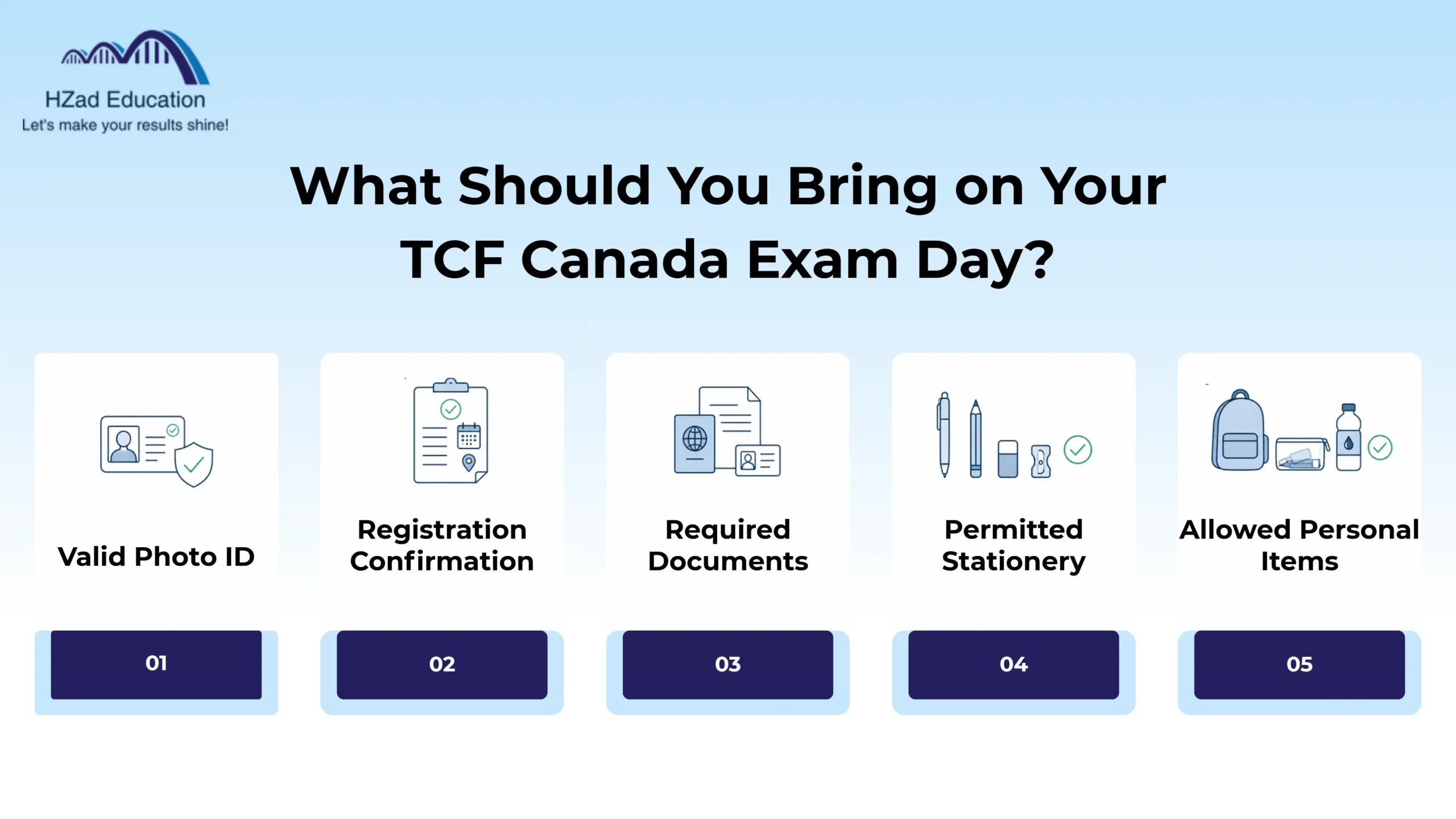
5 items you should bring on your TCF Canada exam day are:
- Valid Photo ID
A valid photo ID is required for identity verification before entering the TCF Canada exam centre. The accepted document must be an original, government-issued identification with a clear photo and matching personal details. Candidates should verify the validity, accuracy, and availability of their ID before departure. TCF test centres reject identification documents that do not meet official acceptance requirements.
- Registration Confirmation
The exam booking details should be confirmed through the registration confirmation before arriving at the test centre. This document verifies the scheduled exam date, time, location, and candidate information. Candidates should review all registration details in advance and bring the required confirmation record for check-in.
- Required Documents
Candidates should bring required documents, such as identification, registration-related documents, and any other materials specified by the exam authority or test centre. Required documents provide the information needed to verify registration details and complete the exam admission process.
- Permitted Stationery
Writing materials such as approved pens, pencils, and other allowed stationery items should be carried for the TCF Canada exam. Only permitted materials are accepted inside the exam centre to maintain secure testing conditions. Candidates should check the list of accepted stationery before exam day and avoid bringing restricted items. The test centre follows specific rules for examination materials during the assessment process.
- Allowed Personal Items
Personal belongings allowed inside the exam centre must follow the approved item guidelines. Candidates should review the storage instructions and remove any restricted items before arrival. Checking personal items in advance helps complete the admission process smoothly and supports compliance with test centre security requirements.
When Should You Arrive at the TCF Canada Test Centre?
You should arrive at your TCF Canada test centre 20 to 30 minutes before the specific reporting time listed on your official exam notice (convocation). Early arrival allows enough time for identity verification, document checks, registration confirmation, and exam instructions before admission. Test centres lock their doors and deny entry to latecomers once exam instructions or tests begin, which can prevent them from participating in the scheduled examination.
How Does the TCF Canada Check-in Process Work?
The TCF Canada check-in procedure begins when candidates reach the assigned test centre with the required original identification document and complete the admission formalities. Test centre staff confirm candidate information, validate registration details, capture a security photograph, and provide instructions for storing personal belongings before the exam starts.
Identity and Document Review
- Identification confirmation: Candidates must present the same valid passport, driver’s license, or national ID card submitted during registration. Copies, screenshots, or electronic versions are not accepted for entry verification.
- Information validation: Test centre staff review candidate details, including name, candidate code, and registration information, to ensure all records match correctly. Any inconsistency must be resolved before admission.
- Security photograph: A digital image is taken during check-in to confirm candidate identity and support exam security measures.
Belonging Storage and Test Centre Security
- Secure item storage: Personal belongings, including mobile phones, smartwatches, electronic devices, bags, and water bottles, must be switched off and placed in the assigned storage area before entering the exam room.
- Restricted materials: Candidates are not allowed to bring notes, papers, or unauthorized tools into the testing area to protect exam integrity.
- Exam location assignment: After completing verification steps, candidates receive instructions for their assigned room, computer station, or examination desk.
What Happens If You Arrive Late for the TCF Canada Exam?
If you arrive late for the TCF Canada exam, you will not be admitted after the scheduled test start time, resulting in the loss of your exam session. Test centres enforce strict arrival deadlines and do not offer refunds, partial credits, or free rescheduling for missed or late arrivals.
Consequences of Late Arrival:
- No entry after the deadline: Test centre doors close at the reporting time mentioned on the official exam notice, and late candidates cannot enter once the examination begins.
- Loss of reserved seat: Missing the exam start time means losing the allocated test slot for that session.
- Forfeited exam fee: The paid registration fee is not refunded or transferred if the exam is missed or if the arrival is late.
- Delayed retest option: Candidates must complete the required waiting period, usually 30 days, before registering and paying for another exam date.
What Rules Should You Follow at the TCF Canada Exam Centre?
You should follow TCF Canada exam centre rules, including mobile phone restrictions, prohibited electronic device policies, personal belongings guidelines, exam room conduct requirements, proctor instructions, and rules for leaving the examination room. These guidelines maintain exam security, ensure fair testing conditions, and help candidates complete the assessment without interruptions.
6 rules you should follow at the TCF Canada Exam Centre are:
- Mobile Phone Policy
Mobile phones must be switched off and stored according to TCF Canada exam centre rules before entering the examination room. This rule prevents interruptions, unauthorized communication, and security risks during the test. Candidates must place their phones in the designated storage area and avoid accessing them during the exam. Using or keeping a phone in the testing room can result in removal from the exam session. Specific storage procedures depend on the test centre’s instructions.
- Prohibited Electronic Devices
Electronic devices such as smartwatches, tablets, headphones, and other unauthorized equipment are not allowed inside the examination room. The restriction protects exam security and prevents access to external information during the assessment. Candidates must turn off and store all prohibited devices before the exam begins. Carrying or using restricted electronics may result in exam cancellation or removal, depending on centre policies.
- Personal Belongings
Candidates must place bags, notes, water bottles, and other personal items in the approved storage area before entering the examination room. Personal belongings must follow the storage rules provided by the TCF Canada exam centre to maintain a controlled testing environment and protect exam integrity. Bringing unauthorized items into the exam area is restricted and may result in security concerns or removal, depending on centre policies.
- Exam Room Conduct
Test takers must remain focused, avoid communication with others, and follow all examination procedures inside the TCF Canada exam room throughout the test session. This rule ensures a quiet and fair environment for all participants. Disruptive behaviour, unauthorized actions, or rule violations can affect exam participation according to test centre regulations.
- Proctor Instructions
All instructions provided by the proctor during the TCF Canada exam must be followed carefully. Proctor guidance ensures that examination procedures, timing requirements, and security measures are completed correctly. Listening carefully and completing required actions during the test session helps maintain proper exam conditions.
- Leaving the Exam Room
The approved test centre procedure must be followed before leaving the examination room during the TCF Canada exam. This process controls movement and maintains exam security throughout the session. Permission must be requested from the proctor, and the approved exit process must be completed before leaving. Unauthorized departure or failure to follow centre instructions can result in exam disruption or invalidation.
What Happens During Each TCF Canada Exam Section?
Each TCF Canada exam section includes Listening Comprehension, which evaluates understanding of spoken French through audio playback and multiple-choice questions, and Reading Comprehension, which assesses understanding of written French through text-based questions.
Written Expression measures structured writing ability through different writing tasks, and Oral Expression evaluates spoken communication through interviews, role-play, and argument-based responses. Together, these four sections assess the complete range of French language skills required for the TCF Canada assessment.
What Happens During the TCF Canada Listening Comprehension Section?
You should complete the TCF Canada Listening Comprehension section by following the audio playback, answering multiple-choice questions, and managing the allocated time limit during the TCF Canada Listening Comprehension Section. Careful attention to the recordings and question details helps ensure accurate responses within the given examination period.
Here is what candidates should understand before taking the TCF Canada exam:
- Audio Playback
During this part of the TCF Canada Listening Comprehension section, candidates listen to recorded French conversations, messages, or statements to identify the required information. Each audio recording is played only once, so candidates must understand key details during the first playback. Candidates receive a few seconds to read the question before the audio begins and have a short response period after the recording ends to select their answer.
- Multiple-Choice Questions
After each recording, candidates answer multiple-choice questions designed to evaluate spoken French comprehension. The section contains 39 questions divided into four parts, with each question providing four answer options and only one correct response. Candidates must answer questions in sequence because they cannot revisit previous questions once they move forward. A correct answer receives 1 point, while an incorrect or unanswered question receives 0 points.
- Time Limit
The TCF Canada Listening Comprehension section operates within an approximate time limit of 35 to 40 minutes. Candidates must complete the audio listening tasks and answer all questions within the allotted time. The module provides a maximum score of 699 points, which is converted into a calibrated score and mapped to a CEFR level (A1 to C2) and an NCLC/CLB level for immigration purposes.
A practical note: Because you cannot return to earlier questions and each clip plays only once, pacing and focus matter a lot here; there is no opportunity to second-guess or revisit an answer once you have moved on.
What Happens During the TCF Canada Reading Comprehension Section?
During the TCF Canada reading comprehension section, you should complete the TCF Canada Reading Comprehension section by answering questions based on written texts and progressing through questions with increasing difficulty levels during the assessment. Careful reading and understanding of text details help candidates select accurate answers within the allocated examination period.
The following are the two criteria covered in the TCF Canada Reading Comprehension section:
- Question Format
During the TCF Canada Reading Comprehension section, candidates answer 39 questions with four answer options and one correct response for each. Questions appear across multiple screens, allowing candidates to move back and revise answers. Each correct answer earns 1 point, while incorrect or unanswered questions receive 0 points.
- Progressive Difficulty
The Reading Comprehension section follows a progressive difficulty structure divided into four parts. Questions begin with simpler written materials, such as short notices, and gradually move toward longer, more complex passages. Later questions require stronger vocabulary understanding, text structure analysis, and inference skills. This format measures a candidate’s ability to understand different levels of written French comprehension.
A practical note: Since candidates can move freely between questions in the Reading Comprehension section, they can skip difficult questions and return to them later. Managing time effectively helps candidates complete easier questions first and avoid spending too much time on a single passage.
What Happens During the TCF Canada Written Expression Section?
During the TCF Canada written expression section, you should complete the TCF Canada Written Expression section by performing writing tasks, following the required response structure, and using the available proofreading time to review and improve your written responses before submission. This section evaluates the ability to communicate ideas clearly through organized and accurate written French responses.
The following are the key components that define the TCF Canada Written Expression section:
- Writing Tasks
The TCF Canada Written Expression section includes three tasks that evaluate writing ability in terms of structure, clarity, vocabulary, and grammatical accuracy. Task 1 requires a short message to inform or explain something (60–120 words). Task 2 requires presenting ideas, opinions, or arguments for a broader audience (120–150 words). Task 3 requires comparing viewpoints from provided texts and expressing a structured opinion (120–180 words).
- Response Structure
Each writing task has a specific communication purpose, including informing, persuading, comparing, or arguing. Responses should follow the expected format, tone, and organization for each task. Candidates can use an on-screen virtual keyboard for French accents if required. Two trained assessors evaluate responses based on criteria such as clarity, vocabulary range, grammatical accuracy, organization, and coherence.
- Proofreading Time
The Written Expression section allows 60 minutes to complete all three tasks, including time to review responses. Candidates should manage time across tasks and reserve a few minutes to check word count, verb conjugations, grammar agreements, and overall accuracy before submission.
What Happens During the TCF Canada Oral Expression Section?
You should complete the TCF Canada Oral Expression section through a face-to-face interview, a role-play task, and an argument-based task that evaluates your ability to communicate effectively in spoken French. Each oral expression task assesses different speaking skills, including interaction, information exchange, and the presentation of structured opinions.
The following are the three key components that define the TCF Canada Oral Expression section:
- Face-to-Face Interview
Task 1 is a structured interview with the examiner that lasts about 2 minutes, with no preparation time. Candidates answer spontaneous questions about personal information, daily life, habits, or opinions on common topics. Since there is no preparation period, candidates need to respond naturally from the beginning of the interaction.
- Role-Play Task
Task 2 is an interaction-based exercise that takes about 5.5 minutes, including preparation time. Candidates receive role-play instructions and must obtain information in a practical situation, such as asking questions to solve a problem or collect required details. A short preparation period is provided to help candidates plan their approach before starting the task.
- Argument-Based Task
Task 3 requires candidates to express and justify an opinion for about 4.5 minutes without preparation time. Candidates respond to a given question and build an argument to support their viewpoint. This task requires spontaneous speaking ability, clear organization, and the ability to explain ideas directly during the assessment.
Practical Note: Since Task 1 and Task 3 require immediate responses without preparation time, candidates should focus on developing natural speaking skills instead of memorizing fixed answers. Examiners assess authentic communication, and overly rehearsed responses can affect performance under exam integrity guidelines.
How Can You Manage Your Time During the TCF Canada Exam?
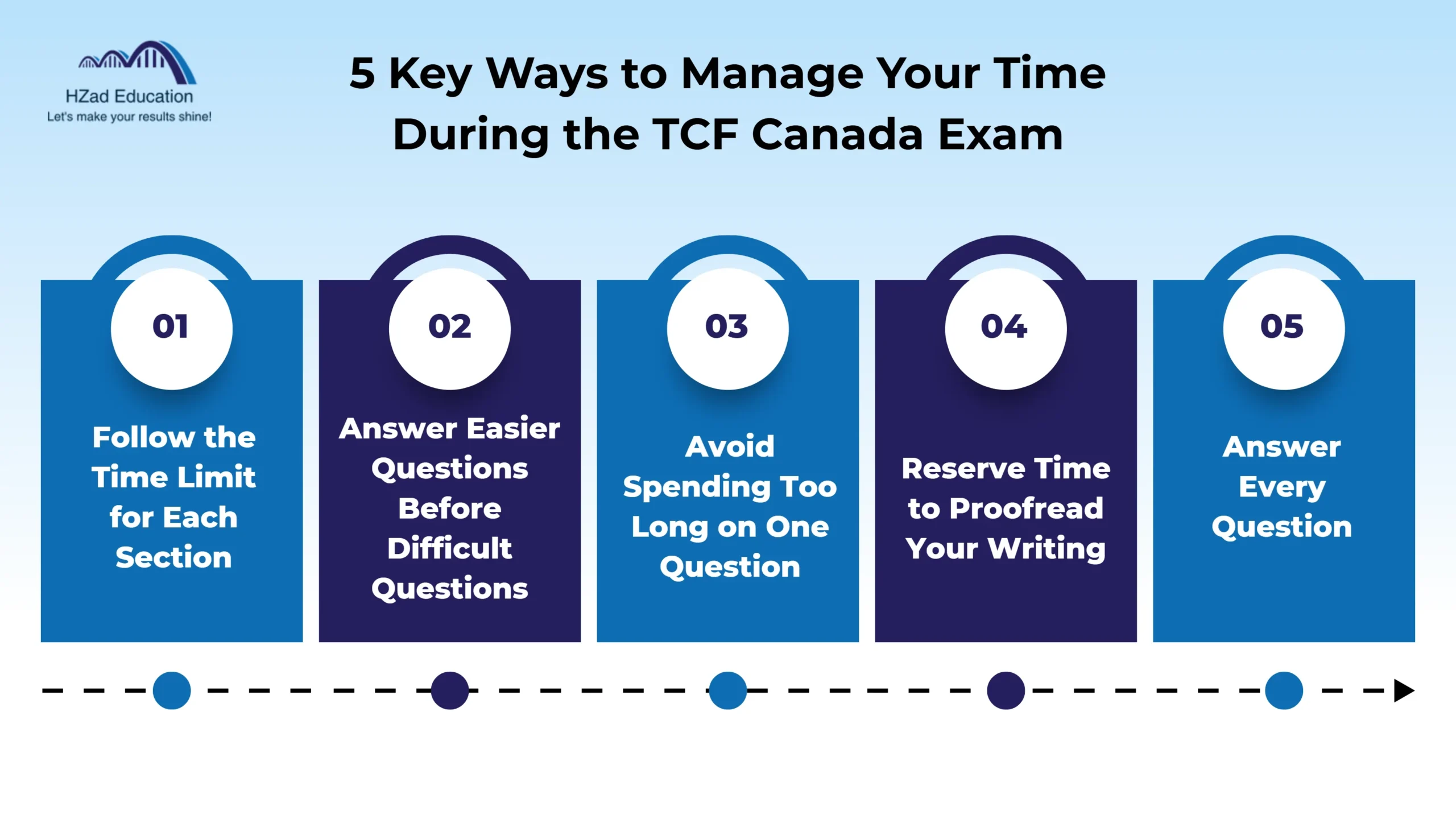 You can manage your time during the TCF Canada exam by following section time limits, prioritizing easier questions, avoiding excessive time on difficult questions, reserving time for writing review, and answering every question before submission. Effective time management helps candidates complete all sections efficiently and reduces the risk of leaving questions unanswered or responses unfinished.
5 key ways to manage your time during the TCF Canada exam are:
- Follow the Time Limit for Each Section: Complete each exam section within the allocated time and avoid spending extra minutes that affect other sections. Maintaining awareness of the remaining time helps you complete all required tasks before the deadline.
- Answer Easier Questions Before Difficult Ones: Start with questions you can answer quickly, then return to more challenging questions when time allows. This approach helps secure available marks while preventing delays on difficult questions.
- Avoid Spending Too Long on One Question: Move on if a question takes too long and maintain a steady pace throughout the exam. Spending excessive time on one question can reduce the time available for other sections or questions.
- Reserve Time to Proofread Your Writing: Keep a few minutes at the end of the Written Expression section to check grammar, spelling, word count, and sentence structure. A final review helps identify mistakes and improve response accuracy.
- Answer Every Question: Attempt all questions before submitting the exam because unanswered questions do not provide scoring opportunities. Completing every question ensures you have a chance to receive points from all sections.
What Mistakes Should You Avoid on TCF Canada Exam Day?
Common mistakes you should avoid on the TCF Canada exam day include arriving late, forgetting your valid photo ID, bringing prohibited items, ignoring exam instructions, mismanaging your time, and leaving questions unanswered. Avoiding these errors helps ensure a smooth exam experience and allows you to complete each section in accordance with the test centre’s requirements.
6 common mistakes you should avoid on the TCF Canada exam day are:
- Arriving Late: Arrive at the TCF Canada exam centre before the scheduled reporting time to complete check-in procedures without delays. Reaching late can result in denied entry after the exam begins and loss of the scheduled test session.
- Forgetting Your Valid Photo ID: Bring the original, unexpired photo ID used during registration for identity verification at the test centre. Forgetting the required identification document can prevent you from completing the admission process.
- Bringing Prohibited Items: Avoid carrying prohibited items such as unauthorized electronic devices, notes, or restricted materials into the exam centre. Following the test centre’s belongings policy helps maintain exam security and prevents possible violations.
- Ignoring Exam Instructions: Follow all instructions provided by the proctor and test centre staff during the TCF Canada exam. Ignoring examination procedures, timing rules, or security requirements can affect your participation in the test.
- Mismanaging Your Time: Manage your time carefully across all TCF Canada exam sections and avoid spending too much time on any single task. Proper time management helps you complete questions, writing tasks, and final reviews within the allotted time.
- Leaving Questions Unanswered: Attempt every question before submitting your exam because unanswered questions do not provide scoring opportunities. Completing all questions allows you to receive points from every possible response.
How Can You Stay Calm During the TCF Canada Exam?
You can stay calm during the TCF Canada exam by reviewing the exam format before arriving, listening carefully to the proctor’s instructions, using controlled breathing, focusing on one section at a time, and avoiding mental review of previous answers. These strategies help maintain concentration and support confident performance throughout the examination.
5 ways you can follow to stay calm during the TCF Canada exam are:
- Review the Exam Format Before Arrival: Review the exam structure, section types, and question formats before arriving at the test centre. Familiarity with the process helps reduce uncertainty and improves confidence during the assessment.
- Listen Carefully to Proctor Instructions: Pay close attention to instructions provided by the proctor before and during the exam. Following the correct procedures helps you avoid confusion and maintain focus throughout the test.
- Use Controlled Breathing: Practice slow and controlled breathing techniques when you feel stressed during the exam. This helps maintain focus, reduce tension, and support a calm approach to each section.
- Focus on One Section at a Time: Concentrate on the current exam section instead of worrying about upcoming tasks. Focusing on one step at a time helps maintain attention and prevents unnecessary stress.
- Avoid Reviewing Previous Answers Mentally: Avoid repeatedly thinking about completed questions or answers during the exam. Direct your attention toward the current task to maintain concentration and complete the remaining sections effectively.
What Happens After You Finish the TCF Canada Exam?
After you finish the TCF Canada exam, the test centre completes the submission process, your responses are evaluated, and your official results are prepared according to the TCF Canada scoring system. Candidates should wait for the result notification, review the score report, and use the certificate for their intended purpose, such as immigration or academic requirements.
When Are TCF Canada Results Released?
TCF Canada exam results are released within 15 working days (around 2 to 3 weeks) after completing all sections of the test. The processing period begins when France Éducation International receives the test materials from the test centre.
Result Processing Timeline:
- Standard processing: Results are generally prepared within 15 working days after the test materials are received by France Éducation International.
- Delivery method: Results are first sent to the test centre, which then provides candidates with an official digital certificate or email attestation according to the centre’s process.
- Seasonal delays: Processing time can increase during peak periods, such as late-summer closures or the December holiday period, with delays extending up to 4-6 weeks.
How Can You Access Your TCF Canada Results?
You can access your official TCF Canada results through the digital certificate sent by email or by collecting the official paper certificate from your test centre. France Éducation International sends results to the test centre within 15 working days after receiving the test materials, and candidates receive the certificate based on the centre’s process.
Key points about accessing TCF Canada results:
- Digital certificate: Many test centres send the signed PDF certificate directly to candidates by email after processing.
- Paper certificate: Some test centres require candidates to collect the official certificate in person.
- Online score portal: TCF Canada does not provide a self-service portal for candidates to directly check individual scores through the France Éducation International website.
- Certificate validity: The official TCF Canada certificate remains valid for 2 years from the date of issue.
- Certificate copy: Candidates receive one official certificate copy and should securely save a digital backup for future use.
How Are TCF Canada Scores Used for Canadian Immigration?
TCF Canada scores are used for Canadian immigration by converting listening, reading, writing, and speaking directly into NCLC levels (roughly 4–10, with higher scores grouped at the top) rather than a simple pass/fail grade. These benchmarks evaluate French proficiency to determine eligibility, grant major bonus points in Express Entry, qualify candidates for targeted Francophone draws, and fulfill provincial and citizenship requirements. Certificates remain valid for 2 years.
How Are TCF Canada Scores Converted to NCLC Levels?
TCF Canada scores are converted into NCLC levels using the official IRCC conversion scale, with Listening, Reading, Speaking, and Writing evaluated separately based on individual skill scores. Listening and Reading are scored from 0 to 699, while Speaking and Writing are scored from 0 to 20.
| NCLC Level | Reading (0–699) | Listening (0–699) | Writing (0–20) | Speaking (0–20) |
| NCLC 4 | 342–374 | 331–368 | 4–5 | 4–5 |
| NCLC 5 | 375–405 | 369–397 | 6 | 6 |
| NCLC 6 | 406–452 | 398–457 | 7–9 | 7–9 |
| NCLC 7 | 453–498 | 458–502 | 10–11 | 10–11 |
| NCLC 8 | 499–523 | 503–522 | 12–13 | 12–13 |
| NCLC 9 | 524–548 | 523–548 | 14–15 | 14–15 |
| NCLC 10+ | 549–699 | 549–699 | 16–20 | 16–20 |
How Can You Prepare Better for the TCF Canada Exam?
You can prepare better for the TCF Canada exam by understanding the test structure, identifying your language skill gaps, and creating a focused study plan for Listening, Reading, Writing, and Speaking. A TCF prep course can help you practise official task formats, improve pacing through timed exercises, measure progress with practice tests, and reduce avoidable mistakes before exam day.