
The TEF (Test d’Évaluation de Français) score chart is the official reference used to convert TEF Canada scores into Niveaux de compétence linguistique canadiens (NCLC) and equivalent Canadian Language Benchmark (CLB) levels recognized by Immigration, Refugees and Citizenship Canada (IRCC).
The exam evaluates Listening, Reading, Writing, and Speaking separately, with each skill receiving its own score and proficiency level. Reading and Listening are scored based on correct answers, while Writing and Speaking are assessed by certified examiners using criteria such as grammar, vocabulary, fluency, coherence, and task completion.
Since IRCC evaluates each language skill independently, a higher score in one module cannot compensate for a lower score in another. The resulting NCLC/CLB levels determine eligibility for Express Entry, Provincial Nominee Programs, permanent residency, Canadian citizenship, study permits, and work permits.
The TEF score chart also enables candidates to compare TEF Canada with IELTS, CELPIP, and TCF Canada, helping them understand language requirements and prepare for their target CLB/NCLC level.
How Does the TEF Score Chart Work?
The TEF score chart works by grading four distinct language skills independently on a numerical scale from 0 to 699 points, mapping those raw numbers to international language levels and Canadian Language Benchmarks (CLB/NCLC). Developed by the Paris Île-de-France Chamber of Commerce and Industry (CCI Paris Île-de-France), this standardized conversion matrix translates test performance into recognized national and international frameworks.
How Are TEF Scores Measured?
TEF scores are measured independently for each language domain rather than being combined into a single, averaged grade. The measurement methodology differs depending on the nature of the evaluation:
- Objective Modules (Listening and Reading): Administered primarily as multiple-choice items. Correct responses generate points, which are then converted via statistical calibration to reflect overall comprehension accuracy.
- Subjective Modules (Oral and Written Expression): Evaluated by certified, independent examiners using standardized assessment grids. Grading focuses on criteria such as task accomplishment, vocabulary range, grammatical control, coherence, and fluency.
Which TEF Sections Have Separate Scores?
The TEF Canada exam reports separate scores for four language skills (listening, reading, oral, and written) because each measures a different aspect of French language proficiency. These individual scores are converted independently into NCLC levels, allowing Canadian immigration authorities to evaluate whether candidates meet the required language benchmark for each skill.
TEF sections that have separate scores are:
- Listening Comprehension (Compréhension de l’oral)
Evaluates a candidate’s ability to process and understand spoken French across audio clips of varying complexity, including announcements, radio segments, and conversational discussions. Scored independently on a calibrated scale from 0 to 699 (with CLB 4 starting at 306), this section isolates auditory processing speed and spoken vocabulary comprehension from text-based or expressive skills.
- Reading Comprehension (Compréhension de l’écrit)
Assesses the capacity to analyze written texts, identify key information, and understand arguments in news articles, administrative notices, and formal documents. Graded on a separate 0 to 699 scale (with CLB 4 starting at 306), it isolates silent reading speed, structural grammar recognition, and textual comprehension from listening or speaking capabilities.
- Oral Expression (Expression orale)
Measures active verbal communication skills through two interactive role-play scenarios requiring information gathering, persuasion, and spontaneous dialogue. Graded on an independent 0 to 699 scale (with CLB 4 starting at 328), it focuses specifically on real-time pronunciation, spoken fluency, interaction strategies, and oral vocabulary range.
- Written Expression (Expression écrite)
Evaluates written communication abilities through two distinct writing tasks (continuing a news story and expressing/defending a personal opinion). Scored on its own 0 to 699 scale (with CLB 4 starting at 268), it evaluates written syntax, textual coherence, orthography, and formal argumentation without being affected by oral fluency or auditory skills.
How Do TEF Scores Convert to CLB and NCLC Levels?
TEF scores convert to CLB and NCLC levels by matching the standardized score achieved in each language skill (Listening, Reading, Oral, and Written) to the official NCLC conversion chart published by IRCC. Although many applicants refer to this as a TEF-to-CLB conversion, CLB (Canadian Language Benchmarks) is the English language benchmark used for IELTS and CELPIP, while NCLC is the equivalent benchmark for French language tests such as TEF Canada.
Because CLB and NCLC represent equivalent proficiency levels in Canada’s official languages, they are used in immigration program pathways such as Express Entry, Provincial Nominee Programs, permanent residency, Canadian citizenship, study permits, and work permits.
| NCLC / CLB Level | Listening Comprehension | Reading Comprehension | Written Expression | Oral Expression |
| CLB 10 | 546 – 699 | 546 – 699 | 558 – 699 | 556 – 699 |
| CLB 9 | 503 – 545 | 503 – 545 | 512 – 557 | 518 – 555 |
| CLB 8 | 462 – 502 | 462 – 502 | 472 – 511 | 494 – 517 |
| CLB 7 | 434 – 461 | 434 – 461 | 428 – 471 | 456 – 493 |
| CLB 6 | 393 – 433 | 393 – 433 | 379 – 427 | 422 – 455 |
| CLB 5 | 352 – 392 | 352 – 392 | 330 – 378 | 387 – 421 |
| CLB 4 | 306 – 351 | 306 – 351 | 268 – 329 | 328 – 386 |
What Are the Minimum TEF Scores for CLB 5, 7, 8, and 10?
The minimum TEF scores for CLB 5, 7, 8, and 10 range across modules from 330 to 387 for CLB 5, 428 to 456 for CLB 7, 462 to 494 for CLB 8, and 546 to 558 for CLB 10, with exact thresholds varying based on the language skill assessed. Because IRCC evaluates applicant profiles on a strict skill-by-skill basis rather than averaging performance, failing to reach any single component’s minimum threshold will drop your usable benchmark tier down to that lowest score.
Here are the minimum TEF scores for CLB 5, 7, 8, and 10 across different tests:
- CLB 5 (Minimum threshold for Canadian Experience Class TEER 2/3 and Federal Skilled Trades) requires a minimum of:
- Listening: 352
- Reading: 352
- Writing: 330
- Speaking: 387
- CLB 7 (The baseline requirement for Federal Skilled Worker and Express Entry French language eligibility) demands minimum scores of:
- Listening: 434
- Reading: 434
- Writing: 428
- Speaking: 456
- CLB 8 (Advanced intermediate tier) requires at least:
- Listening: 462
- Reading: 462
- Writing: 472
- Speaking 494
- CLB 10 (Advanced/superior proficiency tier) requires minimum scores of
- Listening: 546
- Reading: 546
- Writing: 558
- Speaking: 556
How Should You Read the TEF Score Conversion Chart?
The TEF score conversion chart should be read by comparing your Listening, Reading, Writing, and Speaking scores separately against the official NCLC conversion ranges. Since each language skill is assessed independently, you may achieve different NCLC levels across the four modules.
Here is how you can read the TEF score conversion chart accurately:
- Locate Your Calibrated Section Scores: Find the individual scaled scores (ranging from 0 to 699) listed on your official TEF certificate (Attestation de résultats) for Listening, Reading, Writing, and Speaking.
- Match Scores Skill-by-Skill: Check each section score against the corresponding column in the official TEF to CLB/NCLC conversion grid. For instance, a Reading score of 440 falls into the CLB 7 band (434-461), while a Writing score of 480 qualifies as CLB 8 (472-511).
- Determine Your Lowest Qualifying Benchmark: Identify the lowest CLB level across all four evaluated competencies. If your scores yield CLB 9 in Listening, Reading, and Speaking, but CLB 6 in Writing, your overall functional language tier for program eligibility is evaluated at CLB 6.
- Calculate Language Points for Your Application: Input your individual per-skill CLB levels into your target immigration profile (such as Express Entry or a Provincial Nominee Program) to view your exact CRS or stream point allocation.
How Do Raw TEF Scores Match Proficiency Levels?
Raw TEF scores match proficiency levels through specific score bands mapped to the Council of Europe’s Common European Framework of Reference for Languages (CEFR) levels A1 to C2 and Canada’s Niveaux de compétence linguistique canadiens (NCLC)/Canadian Language Benchmarks (CLB). Each Listening, Reading, Writing, and Speaking score falls within a predefined range that corresponds to a proficiency level, allowing educational institutions, employers, and IRCC to evaluate French language ability using standardized benchmarks.
| NCLC Level | CEFR Level | Reading | Listening | Writing | Speaking |
| NCLC 4 | A2 | 121-144 | 145-180 | 181-225 | 181-225 |
| NCLC 5 | B1 | 151-180 | 181-225 | 226-270 | 226-270 |
| NCLC 6 | B2 | 181-206 | 226-248 | 271-309 | 271-309 |
| NCLC 7 | B2 | 207-232 | 249-279 | 310-348 | 310-348 |
| NCLC 8 | C1 | 233-247 | 280-297 | 349-370 | 349-370 |
| NCLC 9+ | C1/C2 | 248+ | 298+ | 371+ | 371+ |
Why Does Each TEF Skill Have a Different Score Range?
Each TEF skill has a different score range because Listening Comprehension, Reading Comprehension, Written Expression, and Oral Expression measure distinct language competencies using separate assessment methods and scoring scales. Reading and Listening evaluate comprehension through objective questions, while Writing and Speaking assess productive language skills based on criteria such as grammar, vocabulary, fluency, coherence, and task completion. As a result, each module has its own score range, which is converted independently to the corresponding NCLC/CLB level using the official TEF score conversion chart.
Can a Higher Score in One TEF Skill Offset a Lower Score in Another?
No, a higher score in one TEF Canada skill cannot offset or compensate for a lower score in another because Listening, Reading, Writing, and Speaking are evaluated independently. Immigration, Refugees and Citizenship Canada (IRCC) assigns a separate NCLC/CLB level to each language skill rather than calculating an overall average or composite score.
To qualify for immigration programs, such as the Federal Skilled Worker Program, or to claim Express Entry skill transferability points, applicants must meet the required CLB/NCLC benchmark in every language module. For example, achieving CLB 9 or 10 in three skills but CLB 6 in the fourth means the application does not meet the program requirement of CLB 7 across all four components, so improvement in the weaker skill is necessary before retaking the test.
What Can You Qualify for at Each TEF Score Level?
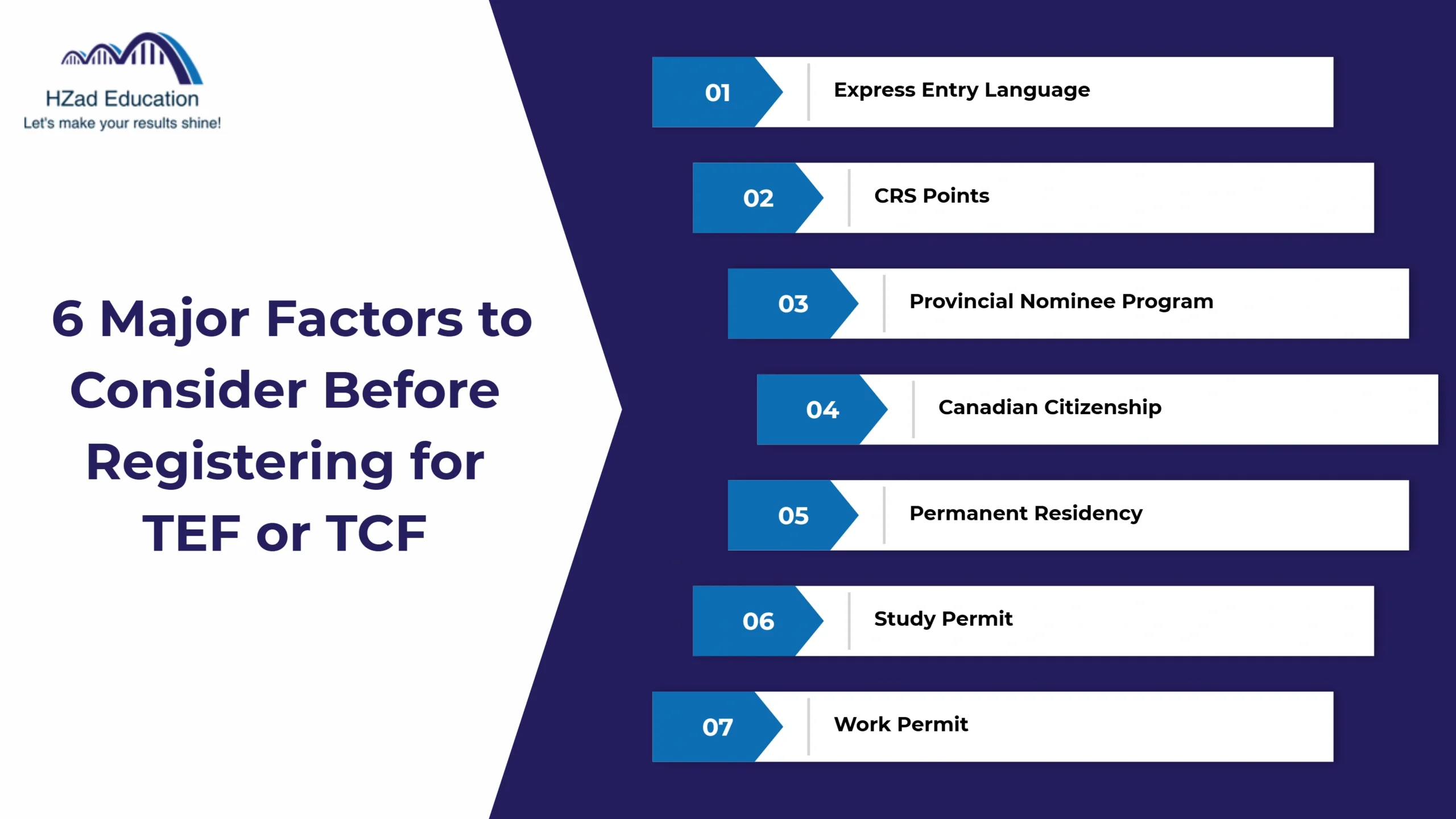
At each TEF score level, you can qualify for Express Entry language, CRS points, Provincial Nominee Program (PNP), Canadian citizenship, permanent residency, study permits, and work permits. Since these pathways evaluate your NCLC/CLB level instead of your raw TEF score, meeting higher language benchmarks can expand your eligibility and strengthen your immigration or study application.
Here are some things you can qualify for at each TEF score level:
- Express Entry Language: Achieving a minimum of CLB 7 (Listening 434, Reading 434, Writing 428, Speaking 456) unlocks eligibility for targeted French-language proficiency category-based draws under Express Entry, significantly lowering required total CRS cutoffs compared to general draws.
- CRS Points: Scoring CLB 7 or higher earns up to 50 additional Comprehensive Ranking System (CRS) bonus points (or up to 74 points when paired with strong English scores), while higher tiers (CLB 8 to 10+) progressively increase your base language points up to 136 total points.
- Provincial Nominee Program: Many PNP streams (such as Ontario’s French-Speaking Skilled Worker Stream or New Brunswick’s Francophone stream) accept CLB 7 for direct nomination, while certain regional pathways accept lower entry thresholds down to CLB 4 or 5.
- Canadian Citizenship: Applicants aged 18 to 54 must demonstrate at least CLB 4 (Listening 306, Speaking 328) in oral communication (listening and speaking components only) to fulfill naturalization requirements.
- Permanent Residency: Meets language requirements across multiple PR pathways, with skilled streams (FSWP) requiring CLB 7 across all four skills and trade/experience streams (CEC/FSTP) requiring CLB 5 (TEER 2/3) or CLB 4 (TEER 4/5).
- Study Permit: Demonstrates required French proficiency for admissions into French-language post-secondary programs across Quebec and designated bilingual institutions in Canada, typically requiring the equivalent of CLB 6 to 7 (CEFR B2).
- Work Permit: Fulfills language requirements for specific Francophone mobility work permits (such as the Mobilité Francophone stream), which requires CLB 5 or higher in listening and speaking to work outside Quebec without a labour market assessment.
How Do TEF, IELTS, and CELPIP Scores Compare by CLB Level?
TEF Canada, IELTS General Training, and CELPIP General measure language proficiency using different scoring systems, but all three are converted to the Canadian Language Benchmarks (CLB) for immigration purposes. While TEF Canada assesses French proficiency and IELTS and CELPIP assess English proficiency, IRCC uses official CLB/NCLC conversion charts to determine whether applicants meet the language requirements for Express Entry and other Canadian immigration programs.
| CLB Level | TEF Canada (NCLC) | IELTS General Training | CELPIP General |
| CLB 4 | NCLC 4 | Listening 4.5, Reading 3.5, Writing 4.0, Speaking 4.0 | Level 4 |
| CLB 5 | NCLC 5 | Listening 5.0, Reading 4.0, Writing 5.0, Speaking 5.0 | Level 5 |
| CLB 6 | NCLC 6 | Listening 5.5, Reading 5.0, Writing 5.5, Speaking 5.5 | Level 6 |
| CLB 7 | NCLC 7 | Listening 6.0, Reading 6.0, Writing 6.0, Speaking 6.0 | Level 7 |
| CLB 8 | NCLC 8 | Listening 7.5, Reading 6.5, Writing 6.5, Speaking 6.5 | Level 8 |
| CLB 9 | NCLC 9 | Listening 8.0, Reading 7.0, Writing 7.0, Speaking 7.0 | Level 9 |
| CLB 10+ | NCLC 10+ | Listening 8.5-9.0, Reading 8.0-9.0, Writing 7.5-9.0, Speaking 7.5-9.0 | Level 10-12 |
How Do TEF and TCF Scores Compare?
TEF and TCF scores compare directly through equivalent alignment with the Common European Framework of Reference (CEFR) and Canadian Language Benchmarks (CLB), though they use different raw point scales and format structures.
While TEF Canada and TCF Canada assign different score ranges for Listening, Reading, Writing, and Speaking, IRCC converts both tests to the same NCLC/CLB benchmarks to evaluate French language proficiency consistently. Understanding these differences between TEF and TCF helps test takers choose the exam that best suits their strengths while ensuring they meet the French language requirements for Canadian immigration.
| Feature | TEF Canada | TCF Canada |
| Administering Body | CCI Paris Île-de-France | France Éducation international (Ministry of Education) |
| Validity | 2 Years | 2 Years |
| Scoring Scale | 0-699 across all 4 skills | 0-699 for Reading & Listening
0-20 for Speaking & Writing |
| Oral Expression Structure | 2 Tasks (Role-play scenarios: gathering info & persuasion) | 3 Tasks (Interview, role-play/argumentation, expressing opinion) |
| Written Expression Structure | 2 Tasks (News article continuation & opinion essay) | 3 Tasks (Short message, personal account/letter, opinion essay) |
| Listening & Reading Mechanics | Standard Multiple Choice (Audio only) | Standard Multiple Choice (May include short video prompts in listening) |
| Perceived Testing Style | Stricter qualitative marking; requires role-play immersion | More structured task breakdown; abundant self-study prep materials |
What Factors Determine Your TEF Score?
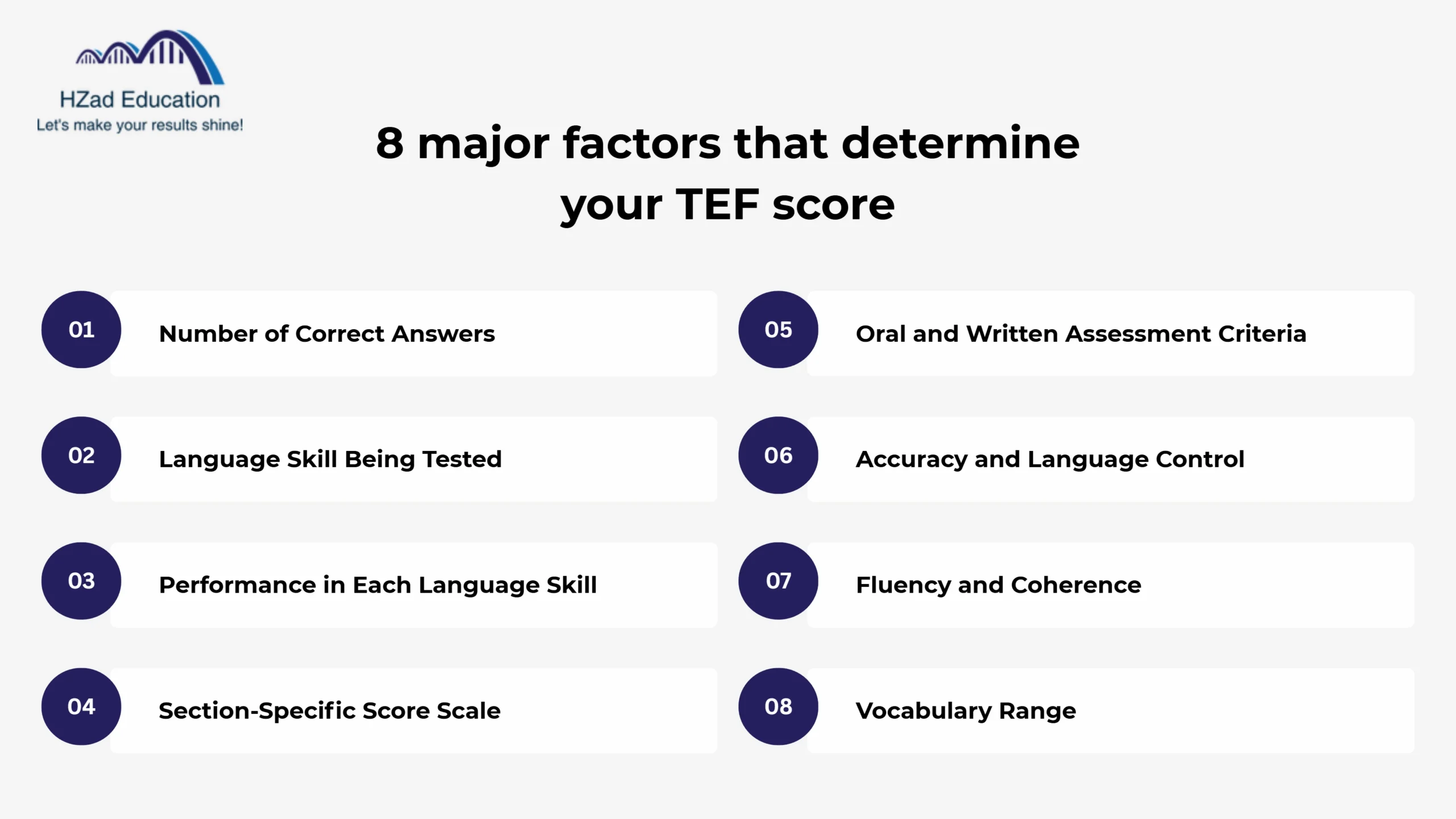
Factors that determine your TEF score include the number of correct answers, language skill being tested, performance in each language skill, section-specific score scale, oral and written assessment criteria, accuracy and language control, fluency and coherence, and vocabulary range. Since TEF Canada evaluates Listening, Reading, Writing, and Speaking independently, each module follows its own scoring method and assessment criteria before the results are converted to the corresponding NCLC/CLB level.
8 major factors that determine your TEF score:
- Number of Correct Answers: In the multiple-choice sections (Listening and Reading), your raw score is determined by the total number of correct answers (+1 point per correct response). Under positive marking rules, there is no negative marking or point deduction for incorrect or unanswered questions.
- Language Skill Being Tested: Each of the four evaluated skills, Listening, Reading, Writing, and Speaking, measures distinct linguistic abilities under different constraints (e.g., fast auditory recall vs. formal text composition).
- Performance in Each Language Skill: Your performance across individual modules dictates section-specific results. Strong results in one skill cannot boost or compensate for weak performance in another.
- Section-Specific Score Scale: Raw points earned in multiple-choice modules are statistically calibrated into a final reported range of 0 to 699 points per component. This calibration accounts for minor variances in question difficulty across different exam versions.
- Oral and Written Assessment Criteria: Active production tasks (Oral Expression and Written Expression) are graded by certified, independent examiners who apply standardized rubrics to evaluate qualitative performance.
- Accuracy and Language Control: Evaluates grammatical correctness, proper verb conjugation, correct syntax, accurate spelling, and precise punctuation in written tasks, as well as grammatical control during speech.
- Fluency and Coherence: Measures how smoothly ideas are expressed without disruptive hesitation, supported by logical paragraphing, clear structural transitions, and effective discourse connectors.
- Vocabulary Range: Assesses the breadth, diversity, and contextual appropriateness of your vocabulary, including the correct usage of idiomatic expressions and formal registers tailored to each prompt.
What Should You Do If Your TEF Score Does Not Meet Your CLB/NCLC Requirement?
If your TEF score does not meet your CLB/NCLC requirement, review your results carefully, identify the language skills that fall below the required benchmark, and focus your preparation on those specific areas before retaking the exam. Since IRCC evaluates Listening Comprehension, Reading Comprehension, Written Expression, and Oral Expression independently, improving your weakest skill can help you achieve the Niveaux de compétence linguistique canadiens (NCLC) level required for your immigration or citizenship pathway.
Here are the most effective steps to improve your TEF Canada score:
- Review your score report: Compare your results with the official NCLC conversion chart to identify which language skills do not meet your target benchmark.
- Focus on weaker language skills: Spend more time practicing the modules where you scored below the required NCLC level, such as Listening Comprehension or Written Expression.
- Follow a structured preparation course: Enrolling in a comprehensive TEF preparation course provides guided practice, exam strategies, and targeted exercises for every language skill. Structured TEF prep courses combine structured lessons, practice tests, and instructor guidance to help candidates improve efficiently.
- Practice with official-style questions: Use mock tests and timed practice exercises to become familiar with the exam format and strengthen accuracy under test conditions.
- Seek expert feedback: A qualified French instructor can identify weaknesses in grammar, pronunciation, vocabulary, fluency, and writing structure, allowing you to correct recurring mistakes before retaking the exam.
- Retake the TEF Canada exam when ready: Once your practice results consistently meet your target NCLC/CLB level, schedule another test attempt to maximize your chances of meeting your immigration or academic requirements.