
TEF Canada and TCF Canada are both official French proficiency tests accepted by Immigration, Refugees and Citizenship Canada (IRCC), so the best test is the one that aligns with your immigration goal, target CLB/NCLC score, preferred exam format, and preparation style. Although both examinations assess Listening, Reading, Writing, and Speaking, they differ in their administering bodies, test structure, scoring systems, task formats, and availability across Canada.
TEF Canada is suited to candidates who prefer to view questions during listening, complete fewer but longer writing tasks, and participate in interactive speaking exercises. TCF Canada may be a better fit for candidates who prefer shorter, structured writing tasks, isolated reading passages, and a more concise speaking assessment.
Regardless of the exam you choose, IRCC converts individual skill scores into Canadian Language Benchmarks (CLB/NCLC) using official equivalency tables, rather than relying on an overall score or CEFR level.
What Are the Key Differences Between TEF and TCF at a Glance?
Key differences between TEF Canada and TCF Canada include their administering bodies, exam formats, scoring structures, task counts, and test availability. Understanding these differences helps you choose the test that best aligns with your target Canadian Language Benchmark (CLB/NCLC) level, preferred test format, preparation approach, and access to local test centres.
Here is a table highlighting the key differences between TEF and TCF:
| Comparison Factor | TEF Canada | TCF Canada |
|---|---|---|
| Full test name | Test d’évaluation de français | Test de connaissance du français Canada |
| Administering Body | Paris Île-de-France Chamber of Commerce and Industry (CCI) | France Éducation international |
| Total Test Duration | 2 hours and 55 minutes | 2 hours and 47 minutes |
| Listening Structure | 60 questions (40 mins) | 39 questions (35 mins) |
| Reading Structure | 50 questions (60 mins) | 39 questions (60 mins) |
| Writing Component | 2 Tasks (60 mins total) | 3 Tasks (60 mins total) |
| Speaking Component | 2 Tasks (~15 mins) | 3 Tasks (~12 mins) |
| Sectional Re-evaluation | Not permitted. | Allowed for writing and speaking components (at an additional fee). |
Which Organizations Accept TEF and TCF?
TEF and TCF are accepted by Immigration, Refugees and Citizenship Canada (IRCC) for Express Entry, Provincial Nominee Programs (PNPs), the Province of Québec (MIFI), and Canadian citizenship. Because both French proficiency tests undergo identical psychometric standardization and rigorous statutory validation, a score certificate from either test holds equal legal weight when processing your immigration, residency, or citizenship application.
Key organizations and pathways that accept TEF Canada and TCF Canada include:
- Immigration, Refugees and Citizenship Canada (IRCC): IRCC recognizes both TEF Canada and TCF Canada as approved French language tests for federal economic immigration programs, including Express Entry under the Federal Skilled Worker Program (FSWP), Canadian Experience Class (CEC), and Federal Skilled Trades Program (FSTP).
- Provincial Nominee Programs (PNPs): Provinces and territories across Canada (including Ontario’s OINP, British Columbia’s BCPNP, and Alberta’s AAIP) formally accept both test profiles to award stream-specific points. This is particularly critical for dedicated provincial pipelines designed to attract French-speaking skilled workers.
- The Province of Québec (MIFI): For candidates intending to settle in Québec, the Ministère de l’Immigration, de la Francisation et de l’Intégration (MIFI) formally recognizes both TEF and TCF results. While Québec historically favoured regional variants (such as TEFAQ or TCF-Québec), standard TEF Canada and TCF Canada score certificates are fully accepted for permanent selection applications under modern Québec economic streams.
- Canadian Citizenship Pathways: For permanent residents applying for citizenship, IRCC accepts the full 4-module versions of both tests. Additionally, specialized shortened formats such as the TEF Canada 2-Modules (which assess only Listening and Speaking) are accepted specifically for citizenship and the Francophone Mobility Program.
Tip: Always verify the exact test version with your legal consultant or the specific program guidelines before paying your registration fee. For example, general academic versions (such as the standard TCF or TEF Tout Public) will not be accepted by IRCC for immigration purposes, as you must register specifically for the Canadian variants.
How Do TEF and TCF Compare in Scoring?
TEF awards scores based on a broader point system ranging from 0 to 699+, where specific ranges map to CEFR levels (like A1 to C2), while TCF uses a numerical scale ranging from 0 to 699 for each section, which is then cleanly mapped to CEFR and NCLC levels. Despite these differences, Canadian immigration authorities interpret both tests through NCLC/CLB equivalency levels for each skill, requiring candidates to assess listening, reading, writing, and speaking scores individually rather than relying on a single overall result.
How Do TEF and TCF Scores Map to Canadian Language Benchmarks (CLB)?
TEF and TCF scores map to the Canadian Language Benchmarks (CLB), also known as the Niveaux de compétence linguistique canadiens (NCLC), through official equivalency tables published by Immigration, Refugees and Citizenship Canada (IRCC). Rather than using a single overall score, IRCC converts the Listening, Reading, Writing, and Speaking results separately and assigns a CLB/NCLC level to each language skill for Canadian immigration purposes.
TEF to Canadian Language Benchmarks (CLB)
| CLB / NCLC Level | Reading (Compréhension de l’écrit) | Writing (Expression écrite) | Listening (Compréhension de l’oral) | Speaking (Expression orale) |
|---|---|---|---|---|
| 10 and Above | 263 – 300 | 393 – 450 | 316 – 360 | 393 – 450 |
| 9 | 248 – 262 | 371 – 392 | 298 – 315 | 371 – 392 |
| 8 | 233 – 247 | 349 – 370 | 280 – 297 | 349 – 370 |
| 7 | 207 – 232 | 310 – 348 | 249 – 279 | 310 – 348 |
| 6 | 181 – 206 | 271 – 309 | 217 – 248 | 271 – 309 |
| 5 | 151 – 180 | 226 – 270 | 181 – 216 | 226 – 270 |
| 4 | 121 – 150 | 181 – 225 | 145 – 180 | 181 – 225 |
TCF to Canadian Language Benchmarks (CLB)
| CLB / NCLC Level | Reading (Compréhension de l’écrit) | Writing (Expression écrite) | Listening (Compréhension de l’oral) | Speaking (Expression orale) |
|---|---|---|---|---|
| 10 and Above | 549 – 699 | 16 – 20 | 549 – 699 | 16 – 20 |
| 9 | 524 – 548 | 14 – 15 | 523 – 548 | 14 – 15 |
| 8 | 499 – 523 | 12 – 13 | 503 – 522 | 12 – 13 |
| 7 | 453 – 498 | 10 – 11 | 458 – 502 | 10 – 11 |
| 6 | 406 – 452 | 7 – 9 | 398 – 457 | 7 – 9 |
| 5 | 375 – 405 | 6 | 369 – 397 | 6 |
| 4 | 342 – 374 | 4 – 5 | 331 – 368 | 4 – 5 |
How Do TEF and TCF Scores Compare with CEFR Levels?
TEF Canada and TCF Canada scores correspond to the Common European Framework of Reference for Languages (CEFR), with proficiency levels ranging from A1 (Beginner) to C2 (Proficient). While both examinations assess French proficiency using the CEFR framework, they use different scoring scales to determine a candidate’s level. For Canadian immigration, however, Immigration, Refugees and Citizenship Canada (IRCC) relies on the Canadian Language Benchmarks (CLB/NCLC) rather than CEFR levels to evaluate language proficiency.
| CEFR Level | Description | TEF Canada Score (Per Skill) | TCF Canada Score (Per Skill) |
|---|---|---|---|
| A1 | Beginner | 101 – 199 | 100 – 199 |
| A2 | Elementary | 200 – 299 | 200 – 259 |
| B1 | Intermediate | 300 – 399 | 260 – 299 |
| B2 | Upper Intermediate | 400 – 499 | 300 – 399 |
| C1 | Advanced | 500 – 599 | 400 – 499 |
| C2 | Proficient | 600 – 699 | 500 – 699 |
Which Test Is Better for Canada?
If your preference is for visual anticipation, looking at reading and listening questions before answering, and dealing with fewer scenarios, TEF Canada is better, whereas for straightforward, shorter written tasks and no extended 10-minute monologues, TCF Canada is better. Both French language tests are accepted for Canadian immigration, so the better choice depends on whether you prefer to do a live conversation (TEF) or monologues (TCF), and how you handle time constraints for reading and writing
How Should You Choose Between TEF and TCF?
Candidates should choose between TEF Canada and TCF Canada by matching the test to their Canada goal, target CLB/NCLC level, skill strengths, preparation timeline, test centre access, and available dates. Whether you prepare independently or through a TCF & TEF Complete course, IRCC treats both certificates as having identical statutory authority, so neither French exam confers an automatic structural advantage in the Express Entry pool. Instead, securing your target Comprehensive Ranking System (CRS) points depends entirely on choosing the testing environment and task design that best protect your weak areas and highlight your natural testing strengths.
When Should You Choose TEF?
Choose TEF Canada if you want to see questions during listening tracks, prefer depth in writing, excel at interactive roleplay, favour grouped reading passages, and need immediate test slot availability. These characteristics make TEF Canada a suitable option for candidates whose strengths align with its exam structure and who want to maximize their chances of achieving their target CLB/NCLC level for Canadian immigration.
You should choose TEF if:
- You want to see questions during listening tracks: TEF Canada displays the multiple-choice options on your screen before and during the audio, allowing you to scan for keywords and anticipate the answers.
- You prefer depth over breadth in writing: The writing section requires only 2 tasks in 60 minutes (continuing a short news story and writing an opinion essay), allowing you more time to structure, plan, and proofread each piece.
- You excel at interactive roleplay: The speaking section relies heavily on interaction, featuring two tasks where you actively question or informally persuade the examiner.
- You favour grouped reading passages: TEF links multiple comprehension questions to a single, deep text passage, meaning you do not have to adapt to a completely new topic for every single question.
- You need immediate slot availability: Because TEF Canada has a larger global network of test centres, it often offers more frequent test dates on short notice.
When Should You Choose TCF?
Choose TCF Canada if you easily get distracted by multitasking while listening, prefer shorter and more practical writing tasks, feel more comfortable with shorter speaking activities, favour isolated reading passages, and want more time per reading question. These features make TCF Canada a suitable choice for candidates who prefer a structured assessment style and want an exam format that aligns with their strengths and preparation approach.
You should choose TCF if:
- You easily get distracted by multitasking while listening: TCF Canada keeps the screen blank or hidden until the audio track finishes playing, allowing you to focus entirely on listening and note-taking without visual distractions.
- You prefer shorter, practical writing tasks: Unlike TEF, TCF breaks the 60-minute writing window into 3 smaller, highly structured, practical prompts (a short message, a formal letter, and a brief comparison) with lower word counts.
- You experience speaking anxiety with extended monologues: The TCF Canada speaking component lasts approximately 12 minutes and includes shorter speaking activities. Its final argumentative task typically requires 5 to 6 minutes of discussion, making it a comfortable option for candidates who prefer shorter verbal responses over extended presentations.
- You prefer a rapid, isolated reading style: TCF features an isolated reading format in which each question is a clean slate tied to its own brief text clip, preventing a single complex passage from ruining multiple questions.
- You want more time per reading question: TCF gives you 39 questions in 60 minutes, roughly 90 seconds per item, compared to the tighter pacing of TEF’s 40-question format.
What Factors Should You Consider Before Registering?
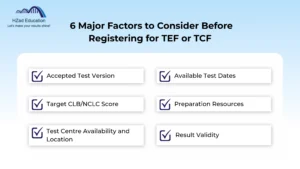
Factors you should consider before registering include the accepted test version, your target CLB/NCLC score, test centre availability, available test dates, preparation resources, and result validity. Reviewing these factors before booking your examination helps you choose the test that best supports your Canada application timeline and maximizes your chances of achieving the required language score.
6 major factors to consider before registering for TEF or TCF are:
- Accepted Test Version
Confirm that you are registering for the correct TEF Canada or TCF Canada exam accepted for your immigration or citizenship pathway. Registering for a different TEF or TCF version may result in your language results not being accepted by IRCC. Always verify the approved test version on the IRCC website and with your authorized test centre before registering.
- Target CLB/NCLC Score
Identify the CLB/NCLC level required for your Canada application before choosing a test. Compare your TEF Canada and TCF Canada practice scores to determine which exam gives you the best chance of reaching your target. You can verify the required language level through the relevant immigration program and IRCC’s official language requirements.
- Test Centre Availability and Location
Compare authorized TEF Canada and TCF Canada test centres near your location. One examination may offer more convenient locations or more frequent sessions, making it easier to register and complete your test within your application timeline. Confirm availability through the official test provider or your preferred test centre.
- Available Test Dates
Check the next available examination dates before making your decision. If one test offers an earlier session, it may better support your immigration timeline or upcoming application deadline. Always verify the latest schedules directly with the authorized test centre.
- Preparation Resources
Choose the examination for which you have better access to official practice tests, preparation courses, tutors, and mock exams. Preparing with resources specifically designed for TEF Canada or TCF Canada can improve your familiarity with the test format and increase your chances of achieving your target CLB/NCLC score.
- Result Validity
For Canadian immigration, TEF Canada and TCF Canada results are generally valid for two years from the date of the examination. Before booking your test, make sure your results will remain valid when you submit your Canada application. Confirm the current validity period through IRCC and your authorized test provider.
Cost, Availability, and Test centres Across Canada
| Factor | TEF Canada (CCI Paris Île-de-France) | TCF Canada (France Éducation international) |
|---|---|---|
| Test Fee (Full 4-Modules) | CAD 350 – CAD 399 (Varies by authorized test centre and province) | CAD 390 – CAD 400 (Varies by authorized test centre and province) |
| National Centre Network | Broadly distributed across 14+ primary hubs, spanning public colleges, language institutes, and regional cultural centres | Concentrated heavily within the official Alliance Française network and key continuing education universities |
| Test Centre Hotspots | Ontario: Toronto, Mississauga, North York, Ottawa Alberta: Calgary, Edmonton Quebec: Montréal, Québec City Other: Vancouver, Halifax, Moncton, Regina |
Ontario: Downtown Toronto, North York, Mississauga, Oakville, Ottawa Alberta: Calgary Quebec: Montréal (Concordia Language Test Centre) |
| Scheduling Frequency | Rapid weekly or bi-weekly session options. | Monthly or fixed quarterly block booking schedule. |
| Registration Deadline | Usually closes several weeks before the examination date. | Usually closes several weeks before the examination date. |
| Certificate Turnaround | Sent digitally within 4 to 6 weeks following your test session (some digital centres optimize delivery to 10 days). | Usually delivered to your portal within 2 to 3 weeks, except during standard European seasonal centre closures. |
| Mandatory Retake Window | Must wait a strict 30-day period before re-registering for a full exam attempt. | Eligible to re-test after a shorter 20-day administrative waiting period. |