
CELPIP Speaking Task 4 requires you to examine an image and predict what is likely to happen next within a 60-second response. To perform well, you should briefly describe the scene, transition naturally into predictions, present a main evidence-based prediction, add secondary predictions, justify each prediction with reasoning, and finish with a clear concluding statement. High-scoring responses depend on accurate future-tense usage, organized delivery, and evidence-based predictions rather than unsupported guesses.
A strong CELPIP Speaking Task 4 response follows a six-step framework that includes recapping the scene, transitioning into predictions, highlighting a primary outcome, expanding with additional possibilities, explaining the reasoning behind each prediction, and ending with a concise conclusion. Candidates can improve their performance by managing their time effectively, focusing on obvious visual cues, recovering smoothly from mistakes, and developing a few strong predictions rather than making many rushed ones. Using vocabulary such as speculative verbs, probability words, reasoning phrases, observational clues, prediction-linking transitions, and alternative outcome expressions can further strengthen fluency, coherence, and vocabulary range while helping meet the scoring criteria used by CELPIP evaluators.
1. Brief Recap of the Scene
Before diving into what will happen in CELPIP Speaking Task 4, you must ground your response by establishing what is happening right now. A strong response opens with a 1-2-sentence description that identifies the overall setting, the primary subjects, and their current visible actions. This initial baseline anchors your response, demonstrates to the evaluator that you have accurately interpreted the image’s context, and establishes a logical foundation for your subsequent speculations.
Model Scene Recap:
“Looking at the image, we can see a crowded outdoor park where a young boy is running quickly toward an ice cream truck while holding a dollar bill in his hand.”
2. Transition into Predictions
Moving abruptly from describing the present scene to guessing the future can make your speech sound disjointed and hurt your fluency score. To maintain a high score in CELPIP Speaking Task 4, you need a smooth linguistic bridge that signals a shift from observation to speculation. This transition should sound natural and conversational rather than like a robotic checklist.
Use one of these highly effective transition phrases to shift your momentum seamlessly:
- Based on what is currently happening in the scene, it is highly likely that…
- Judging by the current situation, we can expect a few things to happen next.
- Looking closely at the details, it seems apparent what will unfold shortly.
- Several things are about to take place in this scene over the next few minutes.
- From what we can observe, a couple of immediate actions are likely to follow.
3. Highlight One Main Prediction
Once you have transitioned, lead with your strongest, most obvious prediction as the event or action most directly supported by the visual evidence in the picture. This primary prediction is the backbone of your CELPIP Speaking Task 4 response; it must be stated clearly using definite future tenses or strong predictive structures, ensuring you name a specific subject and their immediate outcome.
- Weak Prediction (Vague & Passive): Someone will buy something at the truck soon.
- Strong Prediction (Specific & Evidentiary): The young boy is going to reach the front of the queue and order a double-scoop cone.
4. Add a Second or Third Prediction
To easily fill your 60-second response window and demonstrate a broad vocabulary range to the evaluator, you must expand the scope of your speculation. After stating the main event, introduce 1-2 secondary predictions. To maximize your points in CELPIP Speaking Task 4, you can look slightly beyond the immediate spotlight, focusing on background characters, predicting what might happen a few minutes later, or exploring alternative possibilities using the nuanced language of probability.
- Secondary Prediction Example 1:
“Additionally, the dark clouds gathering in the upper left corner suggest that there is a strong chance it might begin raining very soon.”
- Secondary Prediction Example 2:
“Consequently, the family sitting on the picnic blanket could potentially pack up their belongings to seek immediate shelter.”
5. Provide Logical Explanations
A prediction on its own is only half of the requirement; unsupported guessing will severely limit your score. To secure a Band 9 or higher in CELPIP Speaking Task 4, every single prediction must be coupled with a clear justification using the [Prediction] + [Linking Word] + [Reason from Image] pattern. Your reasons must stem directly from visual cues, logical cause-and-effect, or realistic common-sense context.
- Model Example 1:
[The dog is going to slip off its leash] + [because] + [it is pulling incredibly hard against its distracted owner].
- Model Example 2:
[The cyclist will likely slow down in a moment] + [since] + [a group of toddlers has just stepped onto the paved pathway ahead of him].
6. Wrap Up with a Strong Conclusion
Never let your response trail off into awkward silence or stop abruptly because the timer ran out. Conclude your CELPIP Speaking Task 4 speech with a definitive 1-2 sentence closing statement that wraps up the overall situation, provides a final summary thought, or offers a holistic prediction about how the scene concludes.
- Strong Conclusion (Cohesive & Complete):
“Overall, it seems like a chaotic afternoon that will result in everyone rushing home to escape the sudden downpour.”
- Weak Conclusion (Repetitive & Fragmented):
“So yeah, that is what I think will happen next in this picture because it looks like it.”
Proven Strategy to Maximize Your CELPIP Speaking Task 4 Score
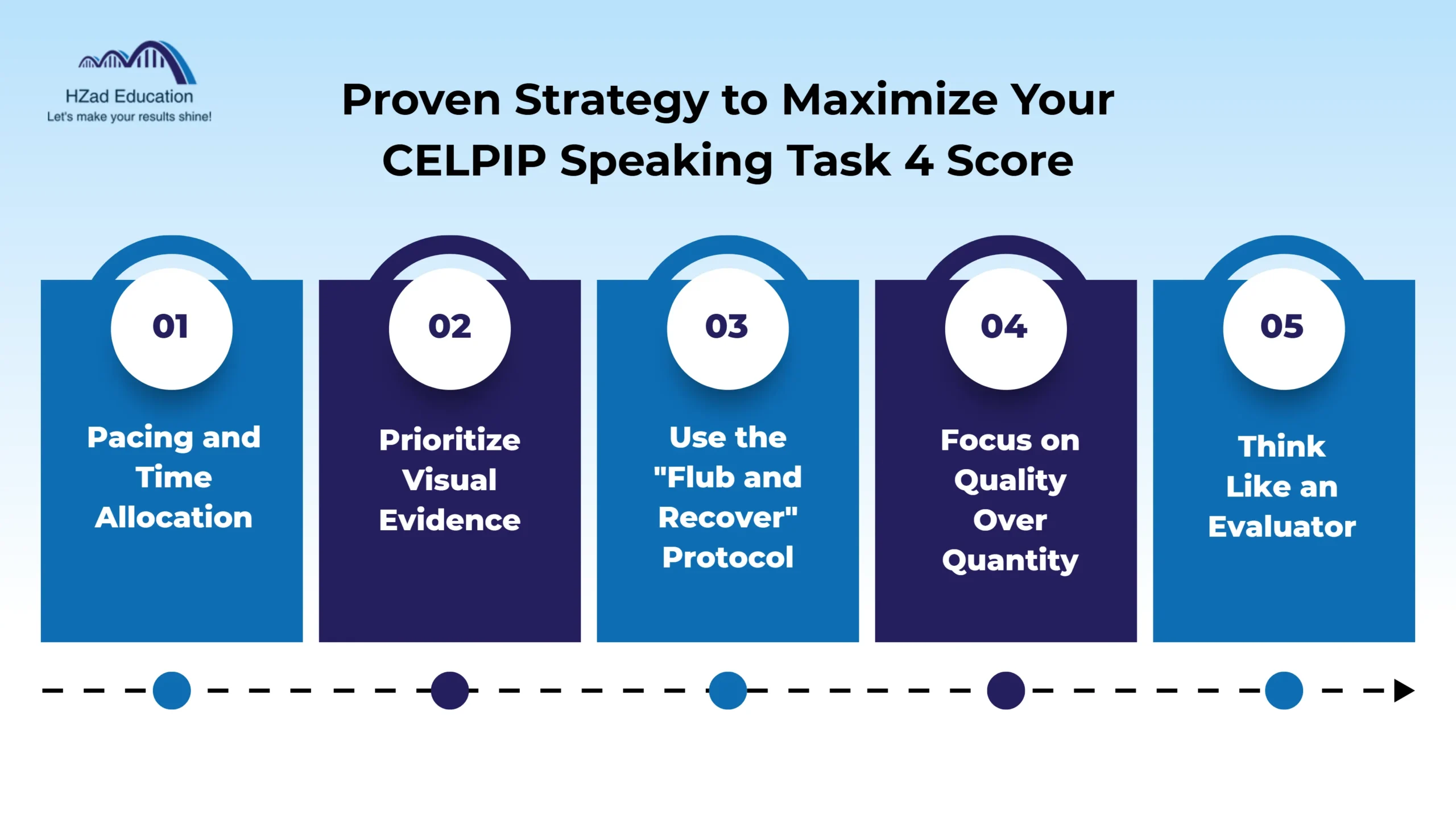
To maximize your CELPIP Speaking Task 4 score, practice pacing and time allocation, prioritize visual evidence, use the “flub and recover” protocol, and focus on quality over quantity. These strategies help you manage the 60-second response effectively while demonstrating the fluency, coherence, vocabulary range, and logical reasoning that CELPIP evaluators assess.
Follow the strategies below to maximize your CELPIP speaking Task 4 score:
- Pacing and Time Allocation
Divide your 60 seconds into distinct, manageable blocks to ensure you finish your response naturally. Aim for approximately 10 seconds for your initial scene recap, 5 seconds for a smooth transition sentence, 35 seconds to deliver 2-3 predictions paired with logical explanations, and a final 10 seconds for your concluding wrap-up sentence.
- Prioritize Visual Evidence
Always choose the most obvious, high-contrast actions in the image for your primary predictions rather than hunting for obscure background details. Selecting prominent subjects ensures you have immediate access to clear, undeniable visual cues to justify why an event is likely to happen.
- Use the “Flub and Recover” Protocol
If you make a grammatical error or misstate a prediction mid-sentence, do not pause or restart the response. Instantly correct yourself using a recovery phrase like “or rather, they are likely to…” and keep speaking as evaluators penalize a loss of fluency and extended silence far more heavily than a quickly corrected slip.
- Focus on Quality Over Quantity
Many candidates assume that more predictions lead to a higher score however, in reality, evaluators assess how effectively you communicate. Two or three well-developed predictions with logical explanations are more valuable than several rushed guesses. A calm pace, clear pronunciation, and organized structure create a stronger impression than trying to fill every second with content.
- Think Like an Evaluator
CELPIP evaluators do not score candidates based on whether their predictions are correct, as they assess how well candidates communicate their ideas. Throughout your response, focus on maintaining clear organization, accurate grammar, varied vocabulary, logical reasoning, and smooth transitions between ideas. When these elements work together, even a simple prediction can become a high-scoring response.
Essential Vocabulary For CELPIP Task 4
Essential vocabulary for the CELPIP Speaking Task 4 includes speculative verbs, probability & possibility words, linking & reasoning phrases, observational clues, linking predictions, and possible outcomes. These vocabulary categories help you make clear predictions, support them with evidence, connect ideas smoothly, and demonstrate the language range needed for a high-scoring CELPIP Speaking Task 4 response.
To systematically build your vocabulary for the CELPIP speaking task 4, you need to master words across six distinct functional categories:
Speculative Verbs
Speculative verbs indicate the action of predicting while simultaneously signalling how certain you are about that outcome. Using a variety of these verbs during the CLEPIP speaking task 4 instead of constantly saying “I think” or “I guess” shows the evaluator that you have strong grammatical control over future tenses.
| Certainty Level | Speculative Verbs | Model Example Sentence |
| Certain | will, is going to, is about to | The child is about to trip over the loose rock on the path. |
| Probable | is likely to, seems to, appears to | The store clerk appears to be closing up the shop for the evening. |
| Possible | might, could, may | The sky is darkening, so it might start raining heavily soon. |
Probability & Possibility Words
Probability words add nuance to predictions in CLEPIP speaking task 4 by showing how confident you are about a future outcome. These expressions determine a range of future possibilities by mixing different modal verbs and often work alongside speculative verbs to create more natural predictions.
Common probability and possibility words to use in CELPIP speaking task 4 are:
- probably
- possibly
- likely
- almost certainly
- there is a good chance that
- it is possible that
- there is a strong possibility that
- it is unlikely that
Combined Model Example: “Based on how fast he is driving, it is highly probable that the courier will arrive ahead of schedule.”
Linking & Reasoning Phrases
Predictions in the CELPIP speaking task 4 become more convincing when they are supported by linking and reasoning phrases. These phrases connect a prediction directly to its underlying cause or visual evidence. They are crucial for hitting your coherence targets because they transform a random guess into a logically defensible statement.
Causal Links (Explaining Cause & Effect):
- because / since / as
- therefore
- which means that
Inferential Links (Drawing Conclusions from Clues):
- this suggests that
- given that
- judging by
Combined Model Example: “Judging by the long queue forming outside, the restaurant is exceptionally popular, which means that the waiting time will likely increase.”
Observational Clues
Linguistic markers focused on observation help you anchor your language in the actual image provided in CELPIP Speaking Task 4. They signal to the evaluator that your predictions are born out of careful observation rather than generic imagination.
Useful observational phrases for CELPIP speaking task 4 are:
- I can see / I notice that…
- The image clearly illustrates…
- There seems to be…
- Looking closely at the scene…
- From what is visible in the background…
Examples
- I can see several people carrying shopping bags, so they will probably continue shopping.
- Looking at the scene, there appears to be a long queue, suggesting the service is popular.
Linking Predictions
Transition markers used between points help you maintain a seamless flow as you move from your first prediction to your second or third. Keeping your thoughts connected in this manner ensures your speech sounds like a unified response rather than a disjointed list.
Prediction-linking phrases to use in CELPIP speaking test 4 are:
- additionally
- following this
- after that
- as a result
- building on this
- another possibility is
- on top of that
Example:
The family will likely start eating lunch because the food is already prepared. Following this, the children might begin playing games in the nearby field. Another possibility is that more relatives could arrive later to join the gathering.
Possible Outcomes
Visual scenarios in CELPIP Speaking Task 4 are sometimes intentionally ambiguous, meaning more than one outcome is possible. Using alternative outcome language allows you to brilliantly speculate on different paths, showing superior critical thinking and flexibility.
Possible outcomes phrases to use in CELPIP speaking task 4 are:
- alternatively
- on the other hand
- it is also possible that
- another outcome could be
- there is a chance that
- it is equally likely that
Examples
- The group may continue their meeting outdoors. Alternatively, they could move inside if the weather changes.
- The man is likely to board the train. Another outcome could be that he decides to wait for the next one if it is crowded.
- It is also possible that the event will be postponed because the organizers appear to be preparing for changing weather conditions.
Common CELPIP Speaking Task 4 Mistakes to Avoid
Common CELPIP Speaking Task 4 mistakes include using the present tense instead of the future tense, making vague predictions without supporting reasons, and running out of content before the 60-second response ends. Avoiding these errors can improve your grammar, coherence, vocabulary range, and overall speaking performance.
Using the present tense instead of the future tense
CELPIP speaking task 4 requires you to predict what will happen next, so your predictions should be expressed using future-focused language. Using the present tense instead of the future tense can make your response sound inaccurate and may suggest that you do not fully understand the task requirements.
- Wrong: “The man goes to the store and buys some groceries.”
- Correct: “The man is going to walk into the store and will likely purchase some groceries.”
Scoring Impact: Using the incorrect tense directly penalizes your performance across both the Task Fulfillment and Grammatical Accuracy scoring metrics.
Vague predictions with no reasoning
A prediction floating without a logical baseline is worth significantly less to an evaluator than one supported by solid visual context. Candidates who simply make guesses without linking them to physical markers in the image fail to provide rich content for evaluation.
- Vague Prediction: “I think that something bad is going to happen in the park.”
- Reasoned Prediction: “Based on the aggressive posture of the stray dog, it is highly likely that it will bark at the passing pedestrians.”
Scoring Impact: Unsupported guessing instantly lowers your marks in the Coherence and Vocabulary Generation dimensions.
Running out of content before 60 seconds
Finishing your recording in 25 to 30 seconds leaves a massive gap of empty airtime, signalling a limited vocabulary range and an inability to expand on a topic. To recover and safely extend your speech to the full 60 seconds without repeating yourself or straying off-topic, master these three distinct recovery techniques:
- Introduce a Secondary Prediction Area: Pivot your gaze away from the central figures and focus on a completely separate background interaction.
Example: “Simultaneously, looking at the far right corner, the street vendor will likely close his stall soon.”
- Elaborate Heavily on Existing Reasons: Dive deeper into the visual details that triggered your first prediction to stretch your explanation naturally.
Example: “This is supported by the fact that the sky is completely covered in dark, dense storm clouds.”
- Deploy Alternative-Outcome Language: Speculate on a completely different path if the visual elements in the scene could lead to two distinct actions.
Example: “Alternatively, if the storefront is already locked, he might turn around and head home instead.”
CLEPIP Speaking Example With answer
Studying real-scored CLEPIP speaking tasks 4 templates is an excellent way to understand how the 6-step structure and predictive vocabulary come together under real test conditions. Below are two full 60-second sample responses based on typical test scenarios. Both examples demonstrate how different execution levels directly impact your final target band score in CELPIP Speaking Task 4.
Band 7-8 sample (park scene)
Response Script:
[Scene Recap] Looking at the image, we can see an outdoor park scene where people are enjoying their afternoon under the sun. [Transition] Judging by the current situation, we can expect a few things to happen next in this picture for this CELPIP Speaking Task 4 response. [Main Prediction + Reason] First, the young boy who is running toward the ice cream truck will buy a chocolate cone because he has a dollar bill right in his hand. [Secondary Prediction + Reason] Additionally, the two men playing soccer on the grass might trip over the picnic blanket since they are running backward and not looking at the ground. [Secondary Prediction 2 + Reason] Also, the woman reading on the bench is going to close her book because the dark clouds in the sky mean it is going to rain soon. [Conclusion] Overall, it looks like a nice day at the park that will probably end up getting ruined by a sudden summer storm.
Scorer’s Note (Band 7-8): This response is highly competent and successfully satisfies all structural requirements of CELPIP Speaking Task 4. The candidate uses future tenses correctly (will buy, is going to close) and provides a valid, logical reason for every prediction. However, it is capped at a Band 7-8 because the vocabulary choices are somewhat repetitive (e.g., “because” and “going to”), and the transitions, while smooth, rely on standard linking structures without showcasing high-tier linguistic variety.
Band 9+ sample (classroom scene)
Response Script:
[Scene Recap] From what is visible in the foreground of this CELPIP Speaking Task 4 image, an instructor is writing an algebraic formula on a whiteboard while a student in the front row holds her hand up. [Transition] Looking closely at the details, it seems apparent what will unfold shortly within this classroom setting. [Main Prediction + Reason] Given that the professor has turned his back to the class, the student with her hand raised will almost certainly voice a question the moment he finishes writing, as she appears confused by the math problem. [Secondary Prediction + Reason] Simultaneously, another distinct possibility is that the two boys whispering in the back row will be reprimanded by the teacher, since their disruptive behaviour is distracting the nearby students. [Possible Outcome] Alternatively, if they notice the teacher turning around, they might quickly open their textbooks to avoid getting into trouble. [Conclusion] Overall, it is an active educational environment that will likely conclude with a brief question-and-answer session before the dismissal bell rings.
Scorer’s Note (Band 9+): This response easily hits a Band 9 or higher due to its superior structural cohesion and sophisticated vocabulary matrix. The candidate seamlessly blends highly precise speculative verbs (will almost certainly voice, might quickly open) with advanced probability adverbs (simultaneously, alternatively). Furthermore, the response demonstrates excellent flexibility by introducing an alternative outcome scenario, which signals total comfort with the complex communicative requirements of CELPIP Speaking Task 4.