
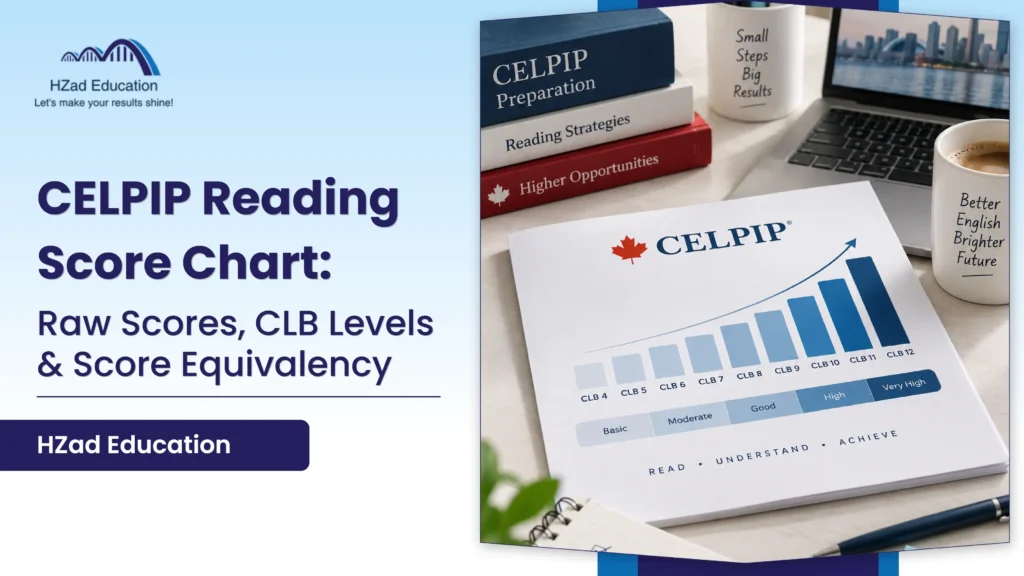
The CELPIP Reading Scoring Chart shows how the number of correct answers on the Reading test approximately corresponds to CELPIP levels and Canadian Language Benchmark (CLB) levels. The Reading component has a maximum raw score of 38, while final results are reported as CELPIP proficiency levels after score equating accounts for slight differences in difficulty between test forms.
Higher CELPIP Reading levels indicate stronger ability to understand details, main ideas, viewpoints, implied meaning, and increasingly complex written information. CELPIP levels also align with CLB benchmarks, making the Reading result easier to interpret for Canadian immigration and other purposes that use CLB language requirements.
| CLB Level | Proficiency Level | Key Reading Capabilities |
| CLB 4 | Basic | Understands simple Reading passages, explicit details, and straightforward written instructions. |
| CLB 5 | Developing | Identifies familiar information, basic arguments, and moderately simple written communication. |
| CLB 6 | Competent | Understands moderately complex Reading content and workplace-related written information. |
| CLB 7 | Adequate | Interprets main ideas, supporting details, and some implied meaning in practical Reading scenarios. |
| CLB 8 | Strong | Understands detailed passages, paraphrased information, and contextual relationships accurately. |
| CLB 9 | Effective | Interprets tone, viewpoints, implied meaning, and complex written arguments with high accuracy. |
| CLB 10-12 | Advanced to Expert | Evaluates complex Reading passages, nuanced meaning, advanced vocabulary, and subtle contextual intent effectively. |
How Does the CELPIP Reading Score Chart Convert Raw Scores Into CELPIP Levels?
The CELPIP Reading score chart converts raw scores into standardized CELPIP levels (M–12) using an official score chart, where the number of correct answers determines the final Reading proficiency level.
The chart maps raw scores out of 38 to CELPIP Reading levels, but the final level is not determined by the raw score alone. Because different test forms can vary slightly in difficulty, CELPIP uses score equating to adjust for these differences. The raw score is first converted to a scaled score, then transformed into the final CELPIP Reading level, ensuring results from different test forms can be compared consistently.
What Are CELPIP Scores Out Of?
CELPIP scores are reported on a scale from 0 to 12, while the CELPIP Reading raw score is calculated out of 38 points. Each correct answer on the 38 scored Reading questions earns one point, and no points are deducted for incorrect answers.
The raw score is not the final CELPIP Reading result because CELPIP uses score equating to account for slight differences in difficulty between test forms. The adjusted score is converted into a CELPIP level, with higher levels indicating greater English Reading proficiency.
What Does Each CELPIP Reading Level Mean?
Each CELPIP Reading level indicates how effectively you can understand written English in increasingly demanding everyday, social, educational, and workplace contexts. Higher levels represent stronger reading comprehension, while lower levels indicate developing or limited ability to understand written information.
The CELPIP levels correspond to Canadian Language Benchmark levels from CLB 3 to CLB 12, while CELPIP Level 2 corresponds to CLB 1–2. Levels 0 and 1 indicate insufficient information to assess proficiency.
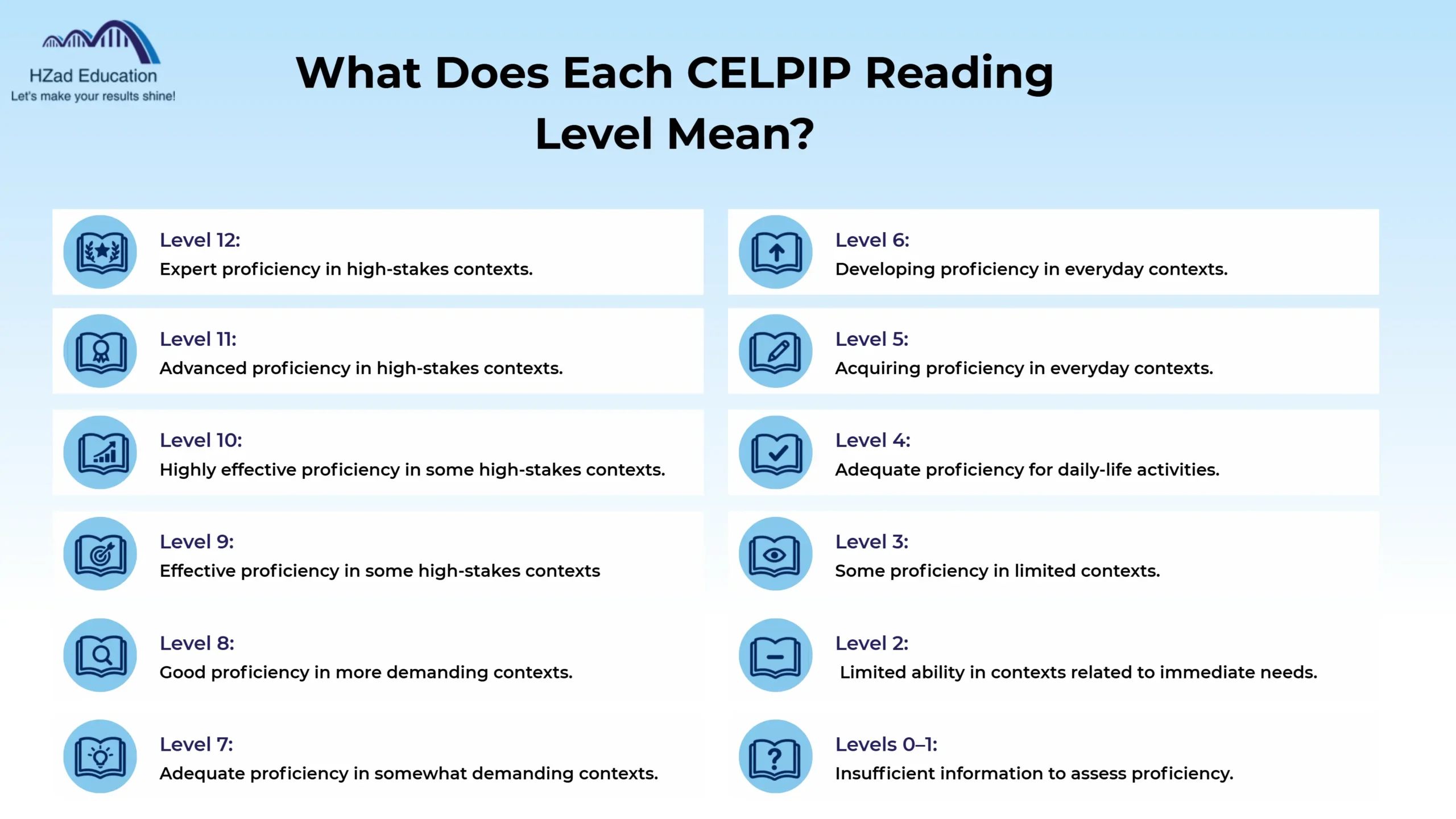
- Level 12: Expert proficiency in high-stakes contexts.
- Level 11: Advanced proficiency in high-stakes contexts.
- Level 10: Highly effective proficiency in some high-stakes contexts.
- Level 9: Effective proficiency in some high-stakes contexts.
- Level 8: Good proficiency in more demanding contexts.
- Level 7: Adequate proficiency in somewhat demanding contexts.
- Level 6: Developing proficiency in everyday contexts.
- Level 5: Acquiring proficiency in everyday contexts.
- Level 4: Adequate proficiency for daily-life activities.
- Level 3: Some proficiency in limited contexts.
- Level 2: Limited ability in contexts related to immediate needs.
- Levels 0–1: Insufficient information to assess proficiency.
CELPIP Reading Raw Score to Level Table
The CELPIP Reading scoring chart shows the approximate number of correct answers needed for each CELPIP Reading level. These ranges can overlap because CELPIP uses score equating to account for slight differences in difficulty between test forms.
| Raw Score (Approx.) | CELPIP Reading Level | CLB Level | Proficiency Interpretation |
| 33-38 Correct | Level 10-12 | CLB 10-12 | Advanced proficiency with strong comprehension of complex Reading passages |
| 31-33 Correct | Level 9 | CLB 9 | Accurately interprets tone, arguments, and implied meaning |
| 28-31 Correct | Level 8 | CLB 8 | Understands detailed passages and paraphrased information |
| 24-28 Correct | Level 7 | CLB 7 | Interprets main ideas, details, and contextual relationships |
| 19-25 Correct | Level 6 | CLB 6 | Understands moderately complex Reading content |
| 15-20 Correct | Level 5 | CLB 5 | Understands familiar written information and straightforward passages |
| 10-16 Correct | Level 4 | CLB 4 | Understands simple and explicit Reading content |
| 8-11 Correct | Level 3 | Below CLB 4 | Limited understanding of basic Reading passages |
| 0-7 Correct | Minimal (M) | Not Applicable | Minimal comprehension; score not assigned to CLB |
Note: These raw-score ranges are approximate rather than fixed cut-offs. The number of correct answers required for a particular CELPIP level may vary slightly because questions can differ in difficulty and are equated accordingly.
How Are CELPIP Reading Raw Scores Calculated?
CELPIP Reading raw scores are calculated by adding one point for each correct answer across the 38 scored questions. Incorrect or unanswered questions receive no points, and there is no penalty for choosing an incorrect answer.
For example, a candidate who correctly answers 28 scored questions has a raw score of 28 out of 38. CELPIP then uses the raw score in its scoring process to determine the final Reading level, rather than reporting the raw score as the official test result.
How Is the CELPIP Reading Test Marked and Graded?
The CELPIP Reading test is marked automatically by computer, with each response graded as either correct or incorrect. Blank answers are marked incorrect, and points are not deducted for wrong answers, so test takers should answer every question. Unlike the Speaking and Writing components, CELPIP Reading does not use human raters or performance descriptors to grade individual responses.
CELPIP then converts the raw score into a CELPIP Reading Level from M to 12 based on the number of points and the difficulty of the questions. CELPIP also uses score equating to account for slight differences in difficulty between test forms, keeping results comparable across different versions of the test.
For example, approximately 24–28 correct answers correspond to Level 7, while 31–33 correspond to Level 9. The test may also contain unscored Reading items used for test development, but test takers cannot identify which items are unscored.
How Does CELPIP Reading Score Map to Canadian Language Benchmark (CLB) Levels?
CELPIP Reading scores map directly to Canadian Language Benchmark (CLB) levels, with CELPIP Levels 3 through 12 corresponding to the same numbered CLB levels. For example, CELPIP Reading Level 7 equals CLB 7, Level 9 equals CLB 9, and Level 10 equals CLB 10.
This direct alignment lets test takers use their CELPIP Reading level to check CLB-based language requirements for Canadian immigration programs. CELPIP Level 2 corresponds to CLB 1–2, while Levels 0 and 1 indicate insufficient information to assess proficiency and do not have a direct CLB equivalent.
CELPIP Reading Score to CLB Equivalency Chart
The CELPIP Reading score to CLB chart shows the direct equivalency between CELPIP Levels 3–12 and the same numbered Canadian Language Benchmark levels. Level 2 corresponds to CLB 1–2, while CELPIP Levels 0 and 1 do not have a CLB equivalency because there is insufficient information to assess proficiency.
| CELPIP Reading Level | CLB Level | Proficiency Description |
| Level 12 | CLB 12 | Expert proficiency |
| Level 11 | CLB 11 | Advanced proficiency |
| Level 10 | CLB 10 | Highly effective proficiency |
| Level 9 | CLB 9 | Effective proficiency |
| Level 8 | CLB 8 | Good proficiency |
| Level 7 | CLB 7 | Adequate proficiency |
| Level 6 | CLB 6 | Developing proficiency |
| Level 5 | CLB 5 | Acquiring proficiency |
| Level 4 | CLB 4 | Adequate proficiency for daily life |
| Level 3 | CLB 3 | Some proficiency in limited contexts |
| Level 2 | CLB 1–2 | Limited ability |
| Level 1 | No CLB equivalent | Insufficient information to assess |
| Level 0 | No CLB equivalent | Insufficient information to assess |
How Can You Calculate Your CLB Level From a CELPIP Reading Score?
You can calculate your CLB level by matching your CELPIP Reading level to the corresponding Canadian Language Benchmark level. CELPIP Levels 3–12 map directly to the same CLB number, so CELPIP Reading 7 equals CLB 7, while CELPIP Reading 9 equals CLB 9.
No mathematical formula or separate CLB calculator is required for these scores because CELPIP is calibrated against the Canadian Language Benchmarks. CELPIP Level 2 corresponds to CLB 1–2, while Levels 0 and 1 do not have a CLB equivalent because there is insufficient information to assess proficiency. IRCC uses this direct CELPIP-to-CLB equivalency when assessing language results for Canadian immigration programs.
How Is the CELPIP Reading Test Structured and Scored?
The CELPIP Reading test is a computer-delivered component with four parts, 38 scored questions, and a current allotted time of 43–56 minutes. The four parts assess Reading Correspondence, Reading to Apply a Diagram, Reading for Information, and Reading for Viewpoints using practical written English and different comprehension tasks.
Each correct response contributes one point toward the Reading raw score, which is then converted into a CELPIP level through the test’s scoring process. CELPIP may also include unscored Reading items for test development, and test takers cannot distinguish these from scored items during the test.
What Is Included in the CELPIP Reading Test?
The CELPIP Reading Test has four Reading parts: reading correspondence, reading to apply a diagram, reading for information, and reading for viewpoints. It includes four parts with 38 scored questions, lasts approximately 43-56 minutes, and evaluates practical English Reading proficiency through everyday Canadian communication scenarios.
Structure of the CELPIP Reading Test:
- Part 1: Reading Correspondence: 11 questions based on written correspondence.
- Part 2: Reading to Apply a Diagram: 8 questions requiring you to connect written and visual information.
- Part 3: Reading for Information: 9 questions based on an informational passage.
- Part 4: Reading for Viewpoints: 10 questions requiring you to understand and compare viewpoints.
What Is the Difference Between CELPIP General and CELPIP General LS Reading Scores?
CELPIP General provides a Reading score, while CELPIP General LS does not include a Reading test or produce a Reading score. CELPIP General assesses all four language abilities, including Listening, Reading, Writing, and Speaking, and is accepted by IRCC for permanent residence applications.
CELPIP General LS assesses only Listening and Speaking and is designed for Canadian citizenship applications. Because Reading and Writing are not tested, CELPIP General LS does not provide a Reading level or corresponding Reading CLB result.
For Canadian citizenship, applicants who need language proof are assessed on Listening and Speaking, with CELPIP scores of 4 or higher accepted for these abilities. A Reading score is therefore not required to meet the citizenship language requirement.
How Are CELPIP Reading Scores Reported in CELPIP Results?
CELPIP Reading scores are reported as a separate component level from 0 to 12 on your CELPIP-General Official Score Report. The report shows individual results for Reading, Listening, Writing, and Speaking, allowing you to see your proficiency level for each language ability separately.
Your report shows the final CELPIP Reading level rather than your raw score or number of correct answers out of 38. CELPIP-General reports also include an Average Score across the four components, but this average does not correspond to a CLB level, and IRCC does not use it.
Once your CELPIP results are released, you can view them through your CELPIP Account and download the Official Score Report as a PDF. Hard-copy score reports have been discontinued.
How Long Does It Take to Get CELPIP Reading Results?
CELPIP Reading results are available online within 2–4 business days after your test date. The Reading score is released together with your other CELPIP-General results, and CELPIP sends you an email notification when your scores are ready.
You can then sign in to your CELPIP Account to view your results and download the Official CELPIP Score Report as a PDF. Your scores remain accessible through your account for two years from the test date.
How Can You Interpret Your CELPIP Reading Result?
You can interpret your CELPIP Reading result by checking your reported Reading level, matching it to its CLB equivalent, and comparing that CLB level with the requirement for your intended purpose. For example, CELPIP Reading Level 7 corresponds to CLB 7, while Level 9 corresponds to CLB 9 and indicates a higher level of English proficiency.
Consider your Reading result separately from your Listening, Writing, and Speaking scores because each language ability receives its own CELPIP level. For Canadian immigration, check each component against the requirements of your specific program rather than treating the CELPIP average score or any single Reading level as a universal passing score.
How Does CELPIP Reading Score Affect Canadian Immigration and PR Applications?
Your CELPIP Reading score affects Canadian immigration by establishing your Reading CLB level, which can determine program eligibility and contribute to your language points. For Express Entry, IRCC evaluates Reading separately alongside Listening, Writing, and Speaking, and the required CLB level depends on the immigration program.
A higher Reading CLB can also increase the language points included in your Comprehensive Ranking System (CRS) score if you are applying through Express Entry. However, Reading is only one part of your language assessment, so meeting a program requirement generally depends on achieving the required levels across all four language abilities.
What CELPIP Reading Score Is Required for Canada PR?
The CELPIP Reading score required for Canada PR depends on the immigration program and ranges from Level 4 (CLB 4) to Level 7 (CLB 7) across the main Express Entry programs. The Federal Skilled Worker Program requires at least CELPIP Level 7 in Reading and all three other language abilities, while the Canadian Experience Class requires Level 7 for TEER 0 or 1 occupations and Level 5 for TEER 2 or 3 occupations.
For the Federal Skilled Trades Program, the minimum Reading requirement is CELPIP Level 4 (CLB 4), while Speaking and Listening require CLB 5. Meeting these minimum scores establishes language eligibility, but higher CELPIP levels may earn more language and CRS points in Express Entry.
What Minimum CELPIP Reading Score Is Needed for Express Entry?
The minimum CELPIP Reading score for Express Entry ranges from Level 4 to Level 7, depending on the program you qualify for. Federal Skilled Worker Program applicants need CELPIP Level 7 (CLB 7) in Reading and all other language abilities.
For the Canadian Experience Class, the minimum is Level 7 for TEER 0 or 1 and Level 5 for TEER 2 or 3 in all four abilities. Federal Skilled Trades Program applicants need at least Level 4 in Reading and Writing, while Listening and Speaking require Level 5.
How Does Your CELPIP Reading CLB Level Affect CRS Language Points?
Your CELPIP Reading CLB level affects your CRS score by determining how many first-official-language points you receive for Reading, with higher CLB levels earning more points. Without an accompanying spouse, CLB 7 earns 17 Reading points, CLB 8 earns 23, CLB 9 earns 31, and CLB 10 or higher earns the maximum 34 points.
With an accompanying spouse, the same levels provide 16, 22, 29, and 32 Reading points, respectively. Your Reading score is combined with your Listening, Writing, and Speaking points to determine your first-official-language CRS score.
Reaching CLB 9 or higher in all four language abilities can also qualify you for the higher skill-transferability tier when combined with eligible education or foreign work experience. Depending on your other qualifications, these combinations can provide up to 50 points per skill-transferability category, subject to the overall 100-point maximum for this section.
What CELPIP Reading Score Do You Need for PNP, PGWP, and Citizenship?
You need different CELPIP Reading scores for PNP and PGWP, while Canadian citizenship does not require a Reading score. PNP requirements vary by province and stream, while PGWP requirements depend on the type of post-secondary program you completed.
- PNP: There is no single CELPIP Reading score for every Provincial Nominee Program because each province and territory sets requirements for its individual streams. Express Entry-linked PNP applicants must also meet the language requirements of the federal Express Entry program for which they qualify.
- PGWP: For applications submitted on or after November 1, 2024, graduates of bachelor’s, master’s, doctoral and other university programs generally need CELPIP Level 7 (CLB 7) in Reading, Writing, Listening and Speaking. Graduates of other college, polytechnic or non-university programs generally need Level 5 (CLB 5) in all four abilities.
- Citizenship: A CELPIP Reading score is not required for the citizenship language requirement. Applicants aged 18–54 who need language proof must demonstrate at least CLB 4 in Speaking and Listening
How Does CELPIP Reading Score Compare to IELTS Reading Scores?
CELPIP Reading Score uses a 12-level scoring scale aligned directly with Canadian Language Benchmark (CLB) levels, while IELTS Reading uses a 9-band scoring system based on the total number of correct answers.
For Canadian immigration, IRCC accepts both CELPIP and IELTS scores and converts them into CLB levels for Express Entry and PR applications. Higher CELPIP and IELTS Reading scores generally indicate stronger comprehension skills, a broader vocabulary, and better interpretation of complex written information.
CELPIP to IELTS Reading Score Conversion Table
The CELPIP-to-IELTS Reading score chart compares scores that correspond to the same Canadian Language Benchmark level for Canadian immigration. CELPIP Reading levels directly match CLB levels from 3–12, while IELTS General Training uses different Reading band scores to reach each benchmark.
| CLB Level | CELPIP Reading Level | IELTS General Reading Score |
| CLB 10+ | 10, 11, 12 | 8.0 – 9.0 |
| CLB 9 | 9 | 7.0 |
| CLB 8 | 8 | 6.5 |
| CLB 7 | 7 | 6.0 |
| CLB 6 | 6 | 5.0-5.5 |
| CLB 5 | 5 | 4.0-4.5 |
Note: IELTS Reading equivalency may vary slightly depending on General Training and official IRCC conversion updates.
Which Test Is Better for Canadian Immigration: CELPIP or IELTS?
For Canadian immigration, CELPIP may be better for candidates who prefer a fully computer-delivered test, everyday Canadian English contexts, and quick results, while IELTS may be better for those who prefer a face-to-face Speaking test or need wider international availability. CELPIP is completed in one computer-delivered sitting and currently provides online results within 2–4 business days.
IELTS has a much larger international testing network, with more than 4,000 test locations across 140 countries, which can make it more accessible for candidates outside Canada. Its Speaking component is conducted with an examiner, making it a different experience from CELPIP’s computer-delivered Speaking test.
For Canadian immigration purposes, however, neither test provides an automatic scoring advantage because IRCC accepts both CELPIP-General and IELTS General Training for Express Entry. The better option depends on your preferred test format, Speaking method, familiarity with the question styles, location, and intended use of the results.
How Does CELPIP Reading Score Compare to TOEFL iBT Reading Scores?
CELPIP Reading measures practical English comprehension using a 0–12 proficiency scale aligned with Canadian Language Benchmarks (CLB), whereas TOEFL iBT Reading measures English comprehension for academic and everyday contexts using a 1–6 scale aligned with CEFR. Since January 21, 2026, TOEFL iBT Reading scores have been reported from 1 to 6 in 0.5-point increments, replacing the previous 0–30 section-score scale for new tests.
CELPIP Reading uses practical tasks such as correspondence, diagrams, informational passages, and viewpoints, whereas the updated TOEFL Reading section includes tasks such as completing words, reading in daily life, and reading an academic passage. The two tests therefore assess Reading through different task formats and proficiency frameworks.
For Canadian Express Entry, IRCC accepts CELPIP-General, whereas TOEFL iBT is not an approved language test for this program. A CELPIP-to-TOEFL comparison can therefore help explain general English proficiency, but TOEFL scores should not be treated as a direct substitute for CELPIP or CLB scores for Express Entry.
CELPIP to TOEFL Reading Score Comparison Chart
CELPIP and TOEFL iBT Reading scores do not have an official direct conversion, but you can compare their scoring scales by looking at the proficiency frameworks each test uses. CELPIP Reading uses a 0–12 scale aligned with CLB, whereas TOEFL iBT Reading uses a 1–6 scale aligned with CEFR for tests taken on or after January 21, 2026.
| Test | Current Reading Scale | Proficiency Framework | Express Entry Use |
| CELPIP-General | 0–12 | CLB | Accepted |
| TOEFL iBT | 1–6 | CEFR | Not accepted |
TOEFL Reading scores of 6 align with CEFR C2, 5–5.5 with C1, 4–4.5 with B2, and 3–3.5 with B1 under the current ETS framework. These CEFR levels should not be converted directly into CELPIP or CLB scores because neither ETS nor IRCC provides an official CELPIP-to-TOEFL Reading conversion.
For Canadian Express Entry, candidates should use an IRCC-approved English test such as CELPIP-General, IELTS General Training, or PTE Core. TOEFL iBT is not currently included among IRCC’s approved Express Entry language tests.
How Do CELPIP and TOEFL Reading Sections Differ?
CELPIP Reading focuses on practical English used in everyday Canadian contexts, whereas TOEFL iBT Reading assesses English comprehension across daily campus and academic contexts. CELPIP uses four task types centred on correspondence, diagrams, informational texts, and viewpoints, while the current TOEFL Reading section uses Complete the Words, Read in Daily Life, and Read an Academic Passage tasks.
CELPIP Reading is computer-delivered and gives candidates 43–56 minutes to complete the section. TOEFL Reading is now adaptive, so its number of items and completion time can vary based on the test form and candidate performance.
CELPIP assesses functional English proficiency through practical Reading tasks, while TOEFL iBT primarily measures English skills used in academic and campus settings. Candidates should therefore compare the task types, scoring systems, and intended use of each test rather than treating CELPIP and TOEFL Reading scores as interchangeable.
How Can CELPIP Reading Practice Help Improve Your Score?
CELPIP Reading practice can improve your score by increasing your familiarity with the test format, question types, timing, and the reading skills assessed in each part. Regular practice also helps you identify whether you struggle more with general meaning, specific information, inference, or other types of comprehension questions.
Timed CELPIP Reading practice tests can help you learn how to divide your time between reading passages and answering questions under test conditions. Reviewing your answers afterward shows which question types you answer incorrectly most often and where you need more practice.
What Is Included in a CELPIP Reading Practice Test?
A CELPIP Reading practice test includes four Reading parts with questions that reflect the format, timing, and question types of the actual test. Official practice materials also provide correct answers so test takers can review their performance and identify areas that need more practice.
- Reading Correspondence: 11 questions based on written correspondence such as emails or messages.
- Reading to Apply a Diagram: 8 questions requiring you to connect written information with a diagram or other visual information.
- Reading for Information: 9 questions that assess understanding of main ideas, specific details, and information in a passage.
- Reading for Viewpoints: 10 questions focused on understanding opinions, arguments, viewpoints, and implied meaning.
The actual CELPIP Reading test may also contain unscored content used for test development, which has the same format as scored content and cannot be identified during the test. Practising all four Reading parts can therefore help you become comfortable with the task types you may encounter on test day.
What Tips Can Help Improve Your CELPIP Reading Score?
To improve your CELPIP Reading score, expand your vocabulary, practice active Reading, read diverse materials, use the question-first method, identify keywords, and improve skimming skills. These strategies can help you understand passages more efficiently and answer different Reading question types more accurately.
7 tips to improve your CELPIP reading score are:
- Expand Your Vocabulary: A stronger vocabulary improves the ability to understand complex Reading passages, interpret implied meaning, and recognize paraphrased information commonly used in CELPIP questions.
- Practice Active Reading & Time Management: Active Reading improves focus on key details, arguments, and supporting information, while proper time management helps candidates complete all Reading tasks within the exam time limit.
- Read Diverse Materials: Reading emails, news articles, advertisements, blogs, and workplace documents increases familiarity with the practical Canadian English scenarios tested in CELPIP Reading.
- Understand, Don’t Memorize: CELPIP evaluates comprehension and interpretation skills rather than memorization, so candidates should focus on understanding context, meaning, and relationships between ideas.
- Use the “Question First” Method: Reading the questions before the passage helps candidates locate relevant information faster and improves answer accuracy.
- Identify Keywords: Identifying names, transition words, dates, and important phrases helps candidates recognize relevant information and contextual relationships more efficiently.
- Improve Skimming and Scanning Skills: Skimming helps you quickly grasp a passage’s overall meaning, while scanning helps you locate specific details needed to answer questions accurately under timed conditions.
How Long Is a CELPIP Score Valid for Immigration?
A CELPIP score is valid for Canadian immigration for up to 2 years, and your results must still be less than two years old when you submit them to IRCC. For Express Entry, your language test results must be valid both when you complete your Express Entry profile and when you submit your permanent residence application.
If your CELPIP results expire before you submit your PR application, you will need valid new results to remain eligible. IRCC states that it can refuse an Express Entry PR application submitted with expired language test results.