
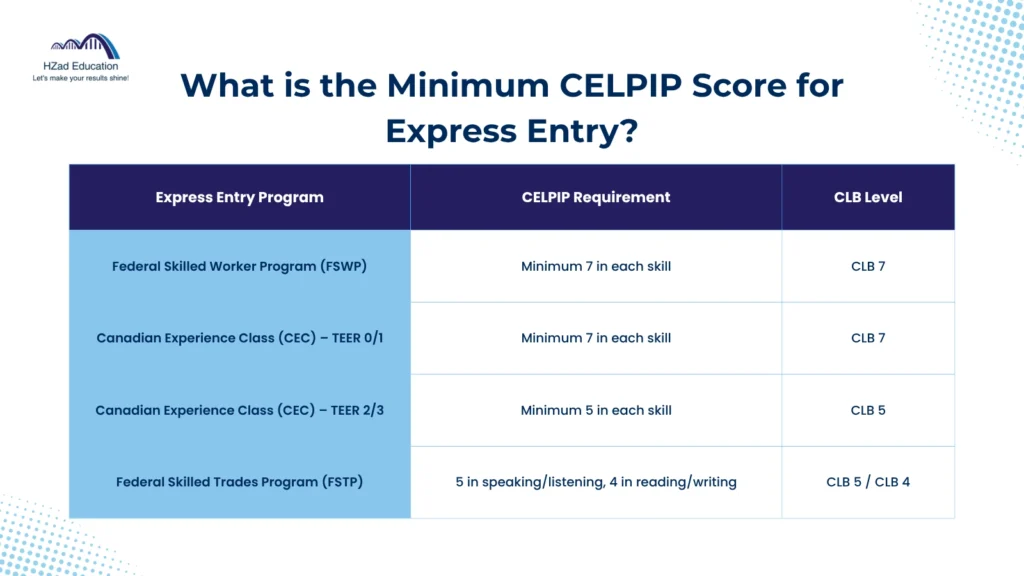
Minimum CELPIP scores for Express Entry are CLB 7 for the Federal Skilled Worker Program, CLB 5–7 for the Canadian Experience Class, depending on the role, and CLB 4–5 for the Federal Skilled Trades Program, depending on the skill.
The Federal Skilled Worker Program (FSWP) requires a CELPIP score of 7 in all four skills (listening, reading, writing, and speaking). For the Canadian Experience Class (CEC), TEER 0 and 1 occupations need a score of 7, while TEER 2 and 3 occupations require a 5. The Federal Skilled Trades Program (FSTP) requires 5 in speaking and listening, and 4 in reading and writing. These scores correspond to CLB levels and determine eligibility for each program.
Meeting these scores is important not only for eligibility but also for earning more CRS points. Higher CELPIP results raise CLB levels, which increases points for core human capital and skill transferability. Strong language skills improve your ranking and boost the chances of receiving an Invitation to Apply (ITA).
CELPIP scores show practical English ability in Canadian workplaces. While meeting the minimum allows entry, achieving CLB 9 or higher gives a significant advantage. Higher proficiency is one of the most effective ways to secure a top CRS score.
What Is Express Entry?
Express Entry is Canada’s online immigration system that manages applications for permanent residency under major economic programs, including the Federal Skilled Worker Program, Canadian Experience Class, and Federal Skilled Trades Program. Applicants create an online profile where they submit details such as age, education, work experience, and language proficiency, including CELPIP scores.
The Express Entry system evaluates each profile using the Comprehensive Ranking System (CRS), which assigns points based on these factors to determine a candidate’s position in the pool. Higher CRS scores increase the likelihood of receiving an Invitation to Apply (ITA) during regular draws conducted by immigration authorities.
This structured selection process allows Canada to identify and invite skilled workers who meet eligibility criteria and demonstrate the language skills and professional capacity required to contribute to the national labour market.
Why Language Scores Matter in Express Entry?
Language scores matter in Express Entry because they determine your eligibility for immigration programs and affect your ranking in the Comprehensive Ranking System (CRS). By completing CELPIP, you demonstrate the communication skills necessary to succeed in the Canadian workforce. Immigration authorities use CLB levels to qualify candidates for programs such as the Federal Skilled Worker Program and the Canadian Experience Class.
Higher scores also increase your Comprehensive Ranking System (CRS) points, especially when combined with education and work experience. Ultimately, strong language proficiency improves your overall ranking and raises the likelihood of receiving an Invitation to Apply (ITA) for permanent residency in Canada.
What are The Minimum CELPIP Score for Each Express Entry Program
Minimum CELPIP scores for Express Entry vary by program and job category. Meeting these thresholds ensures eligibility and contributes to CRS points.
| Express Entry Program | CELPIP Requirement | CLB Level |
| Federal Skilled Worker Program (FSWP) | Minimum 7 in each skill | CLB 7 |
| Canadian Experience Class (CEC) – TEER 0/1 | Minimum 7 in each skill | CLB 7 |
| Canadian Experience Class (CEC) – TEER 2/3 | Minimum 5 in each skill | CLB 5 |
| Federal Skilled Trades Program (FSTP) | 5 in speaking/listening, 4 in reading/writing | CLB 5 / CLB 4 |
Federal Skilled Worker Program (FSWP)
The FSWP provides skilled professionals with a pathway to Canadian permanent residency. Applicants must have at least one year of continuous skilled work experience, meet education requirements, demonstrate sufficient settlement funds, and show strong language proficiency. A minimum CELPIP score equivalent to CLB 7 ensures candidates can communicate effectively in professional and social settings. Higher language scores also boost CRS points and improve competitiveness in the Express Entry pool.
Canadian Experience Class (CEC)
The CEC helps skilled workers with Canadian experience transition to permanent residency. Candidates need at least 1 year of skilled work in Canada in the past 3 years. Language requirements vary by occupation. TEER 0 and 1 roles require a CLB level of 7 in each skill to support complex workplace tasks and confident communication. In contrast, TEER 2 and 3 roles require a CLB level of 5, which is sufficient for basic professional interactions. Strong language skills aid integration and enhance CRS points.
Federal Skilled Trades Program (FSTP)
The FSTP targets tradespeople such as electricians and plumbers seeking permanent residency. Applicants must have two years of full-time trade experience within the last five years and a valid Canadian job offer or trade certification. CELPIP scores of CLB 5 in speaking and listening, and CLB 4 in reading and writing, confirm the ability to perform tasks safely and effectively on the job. Language proficiency also contributes to CRS ranking.
CELPIP Score to CLB Conversion Table
Immigration officials use the CELPIP-to-CLB conversion table to assess language proficiency in Express Entry. The alignment confirms if applicants meet the minimum requirements for various programs.
| CELPIP Score | CLB Level | Language Proficiency Description |
| 12 | CLB 12 | Expert level for workplace and community use. |
| 11 | CLB 11 | Advanced fluency in professional settings. |
| 10 | CLB 10 | Strong skills for complex professional tasks. |
| 9 | CLB 9 | Effective command of workplace communication. |
| 8 | CLB 8 | Good proficiency for everyday activities. |
| 7 | CLB 7 | Adequate skills for work and community needs. |
| 6 | CLB 6 | Growing ability in familiar situations. |
| 5 | CLB 5 | Moderate proficiency for daily routines. |
| 4 | CLB 4 | Basic proficiency in communicating. |
| 3 | CLB 3 | Limited proficiency in communication. |
| 2 | CLB 1, 2 | Limited ability to express basic needs. |
| 1 | – | Minimal Proficiency. |
| 0 | – | Minimal Proficiency. |
How CELPIP Scores Affect Your CRS Points?
CELPIP scores directly influence CRS points through both core human capital and skill transferability factors. While a CLB 7 meets the minimum eligibility for many programs, achieving a CLB 9 or higher significantly boosts a profile’s ranking. These scores also generate additional points when combined with education or foreign work experience, strengthening the overall Express Entry profile.
Since the system ranks candidates competitively, even small improvements in CELPIP results can raise the total CRS score and increase the likelihood of receiving an ITA for permanent residency.
CELPIP Score Validity for Express Entry
CELPIP scores are valid for two years from the test date. To remain eligible for Express Entry, your results must be valid both when you complete your profile and when you submit your final application for permanent residence.
If your scores expire before you receive an ITA or before your application is submitted, you must retake the test. This requirement ensures that immigration authorities assess your current language proficiency and readiness to integrate into the Canadian workforce. Because results expire two years after the test date, it helps to work backward from your profile deadline before you book. A CELPIP Express Entry checklist walks through that timeline, from choosing a CLB target to leaving room for a retake.
Common mistakes Express Entry candidates make
Common Express Entry mistakes include selecting incorrect NOC codes, providing inconsistent work histories, neglecting ECAs, and failing to include spousal documentation or proof of funds. These errors frequently lead to immediate ineligibility, credibility concerns, or the loss of vital CRS points. Ensuring every claim is backed by accurate, complete paperwork is essential to maintaining a competitive ranking and avoiding processing delays.
Claiming the wrong NOC code
Claiming the wrong NOC code can result in immediate rejection of the application. Express Entry prioritizes your actual job duties over your official job title. If these responsibilities do not align with the NOC description, you will lose eligibility and vital CRS points.
A careful comparison between official NOC descriptions and actual job responsibilities ensures accurate selection, while detailed reference letters facilitate smooth verification.
Weak or missing documentation
Weak or missing documentation can lead to refusal, as immigration authorities rely on verifiable proof of work experience, identity, and financial capacity. Incomplete or inconsistent records make validation difficult and may reduce CRS points.
Well-structured documentation, supported by clear employment records and valid financial proof, helps maintain consistency across the profile and application.
Inconsistent Work History
An inconsistent work history creates credibility concerns when employment details differ across submitted records. Gaps, overlapping timelines, or mismatched roles may lead to rejection or loss of CRS points.
Consistency across resumes, reference letters, and the Express Entry profile, along with clear explanations for any employment gaps, helps maintain transparency during assessment.
Missing Education Equivalency
A missing Educational Credential Assessment (ECA) significantly reduces an applicant’s CRS score. Immigration authorities require this verification to officially recognize foreign degrees or diplomas. Without an ECA, officials cannot count international education toward eligibility or points.
Avoid this mistake by obtaining an approved ECA that confirms Canadian equivalency, which allows education credentials to be properly evaluated and included in the CRS calculation.
Spousal Document Neglect
Neglecting spousal documents lowers CRS points because Express Entry assigns additional points for a spouse’s language ability, education, and work experience. However, these points cannot be assigned if the required evidence is missing or improperly documented.
Including complete and verified spousal information ensures that all eligible points are counted and strengthens the overall profile.
Tips to Achieve a Higher CELPIP Score for Express Entry
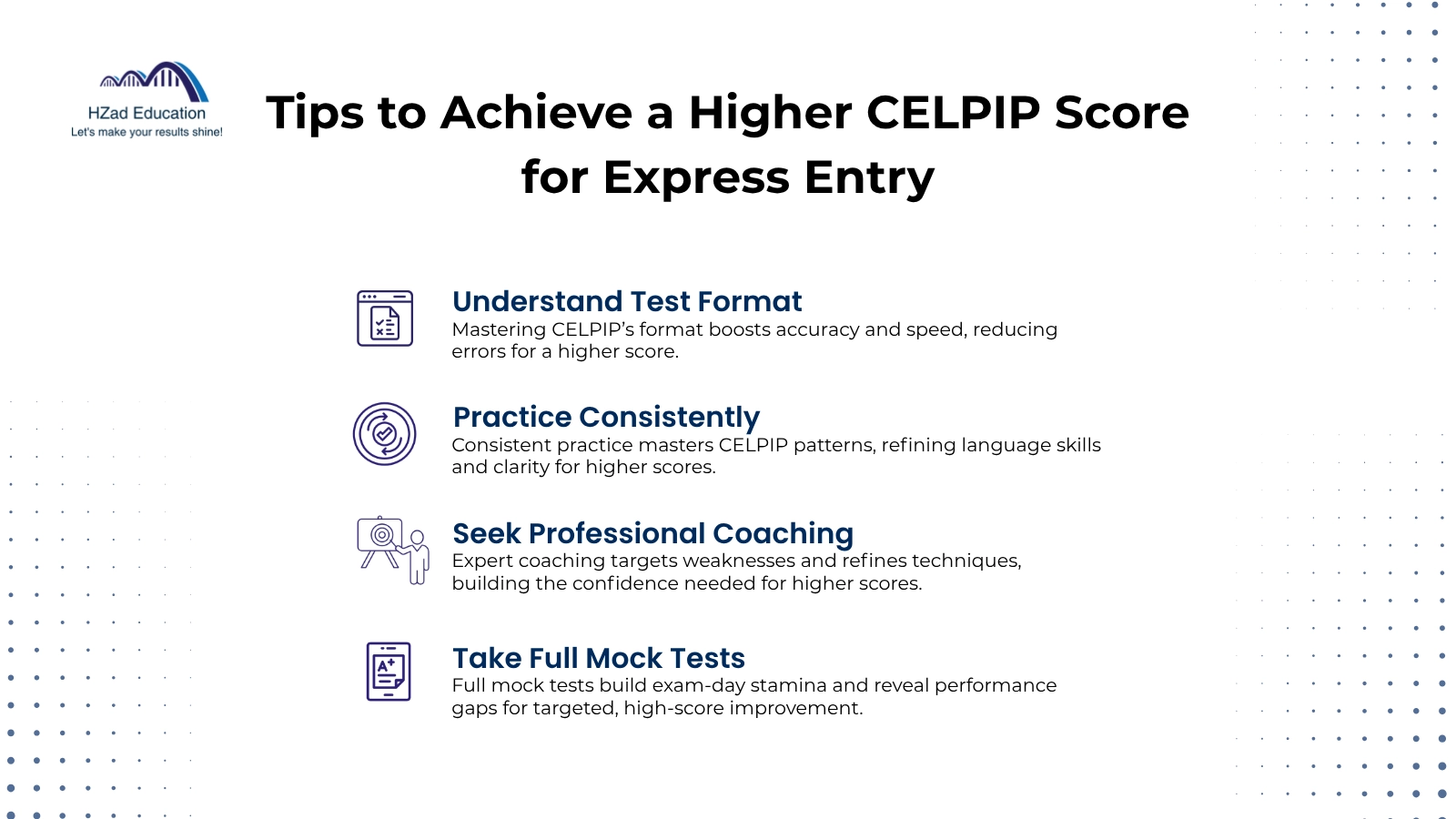
Achieving a high CELPIP score requires a structured preparation strategy that prioritizes test format and consistent practice. Familiarizing yourself with the exam structure improves time management and accuracy, while professional coaching and mock tests help identify weaknesses and simulate real-world conditions. Because higher scores lead to higher CLB levels and additional CRS points, targeted language training directly strengthens your Express Entry profile and increases your likelihood of receiving an ITA.
Understand Test Format
Understanding the CELPIP format improves accuracy and time management across all sections. Familiarity with specific structures and task requirements reduces errors, ensuring higher response quality and a better overall score.
Practice Consistently
Consistent practice improves CELPIP performance by strengthening language skills and building familiarity with test patterns. Regular exposure to test patterns reinforces vocabulary and sentence structure, leading to clearer responses and higher overall scores.
Seek Professional Coaching
Targeted feedback and structured guidance from a professional CELPIP coaching helps candidates address weaknesses and master CELPIP scoring criteria. Expert instruction refines response techniques and prevents common errors, building the accuracy and confidence needed for a higher score.
Take Full Mock Tests
Full mock tests simulate CELPIP exam conditions to build accuracy and improve time management. This process helps you adapt to test pressure and highlights specific performance gaps for targeted improvement before your test date.
What Happens If You Don’t Meet the Minimum CELPIP Score?
If you don’t meet the minimum CELPIP score, you disqualify the Express Entry programs, as achieving the required CLB level is a mandatory eligibility criteria. Furthermore, lower scores also reduce CRS points, weakening ranking and limiting ITA chances.
To improve eligibility, retaking the CELPIP test and updating the profile with higher scores remains the most direct solution. While education and work experience can increase CRS points, language ability continues to have the strongest influence on ranking. Alternative pathways, such as PNPs, may have different requirements, but achieving the required CELPIP score remains the most reliable way to qualify and stay competitive.
How Many Times Can You Take the CELPIP for Express Entry?
There is no limit on how many times an applicant can take the CELPIP test for Express Entry, which allows candidates to improve their scores and strengthen their eligibility. Each attempt requires a separate fee, and a new test can only be booked after you receive previous results. Updated scores can be added to the Express Entry profile as long as they remain within the two-year validity period.
What Is CELPIP-LS and Why It Won’t Work for Express Entry?
The CELPIP-LS is a specialized language assessment designed exclusively for Canadian citizenship applications, focusing only on listening and speaking skills. As CELPIP-LS (Listening and Speaking) assesses only two language skills, it does not meet Express Entry requirements. Express Entry programs require assessment across all four language skills (listening, reading, writing, and speaking) to determine CLB levels and calculate CRS points. Candidates must take the CELPIP-General test to meet the full language requirement for programs such as FSWP, CEC, and FSTP.
Can You Use CELPIP for Provincial Nominee Programs (PNPs)?
As the CELPIP test is officially designated by Immigration, Refugees and Citizenship Canada (IRCC), it is widely accepted for most Provincial Nominee Programs (PNPs) across Canada. While federal Express Entry streams maintain higher language thresholds, some provincial programs have lower or occupation-specific requirements. Applicants who do not meet federal language criteria may still qualify for certain provincial nominations if their CELPIP score meets the province’s specified CLB level.
Why Many Express Entry Applicants Choose CELPIP Over IELTS?
Many applicants prefer CELPIP over IELTS because it is fully computer-based and evaluates practical Canadian English used in daily life and workplaces. CELPIP scores map directly to Canadian Language Benchmark (CLB) levels, simplifying CRS point calculations and profile preparation. The test also provides faster results and consistent digital testing, making it an efficient choice for candidates seeking to optimize their Express Entry profile and improve the chances of receiving an Invitation to Apply (ITA) for permanent residency