
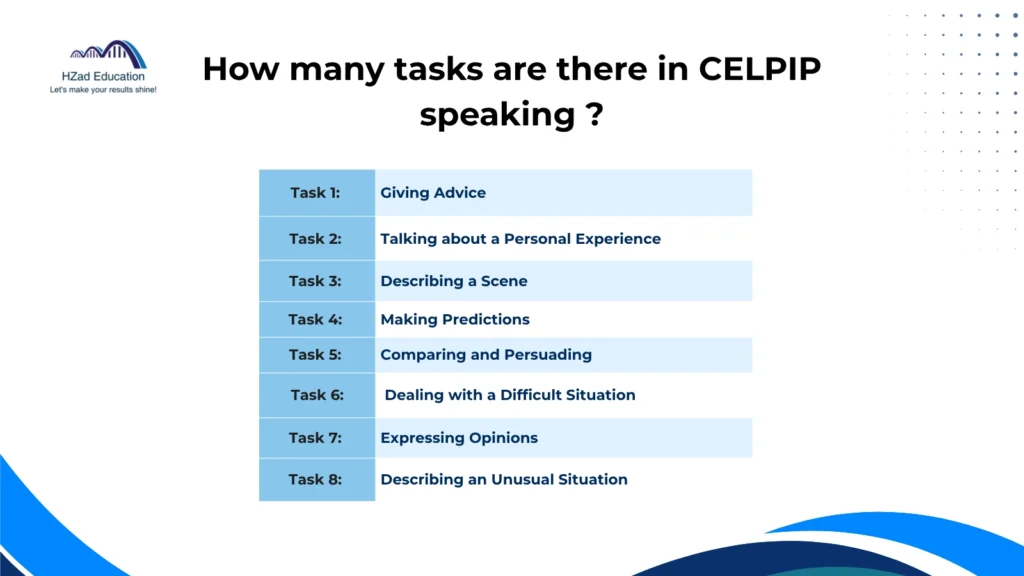
The CELPIP speaking test includes eight exercises designed to assess practical English communication in everyday situations. Candidates are asked to give advice, narrate personal experiences, describe scenes, make predictions, compare and persuade, manage challenging scenarios, express opinions, and explain unusual events. Each task requires clear, structured, and fluent responses, ensuring the test evaluates functional English skills rather than just theoretical knowledge.
Performance depends on organizing ideas logically, using precise vocabulary, and maintaining accurate grammar and pronunciation. The tasks are grouped into practical scenarios, descriptive challenges, and opinion or persuasion exercises. Candidates have 30–60 seconds to prepare and 60–90 seconds to respond per task. Consistent practice, reviewing recorded responses, and understanding the evaluation criteria strengthen confidence and help achieve the CELPIP scores needed for Canadian immigration, citizenship, or professional purposes.
What Is the CELPIP Speaking Test?
The CELPIP speaking test is a 15–20 minute computer-delivered component that evaluates a candidate’s functional English proficiency for Canadian immigration and citizenship. The test requires candidates to complete eight structured speaking tasks based on everyday situations, where they speak into a microphone after listening to instructions and understanding each question.
During the speaking test, the candidate responds within a limited time, demonstrating fluent speech and coherent communication. The system evaluates performance across content, vocabulary, grammar, pronunciation, and listening comprehension, ensuring the candidate can communicate ideas effectively in practical, everyday situations.
Who Needs to Take the CELPIP Speaking Test?
The CELPIP speaking test is required for individuals who need to demonstrate their English speaking ability for Canadian permanent residency, citizenship, or professional certification. The primary target audience includes immigration applicants, such as those applying for permanent residency through programs like Express Entry, for whom the test evaluates their ability to communicate effectively in Canadian workplaces and communities. It also includes citizenship applicants who must meet language requirements by proving their speaking and listening skills through the CELPIP General LS test.
Other candidates who take the speaking test include professionals and skilled workers, such as healthcare staff or administrative employees, who need to verify their English proficiency for licensing or employment purposes in Canada.
CELPIP Speaking Test Tasks Breakdown
The CELPIP speaking test includes eight tasks where candidates give advice, describe experiences and scenes, make predictions, compare, persuade, handle situations, and express opinions. These tasks assess how effectively a candidate can deliver a clear response and complete each speaking task in daily communication contexts.
Note : For a detailed walkthrough of all 8 CELPIP Speaking tasks with sample answers and tips, watch this “CELPIP Speaking Test Tasks 1-8 with Sample Answers”
Task 1: Giving Advice
In task 1, the candidate gives advice for a specific problem or situation described in the question. The candidate typically gets 30 seconds to prepare and 90 seconds to speak. The objective of this speaking task is to assess how clearly the candidate can explain suggestions and provide a structured answer that addresses the scenario. The structure involves identifying the problem, offering 2–3 relevant suggestions, and supporting each idea with a logical explanation.
This task evaluates language skills such as fluent speaking, coherence, vocabulary usage, and the ability to communicate practical solutions effectively. Use modal verbs such as “should,” “could,” or “would,” and organize your response with a brief introduction, followed by clear advice, and a short concluding statement
Task 2: Talking about a Personal Experience
Task 2 of the CELPIP speaking test requires the candidate to narrate a personal experience in response to a given prompt within a structured time frame. The candidate receives 30 seconds to prepare and 60 seconds to speak, and the response must present a clear, fluent narrative in the past tense. The objective of this speaking task is to evaluate how effectively the candidate can organize ideas, include relevant details, and communicate the experience in a logical sequence.
The candidate begins by introducing the situation with key context, such as who, what, when, and where, then describes the event step by step using transitions to maintain a smooth flow. The response ends with a brief conclusion that explains the outcome or reflects personal feelings, ensuring the task is complete and the answer is coherent and structured.
Task 3: Describing a Scene
The candidate describes a visual scene in an image to demonstrate the ability to observe, organize, and communicate details in a clear, structured response. The candidate receives 30 seconds to prepare and 60 seconds to speak, and the response must present a clear, fluent, and well-organized description. The objective of this speaking task is to evaluate how effectively the candidate can observe details, organize information, and communicate the scene in a logical sequence
Describing a scene requires the candidate to observe an image, such as a park or a busy street, and to explain the setting, people, objects, and actions in a clear, detailed spoken response. Use position-based words to describe people, objects, and actions by starting with what is closest and then moving toward what is farther away.
Task 4: Making Predictions
In this speaking task, the test-taker makes predictions by analyzing a given scene and explaining what is likely to happen next based on visual clues. The candidate receives 30 seconds to prepare and 60 seconds to speak, and the response must present clear, logical, and well-organized predictions. The objective of this speaking task is to evaluate how effectively the candidate can analyze visual clues, use future-oriented language, and communicate ideas in a coherent sequence.
The candidate begins by briefly describing the current situation shown in the image, identifying key elements that provide context. Then, the candidate presents predictions about what is likely to happen next, supporting each idea with relevant reasons based on the visual details. The response should use appropriate future-tense forms such as “will,” “might,” or “is likely to,” while maintaining a smooth flow through the use of transitions.
Task 5: Comparing and Persuading
For CELPIP speaking task 5, the test-taker participates in a role-play scenario where they compare two options, such as products, services, or plans, and persuade a specific person, like a friend or colleague, to choose one. The task allows 60 seconds to prepare and 60 seconds to speak, and evaluates coherence, vocabulary, comparison, persuasion, and clear delivery of responses.
A clear approach involves examining both options, identifying key differences such as price, location, or features, and selecting the one with the strongest supporting reasons. The test-taker then presents a structured argument explaining why the selected option is better, using polite and persuasive language.
Task 6: Dealing with a Difficult Situation
Task 6, Dealing with a Difficult Situation, evaluates how the test-taker communicates under pressure, handles conflict, and resolves problems clearly and professionally. Candidates are given 60 seconds to prepare, then required to deliver a clear, structured response within 60 seconds, demonstrating coherence, an appropriate tone, and effective communication. The task requires the candidate to handle a difficult situation politely and assertively with someone, such as giving bad news, making a complaint, or resolving a conflict.
This task evaluates skills such as coherence, vocabulary, problem-solving ability, and the use of polite and assertive language, including phrases like “I understand, but…”, “I’m afraid I can’t…”, or “Would it be possible to…”, to manage difficult communication effectively.
Task 7: Expressing Opinions
For CELPIP speaking task 7, the candidate expresses an opinion on a given topic, clearly stating their position and supporting it with 2–3 logical reasons. Candidates have 30 seconds to prepare and 90 seconds to deliver their answer. The response should begin by paraphrasing the question (e.g., “I firmly believe that…”) and include brief explanations for each reason, ending with a concise conclusion
This task evaluates the candidate’s ability to present a structured and coherent argument using fluent language, appropriate vocabulary, and complex sentence structures. Effective responses often use subordinating conjunctions such as “Although,” “Since,” or “Even though” to support opinions and ensure that reasoning is clear, confident, and logically developed.
Task 8: Describing an Unusual Situation
In CELPIP Speaking Task 8, the candidate describes an unusual or unexpected scene to someone who cannot see it, demonstrating the ability to communicate clearly and effectively. Candidates have 30 seconds to prepare and 60 seconds to deliver their response, focusing immediately on what makes the scene unique rather than on ordinary details.
The participant should use the present tense to describe ongoing actions and appearances (e.g., “It is sitting on…,” “He is wearing…”) and employ descriptive words such as bizarre, peculiar, quirky, or strange to convey the scene’s unusual aspects accurately and engagingly.
How to Prepare for CELPIP Speaking Tasks?
To prepare for CELPIP speaking tasks, candidates should practice with timed mock tests, record and review their responses, and focus on delivering clear, structured, and fluent answers for each task type. Consistent practice helps improve fluency, build confidence, and ensure structured, clear, and effective responses across all task types.
General Tips for All 8 Tasks
For general tips applicable to all 8 CELPIP speaking tasks, candidates should understand the format, practice regularly, improve fluency, expand their vocabulary, use prep time effectively, and seek feedback. Following these strategies helps build confidence, ensures more structured responses, and improves overall speaking performance.
- Understand the Format
To understand CELPIP speaking tasks, candidates should review official guides, sample questions, and practice tests to learn task types, preparation time, and response length. Studying example answers helps with structure, transitions, and vocabulary, enabling clear, organized responses, reducing anxiety, and building confidence in handling each task effectively.
- Practice Regularly
Candidates should regularly practice all CELPIP speaking tasks using sample questions, mock tests, or timed exercises. Consistent practice improves fluency, timing, and familiarity with task formats, helps identify strengths and weaknesses, builds confidence, and develops the ability to deliver clear, well-organized, and effective responses under exam conditions.
- Improve Fluency
To enhance fluency, candidates should record and review their responses and practice speaking English aloud through conversations or mock exercises, focusing on smooth, natural speech and clear pronunciation. Timed practice with various scenarios, like describing pictures or giving advice, helps improve organization, adaptability, and confidence for all CELPIP speaking tasks.
- Expand Your Vocabulary
Candidates should learn and use new words and phrases from everyday, social, and professional contexts by reading diverse materials and practicing them in sentences or speaking tasks. Expanding vocabulary helps express ideas clearly, describe situations vividly, and respond accurately, while regular review strengthens fluency and confidence during the CELPIP speaking test.
- Use the Prep Time Effectively
To use prep time effectively, candidates should quickly organize their thoughts, identify key points, and plan their response structure, including the order of ideas and transitions. Proper preparation ensures responses are coherent, complete, and timely, reduces hesitation, maintains logical flow, and allows focus on clarity, accuracy, and relevant details for each CELPIP speaking task.
- Seek Feedback
Candidates should seek constructive feedback from teachers, peers, or mentors on grammar, pronunciation, vocabulary, clarity, and response structure. Applying this feedback in practice helps refine answers, build confidence, and improve accuracy and effectiveness, leading to stronger performance across all CELPIP speaking tasks.
Tips for Descriptive CELPIP Speaking Tasks (Tasks 3 and 8)
To excel in descriptive CELPIP speaking tasks (Tasks 3 and 8), participants should focus on key details, such as people, objects, actions, and unusual aspects, while understanding the task requirements. They should incorporate phrases like “in the foreground,” “in the background,” “on the left/right,” “next to,” and “in front of/behind” to describe spatial relationships clearly and accurately.
Additionally, using sensory language that appeals to sight, sound, and other senses enhances the response’s vividness and engagement. Combining these strategies ensures answers are structured, detailed, and effectively convey the scene or situation to the listener, demonstrating strong observation and descriptive skills.
Tips for Opinion and Persuasion CELPIP Speaking Tasks (Tasks 5 and 7)
For opinion and persuasion tasks in CELPIP Speaking (Tasks 5 and 7), participants should clearly express their viewpoint at the start and justify it with 2–3 logical reasons. Using persuasive phrases like “I strongly believe…,” “This is better because…,” or “I recommend this option because…” helps reinforce their argument.
Responses should be structured with an introduction, supporting arguments, and a strong conclusion. Incorporating linking words such as “firstly,” “in addition,” and “therefore,” while maintaining polite and confident language, ensures that the answer is coherent and convincing, effectively communicating the candidate’s perspective.
Tips for Situation-Based CELPIP Speaking Tasks (Tasks 1 and 6)
When approaching situation-based CELPIP speaking tasks (Tasks 1 and 6), candidates should first analyze the scenario to clearly understand the problem. Responses should be structured, beginning with acknowledgment of the situation, followed by an explanation of actions or advice, and ending with a resolution.
Polite and assertive language is essential, using phrases like “I understand, but…,” “I’m afraid I can’t…,” or “Would it be possible to…?” Practicing these scenarios through role-play and utilizing prep time effectively helps candidates respond confidently, maintain clarity, and handle challenging situations successfully.
Common Mistakes to Avoid During the CELPIP Speaking Exam
Common CELPIP speaking mistakes include speaking too fast or too slow, overthinking, ignoring task requirements, repeating vocabulary, giving insufficient detail, mismanaging time, and neglecting pronunciation. Avoiding these errors helps candidates deliver clearer, more structured, and confident responses.
- Speaking Too Fast or Too Slow:
Speaking too quickly can cause words to slur together, leading the listener to misunderstand key points, while speaking too slowly may result in incomplete answers or wasted time. To address this, candidates should practice maintaining a steady pace, using pauses strategically to emphasize points, and reading aloud to develop natural rhythm and timing.
- Overthinking Your Responses: Overanalyzing or hesitating can disrupt fluency, cause stress, and make responses seem unnatural. Candidates should focus on quickly outlining key points, trusting their preparation, and prioritizing clear communication over perfection. Regular timed practice helps build confidence in responding under pressure.
- Ignoring the Task Requirements:
Missing parts of the question or responding off-topic can significantly lower scores, as examiners assess task completion. Participant should carefully read or listen to all instructions, underline or note key requirements, and ensure that every part of the prompt is addressed in their answer.
- Using Repetitive Vocabulary: Overusing the same words or phrases makes responses sound basic and limits the ability to showcase language skills. Candidates should actively expand their vocabulary, practice using synonyms, and incorporate varied expressions naturally into practice responses to improve richness and engagement.
- Not Giving Enough Detail: Short, vague answers prevent examiners from fully assessing language proficiency and may appear underdeveloped. Candidates should include examples, elaborate on reasoning, and provide context for their ideas, making responses more complete and convincing.
- Not Managing Your Time: Poor time management can lead to rushed answers, incomplete points, or skipped sections. Practicing with a timer helps candidates allocate time effectively across the task, prioritize key points, and maintain a steady flow throughout their response.
- Neglecting Pronunciation and Intonation: Monotone speech or mispronounced words can reduce clarity and hinder comprehension. Test-takers should practice stress patterns, intonation, and enunciation to make their speech more dynamic and easier to understand, ensuring the listener can easily follow the response.
CELPIP Speaking Score Levels
The CELPIP Speaking Score Levels range from 1 to 12, where each task evaluates fluency, coherence, vocabulary, grammar, pronunciation, and task completion. Understanding the scale helps candidates gauge their proficiency and achieve the score required for immigration, citizenship, or professional purposes.
Understanding the CELPIP Score Scale (1–12)
The CELPIP test assigns scores from 1 to 12 to evaluate English proficiency, with each score corresponding directly to Canadian Language Benchmark (CLB) levels 1–12. Scores are derived from raw test results, with levels 10–12 indicating advanced proficiency, 8–9 indicating strong and effective proficiency, and 4–6 indicating basic proficiency. They are used to check whether you qualify for immigration and to meet language requirements for jobs in Canada, typically a CLB 9 or higher.
| CELPIP Score | Proficiency Level | Use Case |
| 1-3 | Low | Limited English ability; basic understanding only |
| 4-6 | Basic | Basic communication; may need improvement for work or immigration |
| 7-9 | Strong/Effective | Meets FSWP minimum and maximizes CRS points for Express Entry, demonstrating functional English in workplace and community situations |
| 10-12 | Advanced | Fluent and accurate; meets high-level immigration and professional requirements |
How Is Each CELPIP Speaking Task Evaluated?
Each CELPIP speaking task is evaluated on fluency and coherence, pronunciation, vocabulary, grammar, and task completion. Descriptive tasks (3 and 8) evaluate detail and observation, opinion and persuasion tasks (5 and 7) focus on argument and justification, and situation-based tasks (1 and 6) assess problem-solving and tone management.
The Four Evaluation Dimensions
- Content/ Coherence
This dimension evaluates the logical structure and clarity of your response. Raters look for a clear progression of ideas through the introduction, supporting details, and conclusion, and high-scoring responses use signposting words such as furthermore, consequently, or specifically to create a coherent, easy-to-follow narrative.
- Vocabulary
Evaluation in this category centers on the range and precision of your language. Candidates should avoid repetitive or basic words like good, bad, or thing, opting instead for more descriptive alternatives such as beneficial, detrimental, or component. Using idioms, collocations, and natural word pairings demonstrates fluency and vocabulary control, giving responses a polished, native-like quality.
- Listenability
Raters evaluate how easily your speech can be understood, including grammar, verb tenses, articles, rhythm, intonation, and pronunciation. High scores require a steady pace, clear articulation, minimal fillers like “um” or “ah,” and no long pauses, ensuring your message is communicated clearly without being affected by minor errors or accent.
- Task Fulfillment
This criterion evaluates whether your response fully addresses the prompt within the time limit and remains relevant and on-topic. It assesses the relevance of your content, ensuring you did not go off-topic and that your tone is appropriate. For instance, if you are supposed to be persuading a friend, your tone should be informal and warm, whereas an opinion task requires a more professional and authoritative voice.
Task-Specific Evaluation Focus
While the dimensions above are universal, certain tasks weigh specific skills more heavily due to their nature:
- Task 1 (Giving Advice): Supportive tone, 2–3 clear suggestions, logical reasons, organized and relevant ideas.
- Task 2 (Personal Experience): Smooth narrative flow, past-tense use, descriptive details, clear transitions between events.
- Task 3 & 4 (Describing a Scene / Making Predictions): Evaluated heavily on prepositions of place (e.g., “in the background,” “next to”) and the ability to use speculative language (e.g., “it’s likely that,” “perhaps”).
- Task 5 (Comparing & Persuading): Use of comparative language, acknowledgment of alternatives, persuasive reasoning, and clear argument structure.
- Task 6 (Difficult Situation): Evaluated on how well the candidate handles tone, remaining firm yet polite while resolving conflicts or difficult situations.
- Task 7 (Expressing Opinions): Clear thesis, logical supporting points, coherence, relevant vocabulary.
- Task 8 (Unusual Situation): Descriptive precision, specific vocabulary for shapes, textures, positions, and actions for clear visualization.
What Score Do You Need to Pass CELPIP Speaking?
The score you need to pass CELPIP Speaking is 7 for immigration programs, 4–5 for citizenship, and 7–9 for professional or workplace purposes. Achieving the required score ensures you meet language proficiency standards for your purpose, whether for immigration, citizenship, or professional use.
- Immigration: For most Canadian immigration programs, including the Federal Skilled Worker Program, a minimum CLB 7 (CELPIP score 7) is required, while a CLB 9+ (CELPIP score 9) maximizes Comprehensive Ranking System (CRS) points for Express Entry.
- Citizenship: A minimum CELPIP score equivalent to CLB 4–5 is usually sufficient to meet language requirements. This demonstrates basic functional English needed for everyday communication and understanding in both community and official contexts.
- Professional or workplace requirements: Scores vary by organization or licensing body, but generally, CELPIP scores of 7–9 indicate strong functional English suitable for work.