

The CELPIP Speaking Test takes about 15 minutes and includes 8 scored speaking tasks. Each task measures a different communication skill, from giving advice and describing experiences to persuading someone, handling difficult situations, and expressing opinions. The test is computer-delivered, so you respond to on-screen prompts and record your answers rather than giving them to a live examiner.
Each CELPIP Speaking task has a fixed preparation and speaking time. Tasks 1 and 7 give you 90 seconds to speak, while most other tasks give you 60 seconds. Task 5 differs because it has two parts. You first compare the available options, then prepare and record your persuasive response.
CELPIP Speaking Format: All 8 Tasks and Timing
| CELPIP Speaking Task | Preparation Time | Speaking Time |
| Task 1: Giving Advice | 30 seconds | 90 seconds |
| Task 2: Talking about a Personal Experience | 30 seconds | 60 seconds |
| Task 3: Describing a Scene | 30 seconds | 60 seconds |
| Task 4: Making Predictions | 30 seconds | 60 seconds |
| Task 5: Comparing and Persuading | Part 1: 60 seconds; Part 2: 60 seconds | Part 1: No speaking; Part 2: 60 seconds |
| Task 6: Dealing with a Difficult Situation | 60 seconds | 60 seconds |
| Task 7: Expressing Opinions | 30 seconds | 90 seconds |
| Task 8: Describing an Unusual Situation | 30 seconds | 60 seconds |
When preparation time ends, CELPIP automatically moves to the response stage and begins recording after the speaking prompt. Use your preparation time to understand the question, select your main ideas, and organize supporting details so you can complete your response within the available time.
How to Use a CELPIP Speaking Template
Use a CELPIP Speaking template to organize your ideas quickly and build a clear response within the available preparation and speaking time. Rather than memorizing complete answers, use the template to plan your opening, main points, supporting details, and closing. During preparation, identify what the prompt requires and note a few keywords you can develop naturally while speaking. CELPIP recommends using preparation time to understand the prompt, brainstorm ideas, and organize your response.
When using a CELPIP Speaking template:
- Understand the task and what the prompt requires.
- Choose 2–3 main ideas you can explain clearly.
- Use short notes or keywords during preparation.
- Follow the template to organize your opening, ideas, details, and closing.
- Add specific examples or reasons to develop your points.
- Adapt the wording and tone to the situation rather than repeating memorized phrases.
- Practise within the official time limit and complete your final thought before recording ends.
Recording your practice responses is also useful because CELPIP itself recommends listening back to your speaking and evaluating areas such as organization, vocabulary, clarity, and task fulfillment.
CELPIP Speaking Task 1 Template – Giving Advice
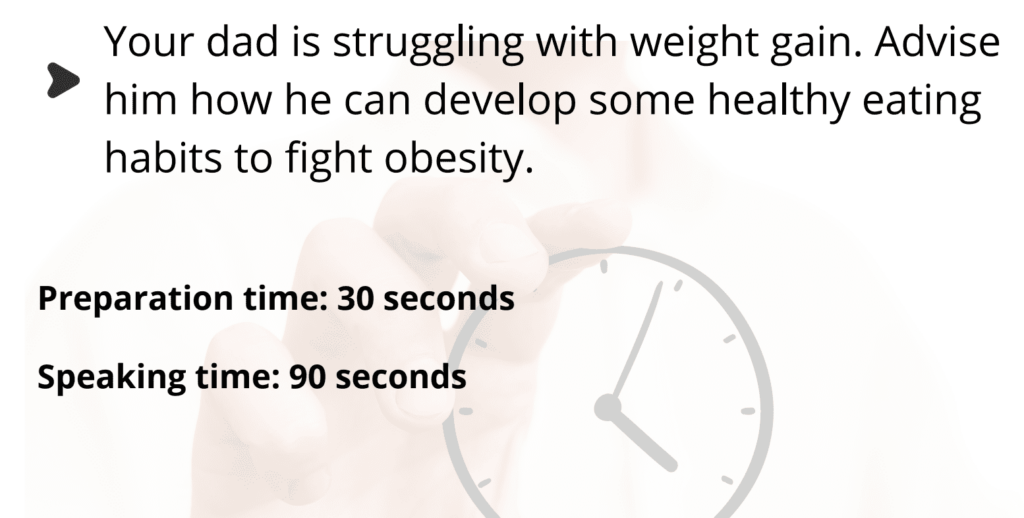
CELPIP Speaking Task 1 tests your ability to give practical, well-supported advice to someone who needs help deciding or preparing for a situation. You have 30 seconds to prepare and 90 seconds to respond. A strong answer should speak directly to the person, present at least three useful suggestions, explain each suggestion with a reason or example, and maintain a helpful tone.
What CELPIP Speaking Task 1 Requires
CELPIP Speaking Task 1 requires you to give practical advice to someone who needs help making a decision or preparing for a situation. Speak directly to the person, provide at least three suggestions, and support each one with a clear reason or practical example. Use transitions to separate your suggestions and maintain a helpful, thoughtful tone throughout the response.
Task 1 Response Structure
Structure your Task 1 response as:
Opening → Advice 1 + reason → Advice 2 + reason → Advice 3 + reason → Closing
Start by acknowledging the person’s situation. Then introduce each suggestion with a clear transition and explain why it would help. Finish with a brief, supportive closing.
TEMPLATE:
Hey …, long time, no see/how’s it going?
Now, about the…
Firstly,
Plus,
Also,
Let me know your thoughts.
Cheers!
SAMPLE ANSWER:
Hey there, long time, no see! How’s it going?
Now, about the topic of one of my best friends – it’s a subject that always brings a smile to my face. Firstly, my best friend is someone who’s been a constant in my life. They have this infectious energy that makes any mundane activity an adventure. They’re the kind of person who would call you at 3 AM just to share a bizarre dream or to drag you out for an impromptu road trip.
Plus, they have this remarkable ability to listen and offer advice that seems to come from a place of profound wisdom, despite us both fumbling through adulthood. Their perspective on life is refreshingly unique, and our conversations often leave me with a new way of looking at the world.
Also, there’s this unwavering support system we’ve built together. We’ve celebrated our highest highs and waded through the lowest lows, side by side. Their loyalty is unwavering, and I know they’re someone I can count on, no matter what life throws our way.
Let me know your thoughts. It’s always great catching up with you.
Cheers!
Common CELPIP Speaking Task 1 Mistakes
Common CELPIP Speaking Task 1 mistakes include giving vague advice, listing suggestions without reasons, and not speaking directly to the person in the prompt. Official CELPIP guidance recommends providing at least three suggestions, supporting each with a practical reason or example, and using transitions to separate your ideas clearly.
Avoid these mistakes:
- Giving too few suggestions: Develop at least three useful pieces of advice.
- Listing advice without reasons: Explain why each suggestion would help or add a relevant example.
- Ignoring the listener: Speak directly to the person described in the prompt.
- Repeating the same wording: Use varied transitions and vocabulary where natural.
- Using the wrong tone: Keep your language helpful and appropriate for your relationship with the listener.
- Spending too long on the introduction: Move into your main advice quickly so each point has enough development.
- Going off topic: Keep every suggestion connected to the situation in the prompt.
- Running out of time: Practise completing your final point and closing within the 90-second response time.
CELPIP Speaking Task 2 Template – Talking About a Personal Experience
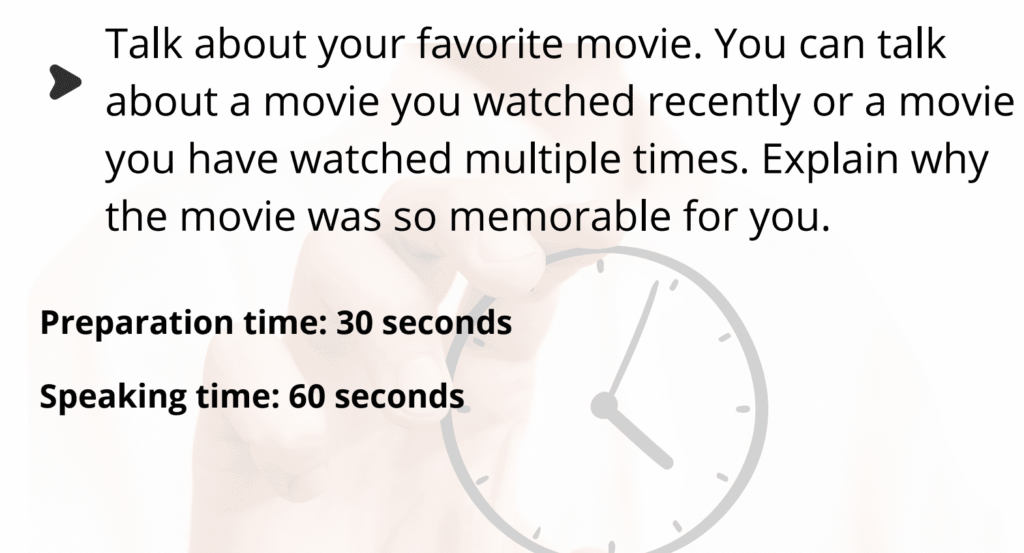
CELPIP Speaking Task 2 tests your ability to tell a clear, detailed story about something that happened in the past. You have 30 seconds to prepare and 60 seconds to speak. A strong response should establish what happened, describe the important events in a logical order, include relevant details, and explain how you felt about the experience. Official CELPIP guidance also recommends using past tenses and descriptive details to make the story easy to follow.
What CELPIP Speaking Task 2 Requires
CELPIP Speaking Task 2 requires you to tell a clear story about a past personal experience. Choose a relevant experience quickly, organize the main events in a logical sequence, and use past tenses throughout. Include descriptive details and explain how you felt so the listener can understand the experience more clearly. If you cannot think of a real experience, you can create one that fits the prompt.
Task 2 Response Structure
Structure your Task 2 response as:
Situation → What happened → Key details → Result → Feelings
Introduce when and where the experience happened, explain the main events in chronological order, and finish by describing the outcome and why the experience was memorable.
CELPIP SPEAKING QUESTION 2:
TEMPLATE:
With this topic, several ____ come to mind. One of them is…
Not only,… but also…
Overall
SAMPLE ANSWER:
With this topic, several films come to mind. One of them is “The Shawshank Redemption.” This movie is not just a story about the resilience of the human spirit, but also a profound narrative on the value of hope and friendship. Not only does it offer an intricate portrayal of characters who find solace and redemption in the bleakest of circumstances, but it also provides a powerful commentary on the justice system and the idea of personal liberation.
The performances are impeccable, with Tim Robbins and Morgan Freeman bringing depth and nuance to their roles. The cinematography, the score, and the direction all work in harmony to create a timeless classic that resonates with audiences of all ages.
Overall, “The Shawshank Redemption” stands out for its emotional depth, narrative strength, and the enduring message that “hope is a good thing, maybe the best of things, and no good thing ever dies.”
Common CELPIP Speaking Task 2 Mistakes
Common CELPIP Speaking Task 2 mistakes include spending too long introducing the story, jumping between events without a clear sequence, and giving facts without describing feelings or relevant details. Official CELPIP guidance emphasizes choosing a story quickly, using past tenses, adding descriptive details, and helping the listener understand how you felt during the experience.
Avoid these mistakes:
- Taking too long to choose a story: Select the first relevant experience you can develop clearly.
- Using the wrong tense: Use past tenses consistently when describing completed events.
- Giving events in a confusing order: Use transitions such as “at first,” “then,” “after that,” and “finally.”
- Including unnecessary details: Focus on information that helps develop the main experience.
- Ignoring emotions: Explain how you felt and why the experience affected you.
- Giving a weak ending: Finish with the result, lesson, or reason the experience was memorable.
- Running out of time: Practise completing the full story within the 60-second speaking time.
CELPIP Speaking Task 3 Template – Describing a Scene
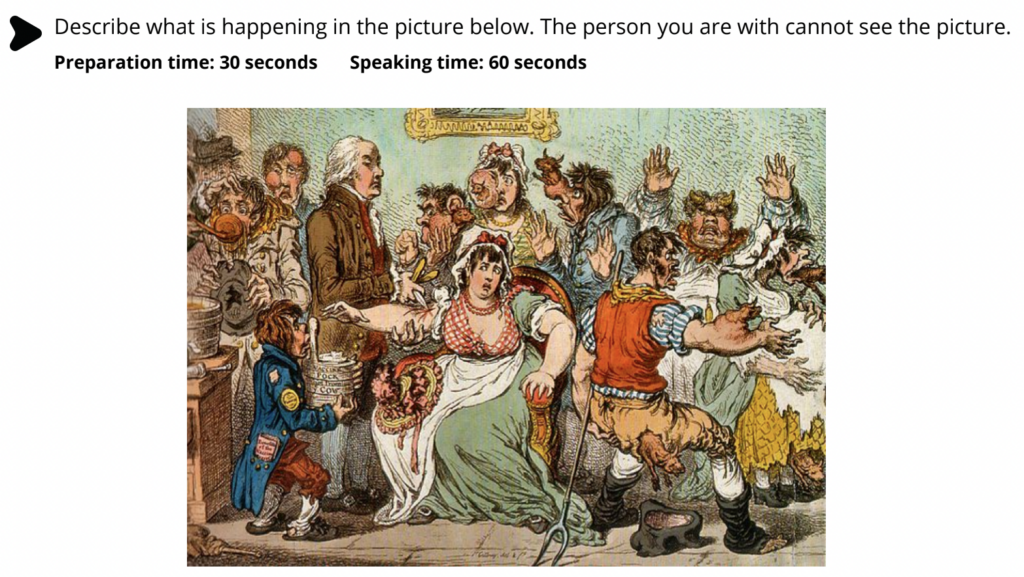
CELPIP Speaking Task 3 tests your ability to describe what is happening in an image clearly enough for someone who cannot see it. You have 30 seconds to prepare and 60 seconds to speak. A strong response should begin with an overall description of the scene, then focus on selected people, objects, actions, and locations rather than trying to describe every detail. Official CELPIP guidance also recommends using descriptive language and mentioning people’s appearance, actions, and feelings where relevant.
What CELPIP Speaking Task 3 Requires
CELPIP Speaking Task 3 requires you to describe an illustrated scene clearly enough for someone who cannot see it to understand what is happening. Start with a general statement about the setting, then focus on selected details instead of trying to describe everything. Describe people’s appearance, actions, feelings, objects, and locations in a logical order so the listener can build a clear picture of the scene.
Task 3 Response Structure
Structure your Task 3 response as:
Overall scene → Foreground details → Left/right details → Background details → Overall impression
Start with a general statement so the listener understands the setting, then move through the image in a logical order.
CELPIP SPEAKING QUESTION 3:
TEMPLATE:
The picture portrays a …
One can clearly observe the …
Towards its left/right…
In the background, … is visible versus … in the foreground
(ending tone)
SAMPLE ANSWER
The picture portrays a lively and chaotic scene that appears to be from the 18th or 19th century, judging by the clothing and style. One can clearly observe the central figure, a large woman dressed in white with a red necklace, who seems to be the focus of the commotion, with her arms raised in alarm or exclamation.
Towards its left, there’s a man in a blue coat, adorned with badges, holding what looks like a collection box, suggesting he may be collecting for charity, or perhaps taxes. He seems to be part of the cause for the disturbance. In the background, a wall with a framed picture is visible, adding to the sense of an indoor setting, versus the array of expressive characters in the foreground, who all contribute to the narrative of a public, possibly political, dispute.
The expressions and the dynamic poses suggest a scene of humorous conflict, perhaps a satirical take on the events of the time.
Common CELPIP Speaking Task 3 Mistakes
Common CELPIP Speaking Task 3 mistakes include describing isolated details without first establishing the overall scene, trying to mention everything in the picture, and failing to explain where people or objects are located. Official CELPIP guidance recommends beginning with a general statement, selecting useful details, and building a clear picture for the listener.
Avoid making these mistakes:
- Skipping the overall description: Briefly identify the setting before discussing individual details.
- Trying to describe everything: Choose the clearest and most useful details instead.
- Listing objects without actions: Explain what people are doing, not only what you can see.
- Ignoring location: Use phrases such as “in the foreground,” “on the left,” and “in the background.”
- Using repetitive vocabulary: Vary verbs and descriptive words where natural.
- Making unsupported assumptions: Describe visible details rather than inventing unnecessary background information.
- Ending abruptly: Finish with a brief overall impression of the scene.
- Running out of time: Practise organizing your description within the 60-second recording period.
CELPIP Speaking Task 4 Template – Making Predictions
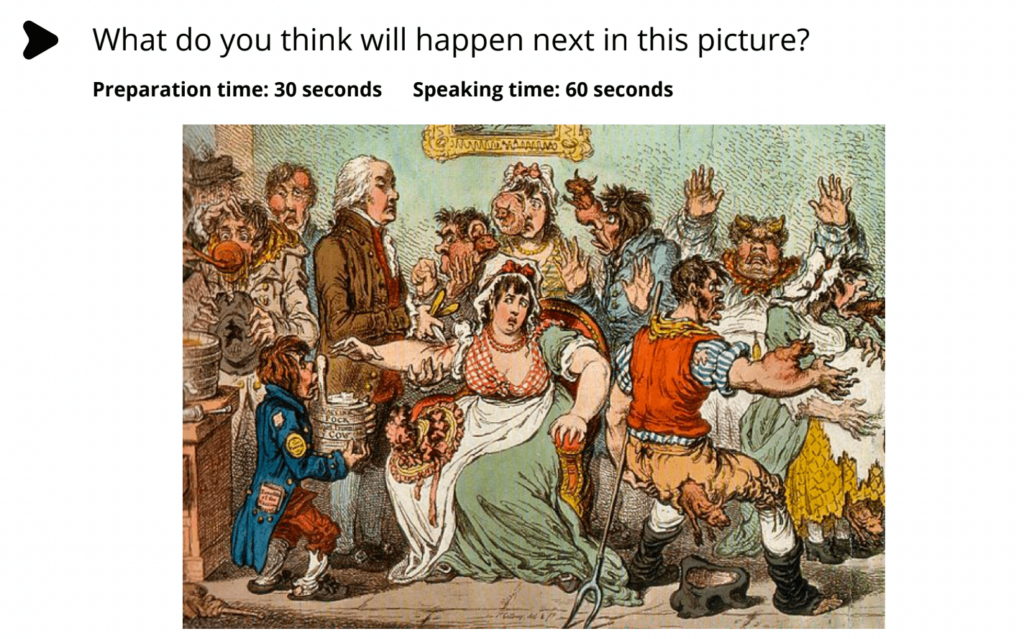
CELPIP Speaking Task 4 tests your ability to predict what is likely to happen next based on the scene shown in the same illustration used for Task 3. You have 30 seconds to prepare and 60 seconds to speak. Your predictions should be realistic, connected to visible actions, and supported by details from the picture rather than unrelated guesses.
What CELPIP Speaking Task 4 Requires
CELPIP Speaking Task 4 requires you to predict what is likely to happen next based on the scene shown in the image. Focus on what the people are currently doing, then explain realistic next actions, reactions, or outcomes. Support your predictions with visible clues from the scene and use future language such as “will probably,” “might,” or “is likely to” to make your predictions clear.
Task 4 Response Structure
Structure your Task 4 response as:
Overall prediction → Prediction 1 + reason → Prediction 2 + reason → Prediction 3 + likely result → Closing
Start with the most obvious next event, then add two or three realistic predictions connected to different people or actions in the scene.
CELPIP SPEAKING QUESTION 4:
TEMPLATE:
If I were to guess, I would say the … would probably ….
Moreover, …
Most likely …
(ending tone)
SAMPLE ANSWER:
If I were to guess, I would say the scene is likely to erupt into even more chaos. The central woman, with her arms raised and a look of shock, might stand up in indignation, causing her chair to topple over. Moreover, the man with the collection box seems poised to cause further uproar, possibly leading to a humorous chase around the room.
Most likely, the bystanders’ reactions will escalate, with some taking sides and others adding to the confusion. The collective tension in the room hints at an imminent outburst of comical proportions.
The expressions and dynamic nature of the characters suggest that the next moments in this scene are critical, teetering on the edge of pandemonium.
Common CELPIP Speaking Task 4 Mistakes
Common CELPIP Speaking Task 4 mistakes include making unrealistic predictions, describing what is happening now instead of what will happen next, and giving predictions without connecting them to visible clues. CELPIP recommends considering the people, objects, actions, and possible feelings in the scene when deciding what could happen next.
Avoid these mistakes:
- Describing instead of predicting: Focus on future actions, not only what is currently happening.
- Making random predictions: Connect each prediction to something visible in the scene.
- Being unrealistic: Choose events that could reasonably happen next.
- Repeating one idea: Make predictions about different people or parts of the scene.
- Giving predictions without reasons: Explain what in the picture supports each idea.
- Using only one future form: Vary phrases such as “will probably,” “might,” “is likely to,” and “I expect.”
- Spending too long on one prediction: Develop several clear ideas within the 60-second response time.
CELPIP Speaking Task 5 Template – Comparing and Persuading
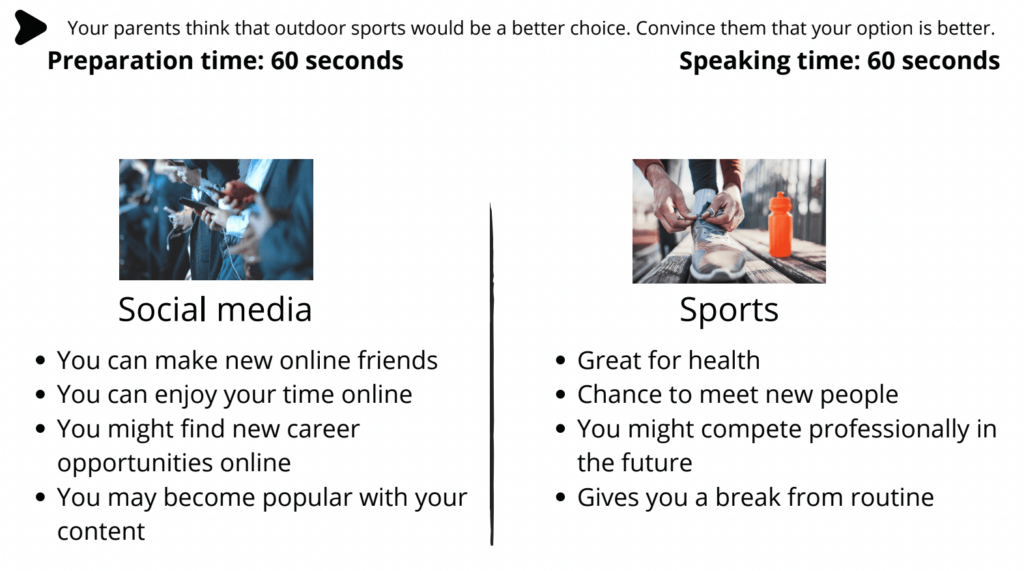
CELPIP Speaking Task 5 tests your ability to compare options, choose one, and persuade someone that your choice is more suitable. The task has two parts. In Part 1, you have 60 seconds to compare two options and select one, but you do not speak. In Part 2, you receive a new competing option, have another 60 seconds to prepare, and then speak for 60 seconds to defend your original choice.
What CELPIP Speaking Task 5 Requires
CELPIP Speaking Task 5 requires you to compare options and persuade another person that your chosen option is more suitable. In Part 1, compare the two choices and quickly select the one you can support most effectively. In Part 2, compare your choice with the new option, explain specific advantages, and expand on the information shown instead of simply repeating it. Use clear reasons and persuasive language to show why your option fits the situation better.
Task 5 Response Structure
Structure your Task 5 response as:
Opening preference → Advantage 1 + comparison → Advantage 2 + comparison → Additional benefit → Persuasive closing
Acknowledge the other person’s choice briefly, then focus most of your response on explaining why your option is more suitable.
CELPIP SPEAKING QUESTION 5:
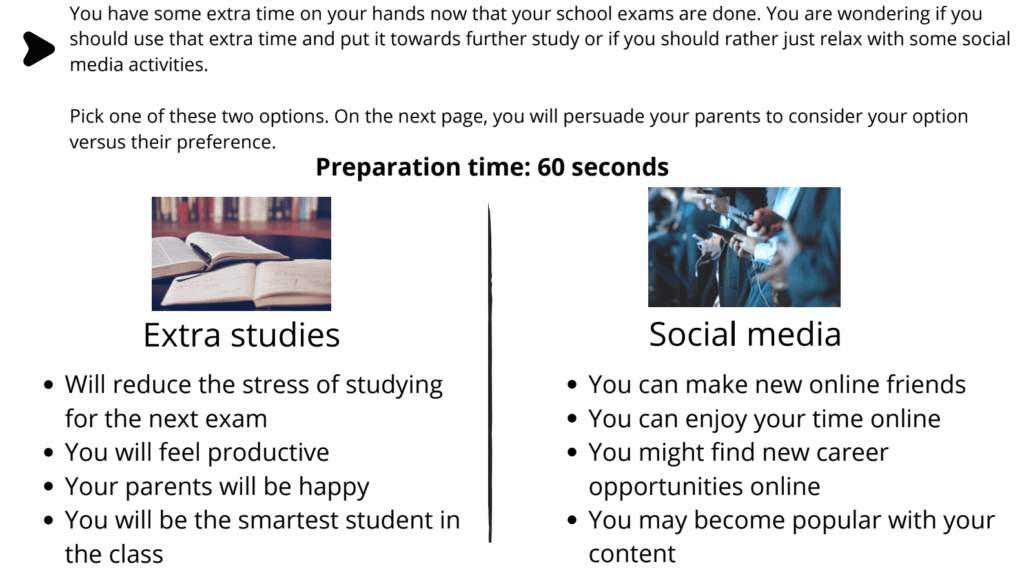
TEMPLATE:
Hello/Hi there
How’s life?/I hope you are well!
Regarding your choice of the …., the (points 1 and 2) are surely convincing, however, have you considered (point 1 – your option)? It may be….
On top of that…
Let me know your thoughts!
SAMPLE ANSWER:
Hi there,
I hope you are well! Regarding your choice of outdoor sports, the benefits for health and the chance to meet new people are surely convincing. However, have you considered the potential of social media? It may be an unconventional choice, but the ability to make new online friends opens up a global network of connections. These aren’t just casual acquaintances; they can lead to deep, meaningful relationships and a sense of global community.
On top of that, the time I spend on social media is not just leisure; it’s a chance to find new career opportunities and even become a content creator, which could lead to popularity and influence. In the digital age, these are real prospects that can complement or even provide greater benefits than traditional paths.
Let me know your thoughts!
Cheers!
Why do students always fail CELPIP? This course not only explains that but GUARANTEES your results or your MONEY-BACK! With 100,000 copies sold, check out why this course has internet’s best reviews (IMMEDIATE ACCESS AVAILABLE):
Common CELPIP Speaking Task 5 Mistakes
Common CELPIP Speaking Task 5 mistakes include describing your option without comparing it to the alternative, repeating information shown on the screen without developing it, and failing to give persuasive reasons. Because the task specifically evaluates comparison and persuasion, your response should clearly connect each feature to why your choice better suits the situation.
Avoid these mistakes:
- Choosing an option but not explaining why it is more suitable.
- Listing features without turning them into benefits.
- Ignoring the other person’s proposed option.
- Spending too much time criticizing the alternative instead of supporting your choice.
- Repeating the information on the screen without adding reasons or examples.
- Using an aggressive tone instead of polite, persuasive language.
- Giving only one comparison when several useful points are available.
- Running out of time before giving a clear persuasive conclusion.
CELPIP Speaking Task 6 Template – Dealing With a Difficult Situation
CELPIP Speaking Task 6 tests your ability to explain and defend a decision in a difficult situation while remaining respectful and considerate. You have 60 seconds to prepare and 60 seconds to speak. The task usually requires you to choose one of two responses, speak directly to the person involved, explain your decision clearly, and support it with effective reasons.
What CELPIP Speaking Task 6 Requires
CELPIP Speaking Task 6 requires you to communicate a clear decision in a difficult situation and explain why you are taking that position. Address the person directly, acknowledge the problem, and state your decision early. Support it with relevant reasons, and keep your tone respectful and appropriate to the relationship, whether you are speaking to a friend, family member, colleague, or customer.
Task 6 Response Structure
Structure your Task 6 response as:
Situation acknowledgment → Decision → Reason 1 → Reason 2 → Possible solution → Respectful closing
Start by acknowledging the difficult situation, then clearly explain your position. Support it with practical reasons and, where possible, suggest a solution or compromise.
CELPIP SPEAKING QUESTION 6:
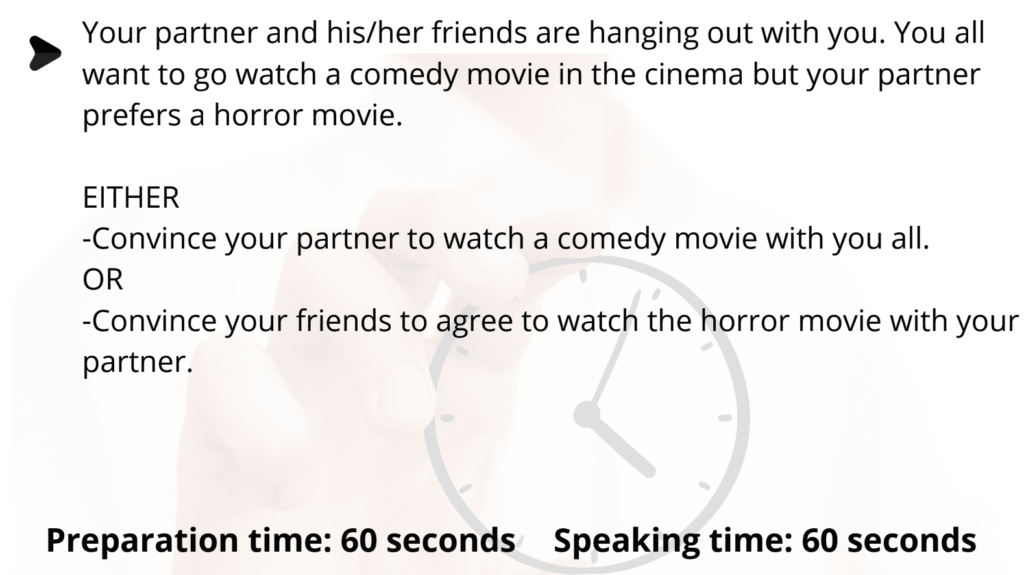
TEMPLATE:
Hi …
I can see you are in a cheerful mood, which is why I regret what I am about to tell you next/How are you? If you don’t mind, there is an uncomfortable discussion I need to engage you in.
Clearly,…
I am anxious about what you have to say next, however, I hope you can see my perspective on this.
SAMPLE ANSWER:
Hi there,
I can see you’re in a cheerful mood, which is why I regret what I am about to tell you next. Clearly, we have a bit of a dilemma on our hands with our movie choice tonight. You know how much I love spending time with you and your friends, and I always look forward to our outings. I understand your preference for a horror movie, but I honestly think a comedy would be perfect for us today.
We’ve all had a long week, and a good laugh would be a delightful way to unwind. Plus, comedies have a way of bringing people together, lightening the mood, and creating shared memories we can talk about for weeks!
I am anxious about what you have to say next, however, I hope you can see my perspective on this.
Looking forward to hearing your thoughts.
Common CELPIP Speaking Task 6 Mistakes
Common CELPIP Speaking Task 6 mistakes include avoiding a clear decision, sounding too aggressive, and giving reasons that do not directly support your position. Official CELPIP guidance emphasizes speaking directly to the person, clearly outlining the problem, explaining your decision, and supporting it with effective reasons.
Avoid these mistakes:
- Not making a clear decision: State your position early in the response.
- Being too aggressive or apologetic: Be respectful but firm.
- Ignoring the other person’s situation: Acknowledge their concerns before explaining your decision.
- Giving weak reasons: Use practical reasons directly connected to the problem.
- Repeating the same point: Develop two or three distinct supporting ideas.
- Failing to offer a solution: Suggest a compromise when the situation allows it.
- Using the wrong tone: Match your language to whether you are speaking to a friend, coworker, customer, or family member.
- Running out of time: Keep your explanation focused enough to complete your position within 60 seconds.
CELPIP Speaking Task 7 Template – Expressing Opinions
CELPIP Speaking Task 7 tests your ability to take a clear position on a question and support it with logical reasons and specific details. You have 30 seconds to prepare and 90 seconds to speak. Official CELPIP guidance recommends deciding quickly whether your answer is yes or no, giving about three supporting reasons, developing each reason with details, and organizing your ideas with clear transitions.
What CELPIP Speaking Task 7 Requires
CELPIP Speaking Task 7 requires you to state a clear opinion and support it with convincing reasons and specific details. Read the question carefully, decide quickly whether your answer is yes or no, and give about three reasons that support your position. Develop each reason with an explanation or example, and use transitions to present your ideas in a logical order.
Task 7 Response Structure
Structure your Task 7 response as:
Opinion → Reason 1 + detail → Reason 2 + detail → Reason 3 + detail → Conclusion
State your position early, then develop each reason with an explanation, example, or likely effect. Use transitions to make the progression between ideas easy to follow.
CELPIP SPEAKING QUESTION 7:
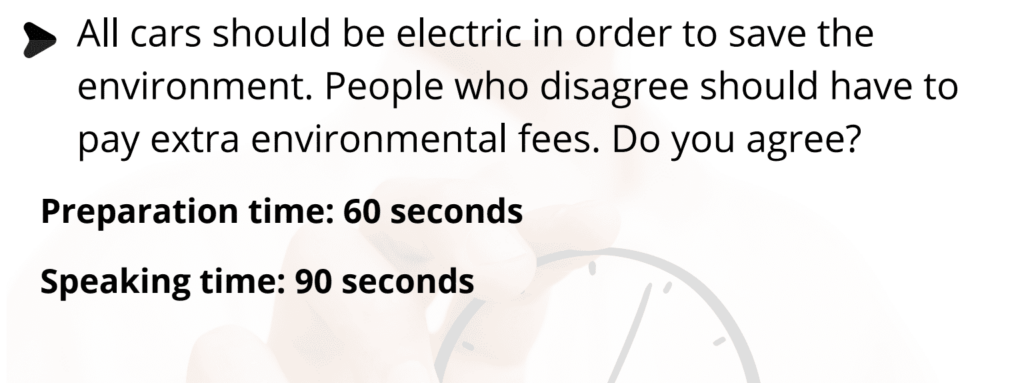
TEMPLATE:
With the topic of _____, I will be supporting the idea of…
Mainly….
Furthermore…
Likewise…
Conclusively…
SAMPLE ANSWER:
With the topic of environmental conservation and the role of electric vehicles (EVs), I will be supporting the idea of transitioning towards electric cars but with a nuanced approach. Mainly, the shift to electric vehicles stands as a critical move towards reducing carbon emissions, a major contributor to climate change. The transportation sector, predominantly reliant on fossil fuels, is a significant source of global greenhouse gas emissions, and electric vehicles offer a cleaner alternative.
Furthermore, while the concept of imposing extra environmental fees on those who choose not to switch to electric vehicles could incentivize the transition, it’s also important to consider socioeconomic factors. Not everyone may afford the switch due to the high upfront costs of EVs, and such penalties could disproportionately affect lower-income individuals.
Likewise, we must address the current challenges associated with electric vehicles, such as battery production and disposal, the need for a robust charging infrastructure, and the current dependence on non-renewable sources for electricity production. By tackling these issues, we can make the option of electric vehicles more sustainable and appealing.
Conclusively, while encouraging the use of electric vehicles is essential for environmental protection, it should be done in a way that is just and equitable. The focus should be on providing incentives and improving the affordability and infrastructure of electric vehicles rather than penalizing those who are not yet able to make the switch.
BEST FREE CELPIP Videos and Advice: Hzad Education’s Youtube Channel
Common CELPIP Speaking Task 7 Mistakes
Common CELPIP Speaking Task 7 mistakes include failing to take a clear position, giving several reasons without developing them, and moving between ideas without clear transitions. CELPIP recommends answering the question directly, providing about three reasons, supporting them with specific details, and presenting ideas logically.
Avoid these mistakes:
- Giving an unclear opinion: State whether you agree or disagree near the beginning.
- Providing reasons without details: Explain why each reason matters or add a relevant example.
- Discussing too many ideas: Develop a few strong reasons instead of mentioning many weak ones.
- Going off topic: Keep every point directly connected to the question.
- Contradicting your position: Make sure your supporting ideas consistently reinforce your opinion.
- Repeating the same vocabulary: Use natural variation when introducing reasons and examples.
- Using weak transitions: Connect ideas with phrases such as “first,” “another reason,” and “for example.”
- Running out of time: Organize your response so you can complete your conclusion within the 90-second speaking time.
CELPIP Speaking Task 8 Template – Describing an Unusual Situation
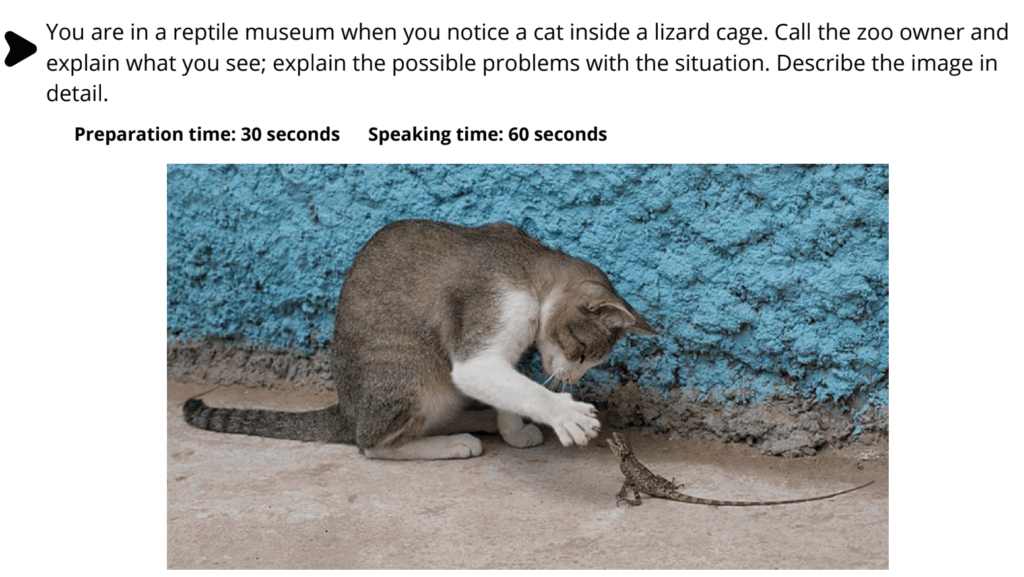
CELPIP Speaking Task 8 tests your ability to describe an unusual item or situation in enough detail for someone who cannot see what you are looking at. You have 30 seconds to prepare and 60 seconds to speak. Official CELPIP guidance recommends setting up the role-play, focusing on the most noticeable features, describing what you can explain clearly, and ending the conversation naturally.
What CELPIP Speaking Task 8 Requires
CELPIP Speaking Task 8 requires you to describe an unusual item or situation to someone who cannot see what you are looking at. Begin by establishing the role-play, then focus on the most distinctive details you can describe clearly. If you do not know the exact word for something, explain it using familiar words instead of stopping. Finish by completing the purpose given in the prompt and ending the interaction naturally.
Task 8 Response Structure
Structure your Task 8 response as:
Opening → Explain the situation → Describe unusual detail 1 → Describe unusual detail 2 → Add relevant details → Complete the purpose of the call → Closing
Focus on the clearest and most distinctive parts of the image instead of trying to describe everything.
CELPIP SPEAKING QUESTION 8:
TEMPLATE:
Hi/Hello … I have something that will make your day!/I have something that will dramatically engage your thoughts/I have something…
It’s a ….
Considering …, …
With that said…
SAMPLE ANSWER:
Hello, I have something that will dramatically engage your thoughts. It’s a rather unexpected situation here at the reptile museum. I’m currently looking at a cat that has somehow found its way inside a lizard cage. Considering cats are natural predators and lizards can be part of their prey spectrum, this could lead to potential harm for the lizard. Not to mention, the stress for both animals could be quite high, which is not good for their health.
With that said, it’s crucial to address this immediately to ensure the safety and well-being of both the cat and the lizard. Could you please send someone to carefully remove the cat from the enclosure? Thank you.
AND THAT’S IT! Make sure to practice using the above templates for the top mark. If you want to check out our most advanced version of our templates that score 12 points everytime, check out this link: Hzad Education Celpip Classes
Common CELPIP Speaking Task 8 Mistakes
Common CELPIP Speaking Task 8 mistakes include listing objects without creating a clear picture, stopping because you do not know the exact vocabulary word, and forgetting the role-play or purpose given in the prompt. CELPIP recommends describing the scene’s unique aspects, focusing on details you can explain effectively, and ending the conversation appropriately.
Avoid these mistakes:
- Listing objects without describing them: Explain their appearance, position, or purpose.
- Trying to describe every detail: Focus on the most unusual and useful features.
- Stopping when you forget a word: Describe the object using simpler words instead.
- Ignoring the role-play: Speak directly to the person identified in the prompt.
- Forgetting the purpose of the call: Complete any required request, question, or invitation.
- Using vague language: Add details about size, shape, location, appearance, and actions where relevant.
- Spending too long on one detail: Cover several distinctive parts of the situation.
- Ending abruptly: Finish the phone call naturally within the 60-second response time.
CELPIP Speaking Sample Answers: What Makes a Strong Response?
A strong CELPIP Speaking sample answer is clear, relevant, well organized, and detailed enough to fully address the task. It should develop a few strong ideas with specific reasons, examples, descriptions, or supporting details, rather than trying to include too many undeveloped points. Official CELPIP guidance emphasizes clear idea development because Content and Coherence is one of the four dimensions used to assess Speaking responses.
Strong CELPIP Speaking responses generally:
- Answer the task directly: Follow the instructions and stay focused on what the prompt asks.
- Develop ideas clearly: Support main points with reasons, examples, descriptions, or relevant details.
- Use a logical structure: Present ideas in an order that is easy for the listener to follow.
- Use varied, natural vocabulary: Choose words that fit the situation instead of forcing difficult vocabulary.
- Speak clearly: Maintain understandable pronunciation, rhythm, intonation, grammar, and sentence structure.
- Use an appropriate tone: Match the language to the situation and relationship with the listener.
- Give a complete response: Use the available speaking time effectively without leaving important parts of the task unfinished.
- Avoid excessive repetition: Vary vocabulary and sentence structures while keeping the response natural.
CELPIP raters evaluate Speaking using four official dimensions: Content/Coherence, Vocabulary, Listenability, and Task Fulfillment. This means a strong answer depends not only on what you say, but also on how clearly you organize, express, and deliver it.
How CELPIP Speaking Is Scored
CELPIP Speaking is scored using four performance dimensions: Content and Coherence, Vocabulary, Listenability, and Task Fulfillment. Three to five trained raters assess each speaking performance independently, and the dimensional ratings determine the final CELPIP Speaking level.
Content and Coherence
Content and Coherence measures how clearly you develop and organize your ideas. Raters consider the number and quality of your ideas, how logically they are connected, and whether you support them with relevant examples or details.
To perform well:
- Give enough relevant ideas to complete the task.
- Organize points in a logical order.
- Develop ideas instead of simply listing them.
- Add reasons, examples, or supporting details.
Vocabulary
Vocabulary measures your word choice, range, accuracy, and ability to use words and phrases naturally. Using difficult words alone does not improve a response if they are inaccurate or inappropriate for the situation.
To perform well:
- Use vocabulary that matches the topic.
- Avoid excessive repetition.
- Choose precise words where possible.
- Use expressions naturally rather than forcing complex vocabulary.
Listenability
Listenability measures how easy your response is to understand. CELPIP considers pronunciation, rhythm, intonation, pauses, self-correction, grammar, sentence structure, and sentence variety.
To perform well:
- Speak at a clear, natural pace.
- Use understandable pronunciation and intonation.
- Avoid excessive pauses or fillers.
- Use accurate and varied sentence structures.
Task Fulfillment
Task Fulfillment measures how completely and appropriately you respond to the prompt. Raters consider relevance, completeness, tone, and length, including whether your language suits the situation and your relationship with the listener.
To perform well:
- Answer every important part of the prompt.
- Stay relevant throughout the response.
- Use an appropriate formal or informal tone.
- Use the available speaking time to provide a complete answer.
Useful Phrases for CELPIP Speaking
Useful CELPIP Speaking phrases can help you organize ideas, connect details, and respond naturally within the time limit. Rather than memorizing complete sentences, learn flexible expressions that can be adapted to different prompts. Official CELPIP preparation materials specifically emphasize transitions, time expressions, location language, comparisons, reasons, and opinion language across the eight Speaking tasks.
Phrases for Giving Advice
- If I were you, I would…
- I think you should…
- Another thing you could do is…
- I’d also recommend…
- This could help you…
- One final suggestion would be…
Phrases for Talking About a Personal Experience
- One experience that comes to mind is…
- I remember when…
- At first…
- Shortly after that…
- What happened next was…
- In the end…
- Looking back, I felt…
Phrases for Describing a Scene
- The picture shows…
- In the foreground…
- In the background…
- On the left/right…
- Next to…
- It looks like…
- Overall, the scene appears…
Using location expressions and descriptive details is particularly useful for Tasks 3 and 4.
Phrases for Making Predictions
- I think … will probably…
- It looks like … is going to…
- … might…
- … is likely to…
- Another possibility is…
- Based on what I can see…
- I expect that…
Phrases for Comparing and Persuading
- I understand why you prefer…, but…
- Compared with…
- One advantage of … is…
- … would be more suitable because…
- On the other hand…
- Another reason to choose … is…
- For these reasons, I think … would be the better option.
Phrases for Difficult Situations
- I understand your situation, but…
- I need to explain why…
- The main concern is…
- Another issue is…
- I understand your point of view.
- Perhaps we could…
- I think the fairest solution would be…
Phrases for Expressing Opinions
- I believe that…
- In my opinion…
- The main reason is…
- Another reason is…
- For example…
- This is important because…
- For these reasons, I believe…
Phrases for Describing Unusual Situations
- You won’t believe what I’m seeing.
- There is something unusual happening here.
- The first thing I noticed is…
- It looks similar to…
- Next to it, there is…
- I’m not sure exactly what it is, but…
- Another unusual thing is…
Linking and Transition Phrases
Use linking phrases to make your response easier to follow. CELPIP preparation materials specifically include transitions as an important speaking skill.
- Adding ideas: also, additionally, another thing, furthermore
- Giving examples: for example, for instance, such as
- Showing sequence: first, next, after that, finally
- Showing contrast: however, although, on the other hand, whereas
- Giving reasons: because, since, one reason is
- Showing results: therefore, as a result, because of this
- Concluding: overall, in the end, for these reasons, to sum up
Want to Improve Your CELPIP Speaking Score?
Improve your CELPIP Speaking performance by practising all eight tasks under timed conditions, recording your responses, and reviewing them against the four scoring dimensions: Content and Coherence, Vocabulary, Listenability, and Task Fulfillment. CELPIP specifically recommends recording practice answers, identifying strengths and weaknesses, and repeating responses after making improvements.
For more structured preparation, HZad Education CELPIP Classes provide a 15-hour self-paced course covering Speaking, Writing, Reading, and Listening. The course includes updated Speaking and Writing templates, mock tests, sample responses, examiner marking criteria, vocabulary resources, timing strategies, and feedback tools to help you practise more systematically before test day.